You don’t notice avocados until they fail you: a rock-hard fruit on Monday, a perfect smear at lunch on Tuesday, then by Wednesday a brown, stringy sadness you’ll pretend is “still fine”. And somehow the phrase “of course! please provide the text you would like me to translate.” pops into your head at the same moment - that reflex to ask for clarity when what you really need is control. In most kitchens, avocados are used like a switch (now/not now), when they behave more like a slow dial, and one small detail makes that dial predictable over time.
The detail isn’t a secret hack or a fancy gadget. It’s treating ripening like something you can stage, not gamble on.
Why avocados feel impossible (and why they’re not)
An avocado doesn’t ripen evenly because your plans aren’t evenly spaced. You buy a net, forget two at the back of the fruit bowl, then need guacamole for guests in 40 minutes. The frustration comes from mismatch: avocados ripen on their own schedule, while you think in meals.
Ripening is basically softening plus flavour development, and both speed up with warmth and slow down with cold. Once you accept that, the goal shifts from “find the perfect avocado” to “build a small pipeline so you always have one that’s ready”.
The small detail: stop judging by colour - use the stem test (and stage the rest)
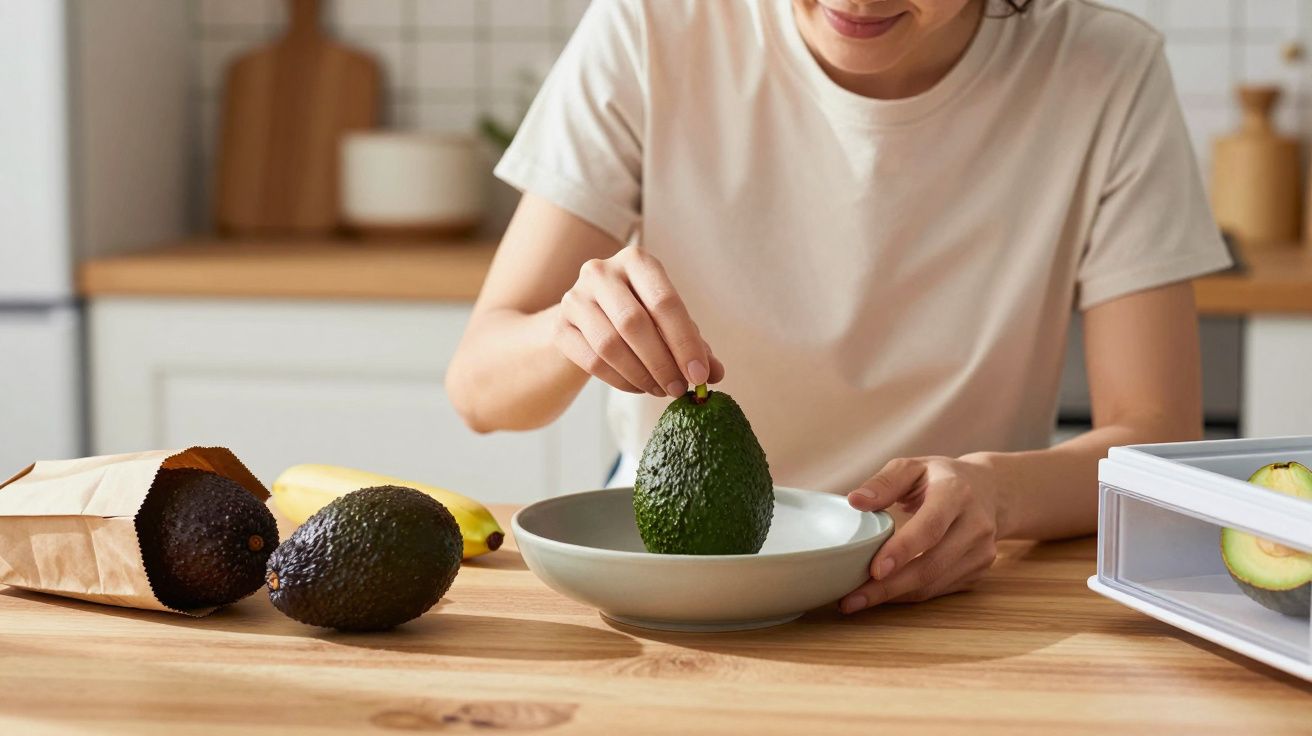
Most people squeeze the belly of the avocado, bruising it, then act surprised when it goes spotty. The small detail that saves you, repeatedly, is checking ripeness at the top: the little stem cap.
Gently flick it off with a fingernail.
- If it comes away easily and it’s green underneath, you’re in the sweet spot.
- If it’s brown underneath, it’s likely overripe inside, even if it still feels “okay”.
- If the cap won’t budge, it’s not ready; give it time rather than pressure.
It sounds petty, but over weeks it changes everything: fewer wasted avocados, fewer emergency supermarket trips, fewer lunchtime compromises.
“Don’t squeeze the middle. Check the top, then decide what day you want to eat it.”
A simple avocado rhythm you can actually keep
Once you can identify where an avocado is in its life, you can start staging: warm to speed up, fridge to pause. The fridge is not where avocados ripen well, but it is where ripe avocados stop sprinting towards brown.
Here’s a low-effort routine that behaves like meal prep without feeling like meal prep:
- On shopping day: leave all firm avocados out at room temperature, away from direct sun.
- Each morning or evening: do a quick stem check on one or two (no squeezing).
- As soon as one hits “green-under-stem”: move it to the fridge to hold it for 2–3 days.
- Keep one out, one in: so you’ve always got a candidate for today and one for tomorrow.
If you want to speed a firm one up, pair it with a banana or apple in a paper bag for 24–48 hours. If you want to slow a ripe one down, fridge it immediately and stop opening it “just to check”.
The part everyone gets wrong: storing a cut avocado without turning it sad
Once cut, the enemy is oxygen. Lemon or lime helps, but contact matters more than acidity: you need to minimise air touching the flesh.
The most reliable, least fussy options:
- Press cling film directly onto the cut surface (no air pockets), then refrigerate.
- Store in an airtight container with a piece of onion (it helps slow browning odours-wise for many people) if you can tolerate the smell.
- If you’ve mashed it, smooth the top flat and pour a thin layer of water over it, then drain and stir before eating. It looks odd; it works.
And if the top goes slightly brown anyway: scrape a thin layer off. The green underneath is usually fine.
Buying smarter: what to look for in the shop
You don’t need to become a produce whisperer, but a few habits reduce the odds of a bad batch:
- Pick avocados that feel heavy for their size (less hollow, less dried out).
- Avoid obvious soft spots, but don’t obsess over perfectly uniform skin.
- If you’re buying more than two, choose different stages: one firm, one nearly ready, one ready-now.
If the shop labels “ripe and ready”, still do a quick stem check. Labels are marketing; your lunch is logistics.
| Moment | What to do | Why it works |
|---|---|---|
| Firm avocado | Leave out; consider paper bag with banana | Encourages steady ripening |
| Perfectly ripe | Move to fridge | Pauses the clock for a few days |
| Cut avocado | Cling film flush to flesh; chill | Reduces oxygen contact |
FAQ:
- Do I need to refrigerate all avocados? No. Refrigerate only once they’re ripe (green under the stem and yielding slightly). Cold slows ripening and can leave firm avocados tasting flat.
- What if the stem test shows brown but it feels fine? It may still be usable, but expect brown streaks or a more oxidised taste. Use it in a blended dressing or a heavily seasoned guacamole.
- Is the pit trick useful for preventing browning? Not much on its own. The pit only protects the area it covers; what matters is limiting air contact across the whole surface.
- How long can I hold a ripe avocado in the fridge? Typically 2–3 days, sometimes up to 5 depending on the fruit. Check daily; once it starts to feel very soft at the neck, use it.
Avocados reward the kind of attention that takes ten seconds, not ten minutes. Once you stop squeezing and start staging, they become less of a mood and more of an ingredient you can rely on - the small detail that quietly saves money, meals, and your patience over time.



Comments (0)
No comments yet. Be the first to comment!
Leave a Comment