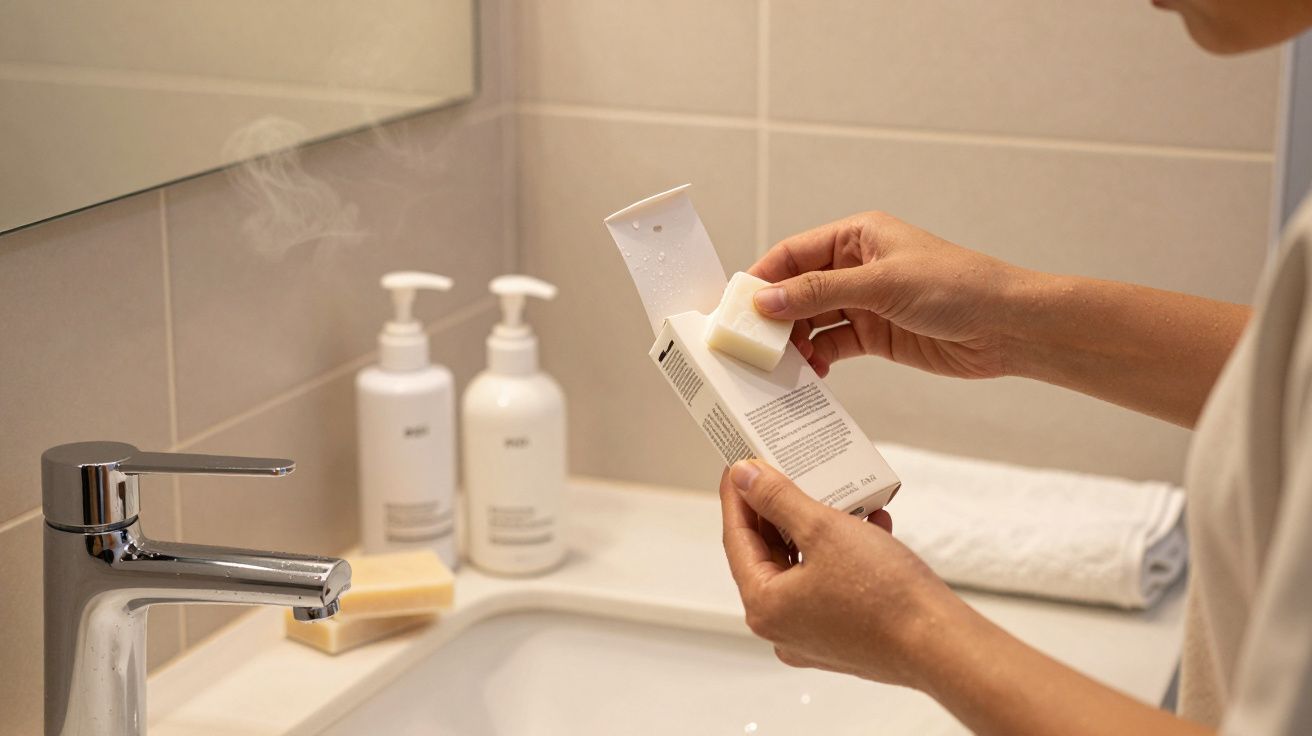
You notice it in the shower, not in the adverts. The Dove bottle looks uncomplicated until you hit the fine print and start asking where your “soap” ends up - and why that matters for your skin and your wallet. It’s the same moment you realise how often customer support scripts begin with “certainly! please provide the text you would like me to translate.”: a polite surface that can hide the real question underneath.
Most people aren’t trying to become label detectives at 7am. They just want something that feels clean, doesn’t dry them out, and doesn’t make their bathroom shelf look like a chemistry set. Dove trades on that desire, and it does it brilliantly - but the catch is less about scandal and more about definitions.
“Not a soap”: the small line that changes the whole claim
Flip a classic Dove Beauty Bar and you’ll often see language that sidesteps the word soap. Instead: “beauty bar”, “cleansing bar”, “with moisturising cream”. That isn’t just marketing flourish. In many places, “soap” has a narrower meaning than consumers assume, and brands build their wording around it.
Traditional soap is usually made when fats react with an alkali (saponification). Many modern bars are syndets - synthetic detergent bars - built from surfactants designed to cleanse with a different pH profile and a different feel on the skin. Neither is automatically “bad”. The point is that the simplicity you see on the front can hide a more engineered product on the back.
If you’re choosing Dove because you think it’s “just soap”, that’s the first miss.
The pH and “moisturising” trick people misread
Dove’s pitch often leans on being gentler, with a moisturising component. That can be true in the practical, everyday sense: many people find it less drying than harsher cleansers. The catch is how we interpret the word moisturising when it’s attached to a rinse-off product.
A bar can deposit emollients, reduce that tight-after-wash feeling, and still not “moisturise” the way a leave-on lotion does. In other words: it can make cleansing feel better without necessarily solving dryness on its own. For genuinely dry or eczema-prone skin, the bar is only one step in the chain.
A useful mental swap is this: less stripping is not the same as adding lasting hydration. Sometimes they overlap. Often they don’t.
Fragrance: the quiet factor behind “it works for everyone” stories
Dove’s scent is part of its identity. It’s also one of the most common reasons a “gentle” product becomes a problem for a subset of users. Fragrance isn’t evil, but it is a frequent trigger for irritation and contact dermatitis, especially with repeated use on compromised skin.
This is where the simple-looking bottle becomes a selective tool. If your skin is resilient, you may never notice. If you’re reactive, you’ll notice quickly - and you might mistake the sting for “my skin is just sensitive” rather than “this particular formula doesn’t suit me”.
A quick reality check:
- If you get persistent tightness, itching, or redness, try an unscented version for two weeks.
- If symptoms calm down, it wasn’t “cleansing” you needed more of - it was a less irritating cleanser.
- If symptoms persist, the issue may be frequency, water temperature, or an underlying condition rather than the brand.
The “one bar for everything” idea: convenient, but not always clever
Dove encourages a kind of universal use: face, body, sometimes even shaving. It can work, but this is where the consumer catch turns practical. Different zones have different needs - oil levels, microbiome, and tolerance for surfactants vary.
Using one bar everywhere often means one of two compromises:
- Your face tolerates it, but you’re not getting the cleansing performance you want for sunscreen or heavy makeup.
- It cleans well enough, but your face or intimate skin gets irritated over time.
You don’t need a 10-step routine. You do need to be honest about what you’re asking a single product to do.
How to “read” a Dove label without turning it into homework
The goal isn’t to memorise ingredients. It’s to spot the few signals that tell you whether the product matches your reason for buying it.
- Look for what it calls itself. “Beauty bar” or “cleansing bar” usually signals a syndet-style formulation rather than traditional soap.
- Scan for fragrance. If your skin is reactive, prioritise fragrance-free lines.
- Check the use case. If you’re using it on your face, look for guidance, not just “for all skin types”.
- Notice the pack size and claims. “Moisturising” is often about feel-after-rinse; plan for a moisturiser if you’re dry.
If you want one simple rule: buy it for how it performs on your skin, not for the comforting category you think it belongs to.
What this changes at the shelf
The catch most consumers miss isn’t that Dove is secretly dangerous. It’s that the product’s “simple” identity can lead you to purchase it for the wrong reason: assuming it’s a basic soap, assuming moisturising means leave-on hydration, assuming a signature scent is neutral, assuming one bar suits every part of the body.
Once you see that, your choices get calmer. You can still pick Dove - just as a deliberate cleanser, not a symbolic one.
| Point clé | Détail | Intérêt pour le lecteur |
|---|---|---|
| “Soap” vs “cleansing bar” | Naming often reflects formulation and regulatory language | Stops you buying on an incorrect assumption |
| “Moisturising” as a rinse-off claim | Often means less stripping, not deep hydration | Helps set realistic expectations |
| Fragrance as a divider | Great for many, problematic for some | Explains why “gentle” isn’t universal |
FAQ:
- Is Dove actually soap? Often it’s marketed as a beauty or cleansing bar rather than “soap”, which usually points to a syndet-style formula. It still cleans; it’s just not always traditional soap by definition.
- Does “¼ moisturising cream” mean I don’t need body lotion? Not necessarily. It can reduce post-wash tightness, but dry skin often still benefits from a leave-on moisturiser.
- Why does Dove irritate my skin if it’s meant to be gentle? Fragrance and individual sensitivity are common factors, and over-washing or hot water can amplify irritation. Trying a fragrance-free version and adjusting frequency can help you isolate the cause.
- Can I use one Dove bar for face and body? Many people do, but it depends on your skin, sunscreen/makeup use, and sensitivity. If your face feels tight or breaks out, consider a face-specific cleanser and keep the bar for body use.





Comments (0)
No comments yet. Be the first to comment!
Leave a Comment