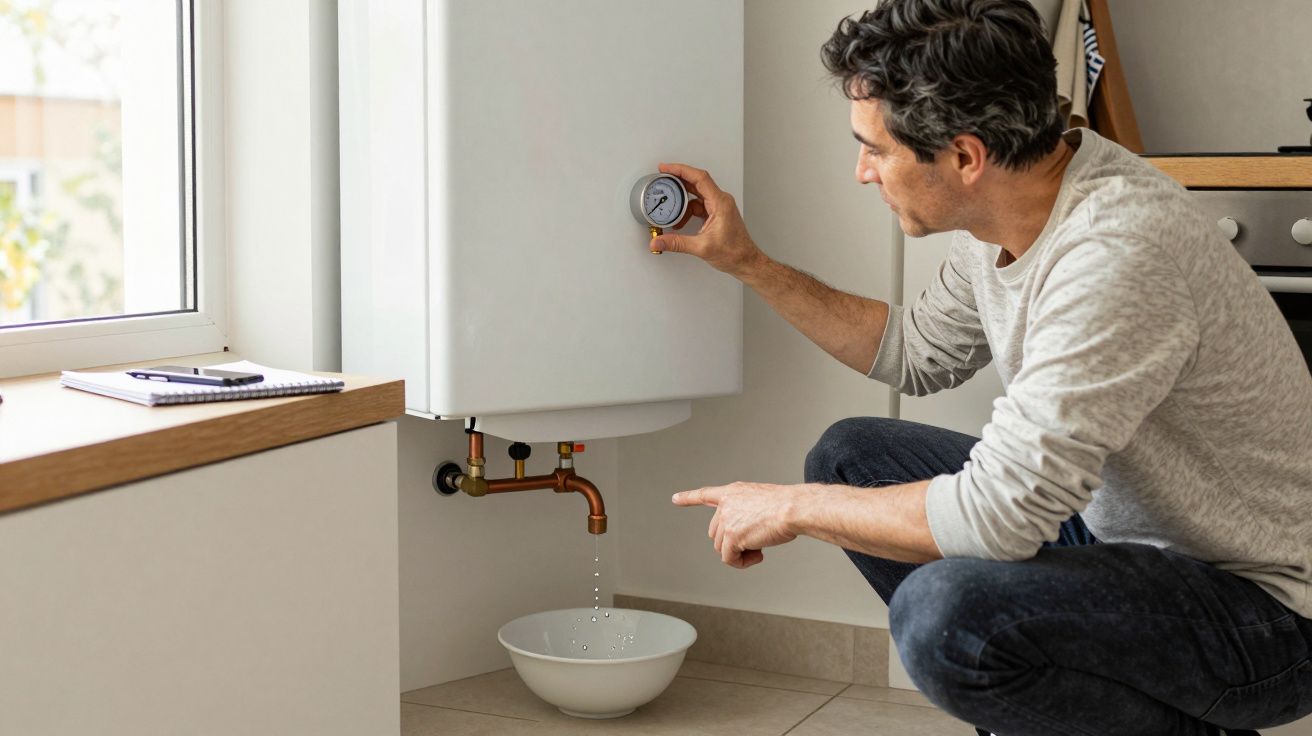
Boiler pressure drop is one of those problems that shows up in ordinary homes, usually right when you want heating or a shower, and it immediately feels like “the boiler is failing”. The catch is that a lot of what gets labelled as a pressure fault is really system misdiagnosis: the gauge is telling the truth about pressure, but not why it’s changing. If you treat the number as the cause, you end up topping up endlessly, bleeding radiators at random, and paying for repairs that don’t touch the real issue.
Pressure is a symptom. The job is to work out which part of the sealed system is misbehaving, and whether the drop is real (water leaving the system) or apparent (volume changing as it heats and cools).
Why the gauge is the most misunderstood “warning light” in your house
Most combi and sealed-system boilers run roughly around 1.0–1.5 bar when cold, rising as the water heats. When the pressure falls below the boiler’s minimum, it locks out to protect itself, so the problem becomes urgent even if the system is otherwise fine.
The common mistake is assuming the pressure “should stay the same”. In reality, small changes are normal; big changes have patterns. Those patterns are what point to leaks, expansion issues, trapped air, or a filling loop that isn’t actually closed.
A helpful mindset: don’t ask “why is the pressure low?” first. Ask “when does it move, and what else changes with it?”
The two types of boiler pressure drop (and why only one is really a “leak”)
1) True pressure loss: water is leaving the system
If the pressure drops when the boiler is off and the system is cold, that usually means water is escaping somewhere. Not always visibly.
Typical routes: - A weeping radiator valve or tail (often evaporates on a warm pipe and leaves only a faint stain). - Pinholes in older pipework, especially under floors. - A pressure relief valve (PRV) that dribbles to the outside discharge pipe. - A leaking heat exchanger (less common, but serious).
2) Apparent pressure loss: water is staying put, but volume control is failing
If the pressure looks fine cold, spikes when heating, then ends up low again after cooling, the system may not be managing expansion properly. This is where misdiagnosis is rampant, because the boiler “loses pressure” even though no meaningful amount of water has left the circuit.
Most often, it’s the expansion vessel (or its charge) that’s the real culprit.
The usual culprit nobody checks properly: the expansion vessel and PRV pairing
A sealed heating system needs somewhere for hot water to expand into. That’s the expansion vessel: a metal tank with a rubber diaphragm and an air charge on one side. If the air charge is low or the diaphragm has failed, the system pressure rises rapidly as the water heats.
Once it rises high enough, the PRV lifts to protect the boiler and dumps water out through the discharge pipe. Then everything cools, the pressure drops, and you’re topping up again-convinced there’s a mystery leak.
Clues that point here: - Pressure rises sharply during heating (for example, from ~1.2 bar cold to 2.7–3.0 bar hot). - You find the external copper discharge pipe intermittently wet. - The pressure “problem” returns quickly after topping up.
A PRV that has lifted a few times can also fail to reseat cleanly, creating a slow, continuous loss that looks like a leak elsewhere.
A quick pattern check you can do before you call anyone
You don’t need tools for this, just a notepad (or your phone) and one heating cycle.
- Note the cold pressure first thing (heating off for a few hours).
- Turn heating on and check the gauge after 10–15 minutes.
- Check again when fully warm, then once more after the system cools.
Use the results to guide the next step:
| Pattern you see | Most likely direction | What to check next |
|---|---|---|
| Drops cold and keeps dropping | True loss of water | Radiators/valves, visible pipework, PRV discharge outside |
| Rises high when hot, then ends low | Expansion/PRV issue | Expansion vessel charge/diaphragm, PRV leaking |
| Slowly drifts down over days | Small leak or filling loop issue | Weeps, discharge pipe, filling loop fully shut |
This isn’t a full diagnosis, but it stops you defaulting to the wrong story.
The “invisible leak” places that steal pressure quietly
A visible puddle is the exception. More often, boiler pressure drop comes from losses that are too small to spot in the moment.
Look for: - Radiator valves and lockshields: greenish crust, rust marks, damp dust “caking”. - Ceilings below bathrooms: a faint brown ring can mean a weep on heating pipework above. - Boiler casing area: signs of staining under the unit (don’t remove panels unless qualified). - External discharge pipe: any dripping or chalky streaks below the outlet.
If you have microbore pipework (common in some UK homes), tiny leaks can be maddeningly slow yet still enough to trigger lockouts.
The top-up trap: why “just add water” makes the system worse over time
Repeatedly refilling isn’t harmless. Each top-up introduces fresh oxygenated water, which accelerates corrosion inside radiators and produces sludge. That sludge reduces circulation, increases noise, and can create hot spots that add stress to components.
A sensible rule:
- If you top up once after bleeding a radiator, fine.
- If you’re topping up weekly (or more), stop treating it as normal and find the cause.
Bleeding radiators: useful, but often blamed for the wrong reason
Air in radiators can lower effective circulation and create cold patches, but it’s rarely the primary reason pressure is collapsing. Bleeding also releases pressure, so if you bleed repeatedly without topping up correctly-or if the system is already struggling-you can chase the gauge downward and mistake the effect for the cause.
If you bleed: - Do it with the heating off and the system cool. - Bleed only until air stops and water appears. - Re-pressurise once, then observe over the next 24–48 hours.
Frequent air return can indicate ongoing corrosion, a leak drawing in air, or poor inhibitor condition-not simply “trapped air”.
When to stop troubleshooting and call a professional
Call an engineer promptly if: - The PRV discharge pipe is dripping regularly. - Pressure jumps near 3 bar when heating runs. - You suspect a leak inside walls/floors or around the boiler. - The boiler is repeatedly locking out and you’re topping up to keep it running.
And if you smell gas, or suspect any combustion/flue issue, stop and get immediate professional help-pressure issues are separate from gas safety.
FAQ:
- Can boiler pressure drop be “normal”? Small variations are normal, but needing regular top-ups isn’t. If you’re refilling more than occasionally, something is wrong.
- Is it safe to keep repressurising the boiler? Occasionally, yes. Repeatedly, it can accelerate corrosion and mask a failing component (often the expansion vessel or PRV).
- My pressure is fine cold but drops after heating-does that mean a leak? Not necessarily. That pattern often points to expansion control problems, where the PRV dumps water when hot and the system ends up low when cool.
- What pressure should my boiler be at? Many sealed systems sit around 1.0–1.5 bar when cold, but always follow your boiler manual’s guidance for your model.
- Could the gauge be wrong? It can be, but it’s less common than people think. Check patterns first, then have it tested if other evidence doesn’t line up.


Comments (0)
No comments yet. Be the first to comment!
Leave a Comment