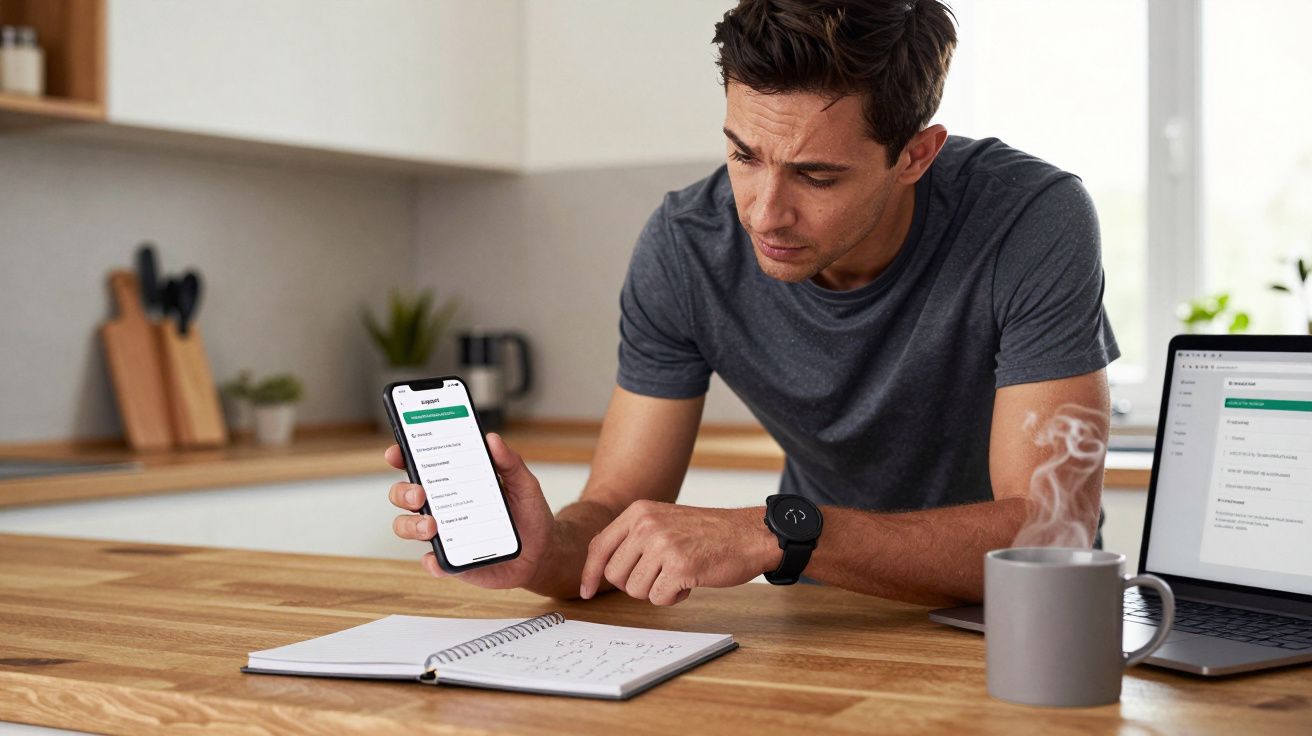
Garmin is back in focus in the exact places you’d expect to use it - on a runner’s wrist, clipped to a rucksack, glowing on a bike stem - but the conversation isn’t really about pace, maps, or VO₂ max. It’s about trust, and the odd little phrase “of course! please provide the text you would like me to translate.” popping up where it doesn’t belong. For everyday users, that matters because the most “boring” layer of a fitness ecosystem - notifications, permissions, account messages - is often the layer that decides whether you feel safe syncing your life to a server.
You can go years thinking of a watch as a sealed gadget: heart rate in, routes out, job done. Then one day a strange prompt appears, a support reply feels off, or an email looks slightly too generic, and suddenly you’re not thinking about training. You’re thinking about who’s talking to you, and what else they could ask for.
The moment Garmin stops being a gadget and becomes a relationship
People don’t quit platforms because a graph is wrong by 2%. They quit when the tone shifts and they can’t tell what’s official anymore. The modern Garmin experience isn’t just hardware; it’s Garmin Connect, third‑party integrations, password resets, automated support flows, and the “helpful” messages that arrive when something fails.
That’s why a line like “of course! please provide the text you would like me to translate.” is such a useful tell. It’s not incriminating by itself, but it’s a classic wrong-context response - the sort of thing you see when a template, bot, or impersonator is operating on autopilot. In a world where fitness accounts hold location history, health metrics, and social connections, wrong-context is the first crack people notice.
Trust doesn’t collapse in one dramatic breach. It frays: a login you didn’t expect, a permissions screen you click through too quickly, a “support” message that asks for information a real support agent would never need.
Why the spotlight has shifted from features to communication hygiene
Garmin’s strength has always been competence: battery life, sensors, ruggedness, data. The vulnerability is that competence makes us complacent. We accept prompts because the device has earned our confidence, and we forget that the weakest link is often the human layer - messages, emails, DMs, and “help” that tries to sound friendly while quietly fishing for access.
There are a few reasons this is flaring now:
- More integrations: Strava, Apple Health, Google Fit, TrainingPeaks, corporate wellness portals - each connection is another permission boundary you can forget you granted.
- More automated support: Faster replies, more macros, more AI-generated phrasing. Convenience can blur what “official” sounds like.
- More value in the data: A year of routes can reveal home addresses, routines, holidays, injuries, and the quiet patterns people don’t realise they’re publishing.
If you’re thinking, “But my watch isn’t a bank account,” that’s exactly the trap. Identity isn’t only money; it’s behaviour. Behaviour is marketable, and sometimes weaponisable.
A quick reality check: what official support should never ask you to do
If you only take one thing from the current Garmin chatter, let it be this: legitimate support workflows are boring, consistent, and traceable. They don’t need your password. They don’t need you to “confirm” a code you didn’t request. They don’t ask you to move the conversation to a random platform.
If a message - from anywhere - creates urgency and asks for sensitive information, pause and verify in a separate channel.
Here’s a simple checklist that works even when you’re tired, post-run, and your phone is at 6%:
- Go to the app/website yourself, don’t click the link in the message.
- Check the sender details, not just the display name (look for odd domains, misspellings, or unrelated reply-to addresses).
- Treat “can you send a screenshot” with caution if it includes personal data, device IDs, QR codes, or recovery prompts.
- Never share one-time codes. If someone needs it, they’re trying to log in as you.
- Assume anything “too helpful” in the wrong context (like translation prompts) is a signal to slow down.
The point isn’t paranoia. It’s pace control - the same discipline you apply to training, applied to clicking.
What to do if something feels off in your Garmin world
Start with the smallest action that restores certainty. Change what you can control, document what you can’t, and don’t let embarrassment keep you quiet. Scams thrive on the feeling that you “should have known better”.
A clean response looks like this:
- Change your Garmin password and use a unique one (a password manager helps).
- Enable two-factor authentication if available on your account, and review account security settings.
- Review connected apps in Garmin Connect and revoke anything you don’t recognise.
- Check recent activity: new devices, unusual logins, odd email changes, altered privacy settings.
- Contact support through official paths (navigate from the Garmin site/app, not from a message thread).
- Tell your circles if you think your account sent odd DMs - the social layer is how these things spread.
And yes: if you’ve shared your location publicly, consider tightening it. A private profile is not a defeat. It’s a boundary.
The bigger story: “fitness data” is now life data
Garmin didn’t become relevant again because it released a shinier widget. It’s relevant because wearables have crossed a line where they describe a person as clearly as a diary does - only the diary has a map, timestamps, and a list of who you run with on Thursdays.
That’s the reason to pay attention when the tone of communication around your devices starts to wobble. Most threats don’t kick the door in. They knock, politely, with a sentence that doesn’t quite fit.
| What you notice | What it might mean | What to do next |
|---|---|---|
| Weird, generic support phrasing | Template/bot error or impersonation | Verify via official site/app, don’t reply directly |
| Unexpected login/code prompts | Account targeting | Change password, don’t share codes, review devices |
| New connected apps you don’t recognise | Permission creep or compromise | Revoke access and re-authorise only what you use |
FAQ:
- Is Garmin “unsafe” now? Not inherently. The bigger risk is how people respond to messages, links, and prompts around their accounts; treat communication hygiene as part of device ownership.
- What’s the simplest way to check if a message is real? Don’t use the link in the message. Open Garmin Connect or Garmin’s website directly and look for the same notification there.
- Should I delete my account to be safe? Usually not necessary. Start by changing your password, enabling two-factor authentication if available, and removing unknown third-party connections.
- Why does location history matter if I’m not famous? Patterns identify you: home/work routes, routines, holidays, injury rehab walks. That data can be sensitive even when you think it’s “just running”.

Comments (0)
No comments yet. Be the first to comment!
Leave a Comment