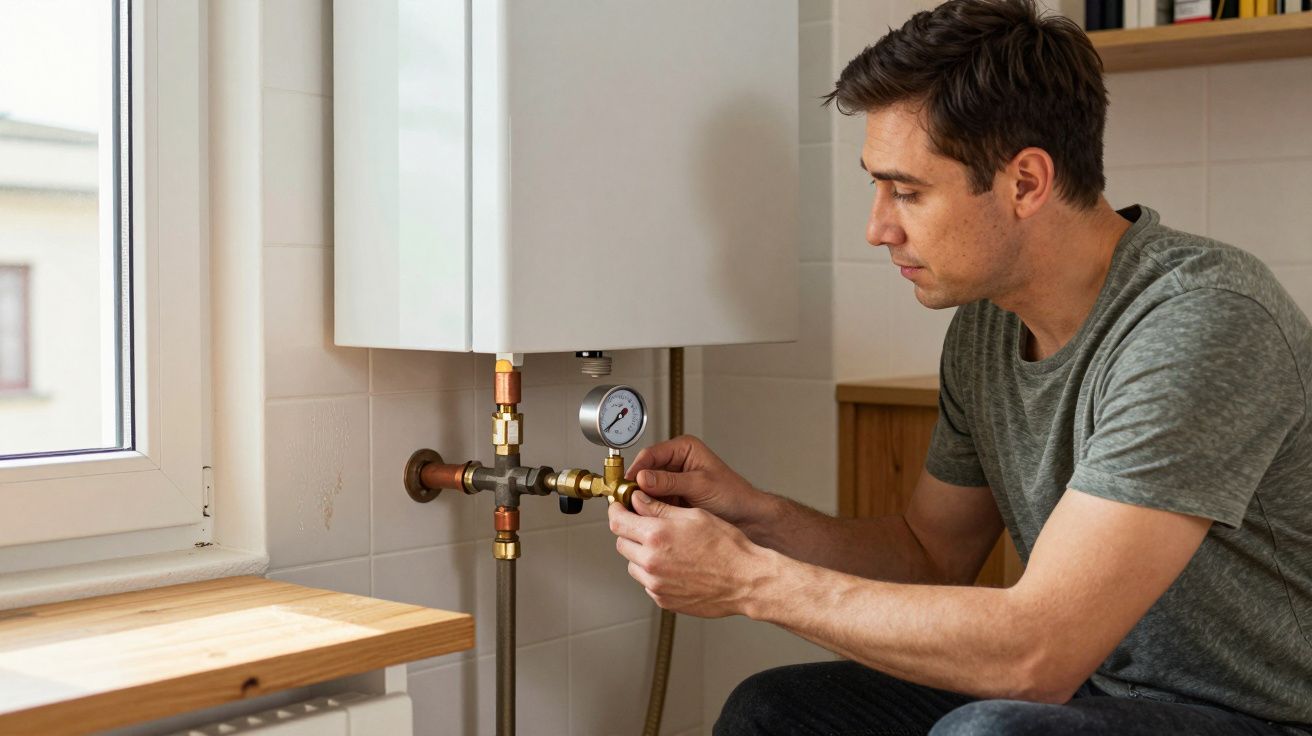
The warning signs rarely look dramatic. A boiler still fires, radiators still warm up, and you carry on-until the expansion vessel quietly stops doing its job and your system stability begins to drift, week by week, into something brittle. It’s the kind of fault that doesn’t announce itself with a bang, but with small behaviours you start treating as “just how this house is”.
It often begins with a top-up. A little hiss at the filling loop, a glance at the gauge, then back to normal life. Except “normal” becomes a cycle: pressure drops, you top up, pressure climbs too high, a pipe spits outside, and the whole system starts living on a rollercoaster.
The tiny pressure swing that starts the long decline
A sealed central heating system is meant to cope with water expanding as it heats up. Water doesn’t compress, so as the system warms, pressure naturally rises. The expansion vessel is the cushion: a tank with a rubber diaphragm that holds a pocket of air (or nitrogen) on one side and system water on the other, absorbing that extra volume without drama.
When the vessel loses its charge, or the diaphragm fails, that cushion disappears. The boiler still tries to run as if nothing’s changed, but now every heat-up pushes pressure higher than it should, and every cool-down pulls it lower. It’s not just an annoying gauge dance; it’s stress, repeated, on every component that was designed for gentler swings.
People often blame “a dodgy pressure gauge” or “old radiators”. The truth is usually more mundane: the one part designed to keep the system calm is no longer buffering anything.
Why the expansion vessel gets ignored (and why that’s a problem)
It’s tucked away, it has no on/off switch, and it’s easy to misunderstand. Many homeowners only learn it exists after the first winter of topping up every few days, when someone finally says, “It’ll be the expansion vessel.”
The problem is that the system often muddles through for a while. Like a bread knife that still “sort of cuts”, a failed vessel can still let the house heat-badly. You adapt. You start topping up before guests arrive. You learn which radiator gurgles first. You stop trusting the boiler, but you don’t fix the underlying reason it’s acting nervous.
That’s how a single ignored fault slowly destabilises the entire heating system: not by stopping it outright, but by forcing it to operate outside its comfortable range, over and over again.
What it looks like in real life: the familiar cycle
A typical pattern goes like this:
- The boiler pressure is low when cold, so you top up to the “green” zone.
- When the heating runs, pressure rises quickly and may hit 2.5–3 bar (or higher).
- The pressure relief valve (PRV) opens to protect the system and discharges water outside.
- Once everything cools, the pressure drops again-sometimes to near zero-because water has been lost.
- You top up again, adding fresh water and oxygen, and the loop repeats.
Each step feels reasonable in isolation. Together, they create a system that never settles, and stability is exactly what a sealed circuit needs.
The hidden damage: what repeated top-ups do to system stability
Topping up isn’t just “adding water”. You’re also adding dissolved oxygen, and oxygen is the quiet fuel for internal corrosion. Over time that can mean sludge, sticking valves, noisy pumps, and cold spots in radiators.
There’s also the PRV issue. Once a PRV has lifted a few times, it can fail to reseat properly. So even after you eventually fix the expansion vessel, the system may still lose pressure because the valve continues to weep. One neglected component can recruit others into the problem.
Then there’s scale and debris. Fresh mains water brings minerals; pressure turbulence shifts old sediment. None of this tends to break on day one. It just makes everything more temperamental, less efficient, and harder to diagnose later.
“It’s not the leak that ruins most systems,” one heating engineer told me. “It’s the years of topping up to compensate for a fault nobody wanted to pay for.”
The quick checks that tell you it’s more than “a little pressure drop”
You don’t need to be an engineer to notice the pattern. A few tells are hard to ignore once you know them:
- Pressure is fine when cold, but climbs sharply as soon as the boiler heats.
- You regularly find the gauge near zero and have to top up every week (or every few days).
- There’s water staining on the outside wall near the PRV discharge pipe.
- The boiler cuts out with high-pressure faults, especially after bleeding radiators.
- Radiators have frequent gurgling because pressure keeps dipping and air keeps entering.
One of these can happen for other reasons. Three or more, and the system is effectively telling you it has lost its “shock absorber”.
How to fix it without making it worse
The safest approach is simple: stop treating the symptom as the solution. Continual topping up keeps the heating limping along, but it actively pushes the system away from stability.
What happens next depends on the cause:
- Loss of air charge in the expansion vessel: it may need recharging to the correct pressure (done with the system depressurised and to manufacturer spec).
- Failed diaphragm: the vessel usually needs replacing, or fitting an external vessel if access is poor.
- PRV that has been lifting: often needs replacement at the same time, because it may now drip even at normal pressure.
- Secondary knock-ons (sludge/noise): a clean, inhibitor dose, and sometimes a filter can restore calmer circulation.
If you’re tempted to keep bleeding radiators and topping up “until spring”, remember the trade you’re making: short-term warmth in exchange for long-term corrosion and more parts being dragged into the mess.
A steadier system feels boring - and that’s the point
When an expansion vessel is healthy, the pressure rise from cold to hot is unremarkable. The gauge moves a little, then sits there. The boiler stops cycling in panic, radiators behave, and you stop thinking about the filling loop entirely.
That boredom is system stability: predictable pressure, fewer fault codes, less oxygen introduced, and less wear on seals and safety valves. It’s not glamorous maintenance, but it’s the difference between a heating system that quietly lasts and one that slowly unravels while still “working”.
| Sign you’ll recognise | What it often means | Why it matters |
|---|---|---|
| Pressure rockets up when heating runs | Expansion vessel isn’t absorbing expansion | PRV lifts, parts see repeated stress |
| You top up often | Water is being dumped or lost | Oxygen/corrosion risk rises fast |
| Staining at discharge pipe outside | PRV has been lifting or is passing | Leak continues even after topping up |
FAQ:
- Is a small pressure drop always the expansion vessel? No. It can be a leak, a weeping PRV, or air being bled out after work. But if pressure rises sharply when hot and falls very low when cold, the expansion vessel is a prime suspect.
- Can I just keep topping up the boiler pressure? You can, but it’s a short-term crutch. Frequent top-ups add oxygen and accelerate corrosion, and repeated PRV lifting can cause the valve to leak permanently.
- Why does the pressure relief valve start leaking after a while? Once it has opened a few times, debris and wear can stop it sealing perfectly. Then it can drip even at normal operating pressure.
- Will fixing the expansion vessel stop all pressure problems immediately? Often it stabilises things quickly, but if the PRV has been damaged or there’s sludge/air issues from months of topping up, you may need additional work to fully restore stability.
- Should I DIY an expansion vessel recharge? Only if you’re confident, have the correct tools, and follow the boiler manufacturer’s instructions. The system must be depressurised and set to the right charge; getting it wrong can make faults worse or trigger the PRV again.



Comments (0)
No comments yet. Be the first to comment!
Leave a Comment