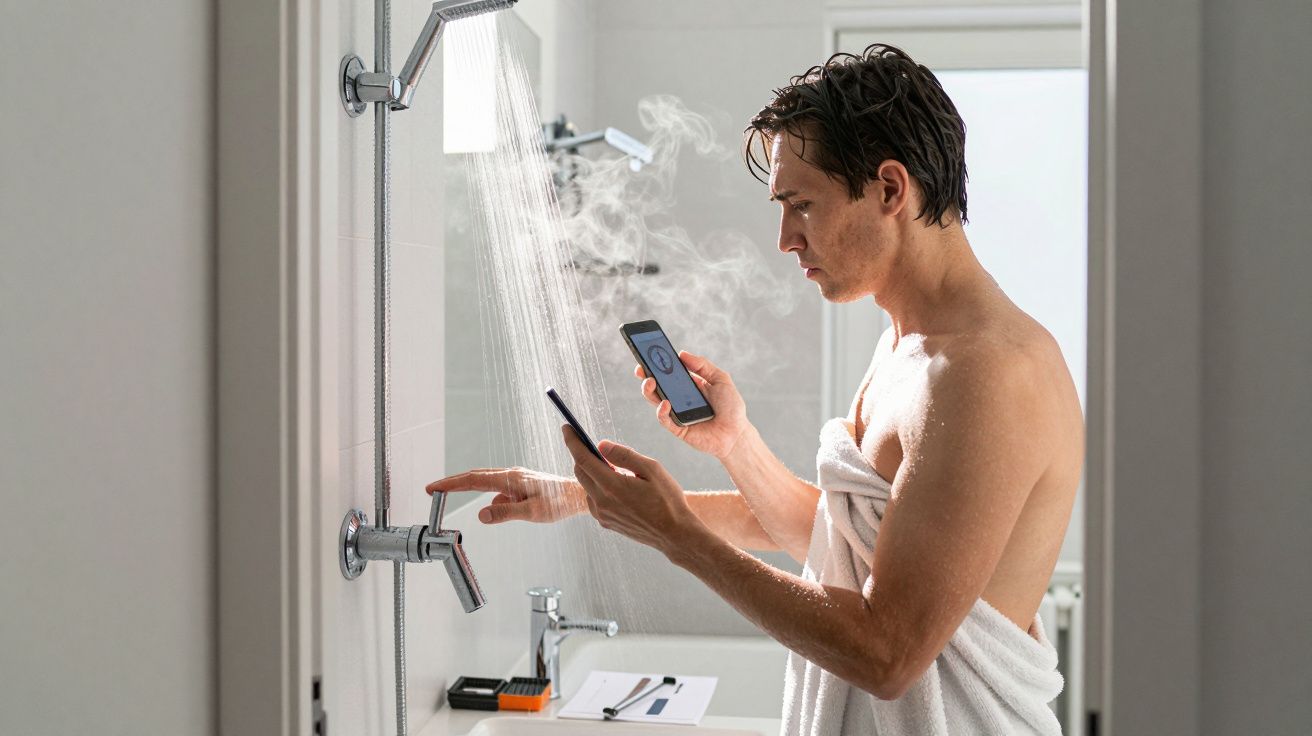
Hot showers are a small certainty until they aren’t, and hot water plumbing systems have a knack for failing when you’ve already got shampoo in your hair. The most alarming version is sudden water loss: the tap goes cold, the flow thins to nothing, and the house feels like it’s switched itself off. Understanding why it happens matters because the “it worked yesterday” moment often points to one simple fault - and one quick decision that can prevent damage.
The tricky bit is that these systems usually fail quietly for weeks, then tip over in a minute. A valve sticks, a sensor drifts, sediment shifts, a pressure switch gets fussy. Everything looks normal until it doesn’t.
The “worked yesterday” illusion
Hot water systems don’t fail on a schedule; they fail on thresholds. Pressure drops below a set point, temperature overshoots a safety limit, or a tiny leak becomes big enough to trip a cut-out. You don’t notice the slow build because your routine masks it: short showers, a mild day, nobody running the washing machine at the same time.
Then you run a bath after the dishwasher has just finished, the boiler fires, the cylinder refills, and the weakest link finally shows itself. The result feels sudden, but the cause is often boring.
Four common ways hot water stops fast
1) A safety device does its job (and feels like a breakdown)
Modern boilers and cylinders are packed with protection: pressure relief valves, high-limit thermostats, flow sensors, flame supervision, freeze stats. When one of those triggers, the system can lock out to prevent overheating, overpressure, or unsafe combustion. To you, it looks like a failure; to the kit, it’s a controlled stop.
If it’s a one-off lockout, a reset might bring it back. If it repeats, treat it like a warning, not a nuisance.
The system isn’t being dramatic. It’s telling you it has crossed a line it doesn’t want to cross again.
2) Pressure and feed problems: the hidden reason behind “no hot”
A combi boiler needs mains pressure and a minimum flow to fire. A vented cylinder needs cold feed into the loft tank, and an unvented cylinder needs balanced pressure through valves that can clog. If that cold side is restricted, the hot side suffers first - and sometimes disappears entirely as the unit protects itself.
Common culprits include: - A partially closed stopcock after other work. - A blocked inlet filter on a combi. - A failed pressure reducing valve on an unvented cylinder. - A loft cistern ball valve sticking (vented systems). - Local mains issues that show up as sudden water loss across taps.
A quick tell: if cold taps are also weak, it’s rarely “just the hot”.
3) Airlocks, pump issues, and diverter valves that choose the wrong job
In conventional systems, pumps can seize after summer, especially if they haven’t run for months. In combis, diverter valves can stick mid-position, sending heat to the wrong circuit or not enough to either. You’ll get radiators warming when you wanted a shower, or hot water that goes lukewarm as soon as demand rises.
The failure feels instant because it’s a moving part finally refusing to move. Often you’ll hear it: a hum, a short cycling boiler, a rattly pump, a click without follow-through.
4) Limescale and sludge: the slow villains that trigger sudden shutdowns
Scale doesn’t usually “break” a system; it narrows it. Heat exchangers lose efficiency, sensors read hotter than the water actually feels, and flow drops just enough to trip limits. Sludge does the same in pipes and plate heat exchangers, especially after radiator work or a drained-and-refilled system.
This is where the timing stings: you can have usable hot water right up to the point the system can no longer stay within safe operating limits. Then it cuts out, sometimes repeatedly, until you stop asking it to do hard work.
What to do in the moment (calm, quick, and safe)
Start with a simple rhythm: pause, observe, then act. The goal isn’t heroics; it’s to avoid making a small fault expensive.
1) Check whether it’s whole-house or hot-only. Try a cold tap in the kitchen (often closest to the mains) and see if flow is normal.
2) Look for obvious safety clues. Boiler display codes, a flashing pressure light, or a visible drip from an external discharge pipe (unvented cylinders).
3) Check boiler pressure (if you have a combi). Many need roughly 1.0–1.5 bar when cold; too low can stop firing. Don’t keep topping up if pressure drops again - that points to a leak.
4) Avoid repeated resets. One reset is a test; five resets is you overriding a warning.
5) If you smell gas, hear hissing, or see water near electrics: stop and call for help. Turn off at the isolation point if you know it and it’s safe.
What not to do? Don’t open random valves “to see what happens”, and don’t block or cap a discharge pipe from a relief valve. Those parts exist for a reason.
A few habits that prevent the “cold shower surprise”
Most sudden failures are preventable with small, dull routines - the sort you only remember after you’ve already suffered.
- Annual service for boilers and unvented cylinders. It’s not just for efficiency; it’s to keep safety devices working correctly.
- Know your stopcock and isolation valves. Not during a crisis, but on a quiet Saturday.
- Watch for pattern changes. Hot water that runs out faster, temperature that wobbles, or a boiler that cycles more than it used to.
- If you’re in a hard-water area, plan for scale. A scale reducer or softener can extend heat exchanger life; periodic descaling may be needed.
- After any plumbing work, expect teething problems. Air, debris, and partially reopened valves are classic “worked yesterday” triggers.
Let’s be honest: nobody really does this every month. But one quick check each season beats discovering the system’s weak point on a Monday morning.
A quick guide to symptoms and likely causes
| What you notice | Likely cause | First sensible step |
|---|---|---|
| Hot stops, cold is fine | Boiler lockout, diverter valve, sensor/flow issue | Note error code; reset once; call if repeats |
| Hot and cold both weak | Mains issue, stopcock partly shut, blocked inlet | Check other taps; check stopcock; ask neighbours |
| Boiler pressure keeps falling | Leak or failed expansion vessel/PRV | Stop topping up; book an engineer |
| Hot goes warm when another tap runs | Flow restriction, scale, pressure imbalance | Clean/inspect filters; engineer for unvented valves |
When it’s time to call a professional
Call sooner (and explain what you’ve observed) if: - You have an unvented cylinder and see discharge from the tundish or external pipe. - The boiler repeatedly locks out, or you see burner/flame fault codes. - Pressure drops repeatedly after topping up. - There’s visible water around the boiler, cylinder, or consumer unit. - You suspect a hidden leak (damp patches, staining, hissing, unexplained meter movement).
A good engineer will ask about flow, pressure readings, any recent work, and whether sudden water loss affects cold taps too. Those details shorten the diagnosis and reduce the “let’s replace parts until it stops” approach.
FAQ:
- Why did my hot water stop but the heating still works? Often it’s a diverter valve sticking (combi) or a hot-water control/thermostat issue (system boiler/cylinder). Heating can run normally while hot water demand isn’t being met.
- Is sudden water loss always a leak? No. It can be a mains interruption, a closed valve, a blocked filter, or a safety cut-out stopping flow/heat. If pressure keeps dropping or you see damp, treat it as a possible leak.
- Can I keep resetting the boiler to get through the day? A single reset is reasonable; repeated lockouts suggest an unsafe or unstable condition. Continued resets can worsen damage and delay a proper fix.
- What’s the most common “it worked yesterday” cause after plumbing work? Partly reopened valves, debris in inlet filters, and airlocks. If the timing matches recent work, start there and tell the engineer.




Comments (0)
No comments yet. Be the first to comment!
Leave a Comment