You slice mangoes for breakfast, toss them into smoothies, or cube them for a quick desk lunch - and the small choices you make around them quietly decide whether they become a habit or a hassle. Even that odd message - “it appears you haven't provided any text for me to translate. please provide the text you'd like translated into united kingdom english.” - is a reminder of the same principle: tiny missing details create friction, and friction is what makes good intentions fade. With mangoes, the difference over time isn’t willpower; it’s method.
I noticed it in my own kitchen: weeks when mangoes felt effortless, and weeks when they sat on the counter until they went over. Same fruit, same me. The shift came from one unglamorous tweak that made them easier to reach for, day after day.
The real problem with mangoes isn’t flavour. It’s friction.
Mangoes are generous when they’re perfect and oddly punishing when they’re not. Too firm and you’re sawing at a slippery oval; too ripe and you’re wiping juice off the worktop and your wrists. Most people don’t stop eating mangoes because they dislike them. They stop because they’re inconvenient on a normal Tuesday.
A friend of mine buys them with the best intentions, the “I’ll be healthier this week” kind. By Thursday, the fruit bowl looks like guilt: a couple of mottled mangoes and a banana that’s given up. It’s not a nutrition issue. It’s a systems issue.
There’s also the ripeness roulette. Mangoes don’t announce themselves clearly, and supermarkets often stack “ready” and “not yet” together like it’s all the same. If your first attempt is fibrous and sour, your brain remembers the disappointment and you reach for something easier next time.
The small detail that changes everything: ripen, then chill
The detail is simple: once a mango is ripe, move it to the fridge and treat it like “prepared” fruit, not a waiting project. Cold storage buys you time and consistency - two things habits are built on.
Ripen at room temperature until it yields slightly to a gentle squeeze (think: a soft avocado, not a squishy peach). Then refrigerate. In the fridge, a ripe mango holds its sweet spot for several days instead of hours, which means you’re far more likely to actually eat it.
This sounds almost too basic, but it changes the rhythm of the week. You stop gambling on the one perfect moment and start giving yourself a longer window where mango is simply available.
A greengrocer once put it to me in a line I’ve stolen ever since:
“Don’t chase peak ripeness. Bank it.”
A quick ripeness cheat-sheet (so you stop guessing)
- Feel beats colour: many varieties stay green even when ripe.
- Smell the stem end: a ripe mango often has a fruity, floral scent there.
- Avoid the “rock hard” purchase trap: buy a mix - one slightly yielding, one firmer for later.
- Chill after ripening: it slows the slide from perfect to overripe.
Make mangoes “reach-first” by prepping once, not daily
If you want mangoes to matter over time, make them the easy option. The best trick is a five-minute prep session when you have a ripe one, not when you’re hungry.
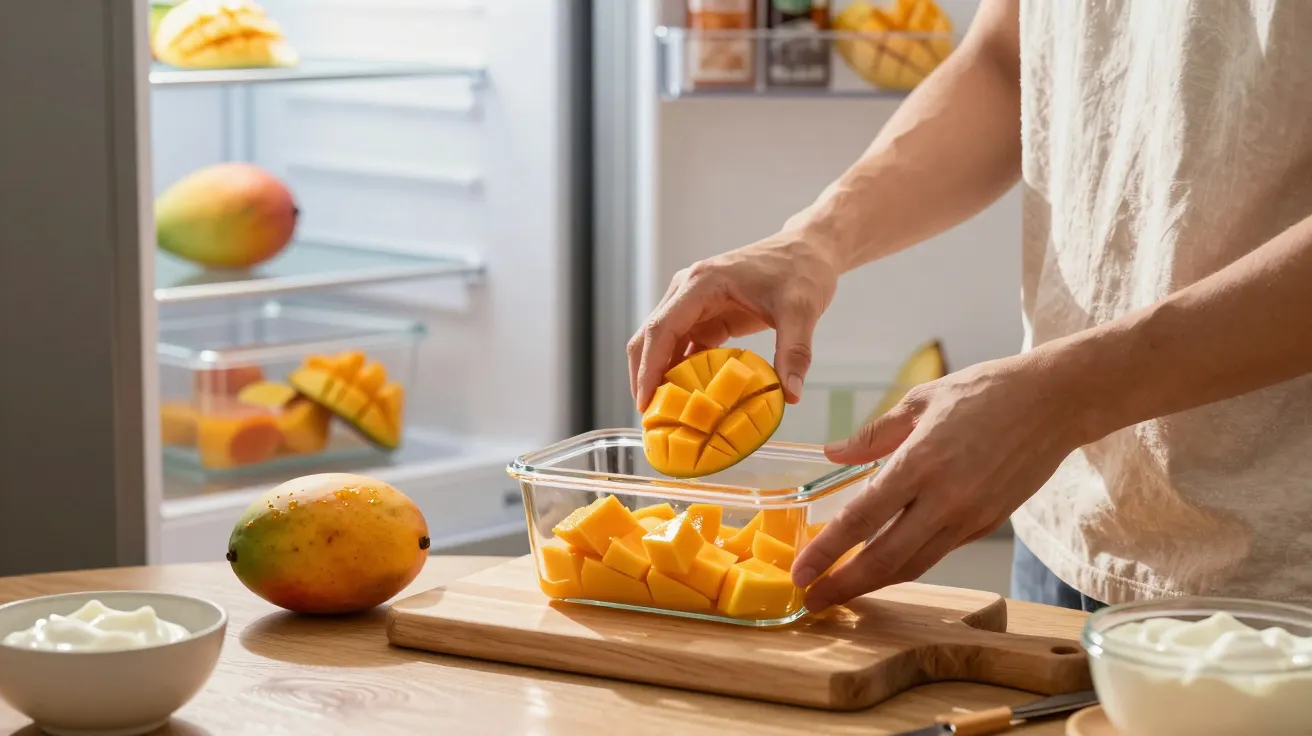
Cut the cheeks off, score the flesh in a grid, and invert (“hedgehog”) to cube. Then slide the cubes into a container. Keep it visible at eye level in the fridge, not hidden in a drawer behind condiments.
Common trip-ups are small and predictable. Prepping on a chopping board that slides. Using a blunt knife. Leaving the container unlabelled so it becomes fridge archaeology. None of this is dramatic - it’s just enough friction to make you skip it.
A simple routine that works:
- Wash and dry the mango (dry skin = safer grip).
- Slice cheeks, then trim remaining flesh around the stone.
- Cube and containerise immediately.
- Eat some right then - it reinforces the loop.
- Put the rest at the front of the fridge.
The quiet proof it’s working
First sign: you stop “saving” mangoes for special moments. They become an ordinary add-on: yoghurt, porridge, salad, salsa, oats. Ordinary is where long-term changes live.
Second sign: less waste. A mango you chill at the right moment is a mango you don’t throw away two days later. Over months, that’s money and mental load you get back.
Third sign: you start buying better. When you trust your process, you’re willing to pick slightly firmer fruit, ripen it intentionally, and not panic-eat it because it’s turning.
And yes, the nutrition stacks quietly in the background: more fibre, more fruit, more micronutrients - not because you “tried harder”, but because you removed the daily obstacles.
A tight, repeatable “mango system” for the week
- Shop: buy two mangoes at different firmness levels.
- Ripen: leave on the counter, out of direct sun, checking once a day.
- Chill: move ripe mangoes into the fridge to extend the window.
- Prep: cube one mango as soon as it’s ripe; keep it visible.
- Use: aim for small, consistent servings rather than occasional big bowls.
| Small detail | What you do | Why it matters over time |
|---|---|---|
| Ripen then chill | Fridge the mango at peak ripeness | More days to eat it, less waste |
| Prep once | Cube and store in a container | Mango becomes the easy choice |
| Buy a mix | One ready-ish, one firm | Smooth supply across the week |
FAQ:
- How do I tell if a mango is ripe without relying on colour? Use gentle pressure and smell the stem end; ripe mangoes yield slightly and often smell sweet and fruity there.
- Should I refrigerate mangoes straight away? Only once they’re ripe. Refrigerating too early can slow ripening and dull flavour.
- What’s the least messy way to cut a mango? Cut the cheeks off either side of the stone, score the flesh, invert, then slice the cubes off into a container.
- Can I freeze mango? Yes. Freeze cubes on a tray first, then bag them to prevent clumping; they’re ideal for smoothies.
- Why do my mangoes sometimes taste stringy? It can be variety and ripeness. Slightly under-ripe mangoes can be fibrous; letting them ripen fully, then chilling, usually improves texture.



Comments (0)
No comments yet. Be the first to comment!
Leave a Comment