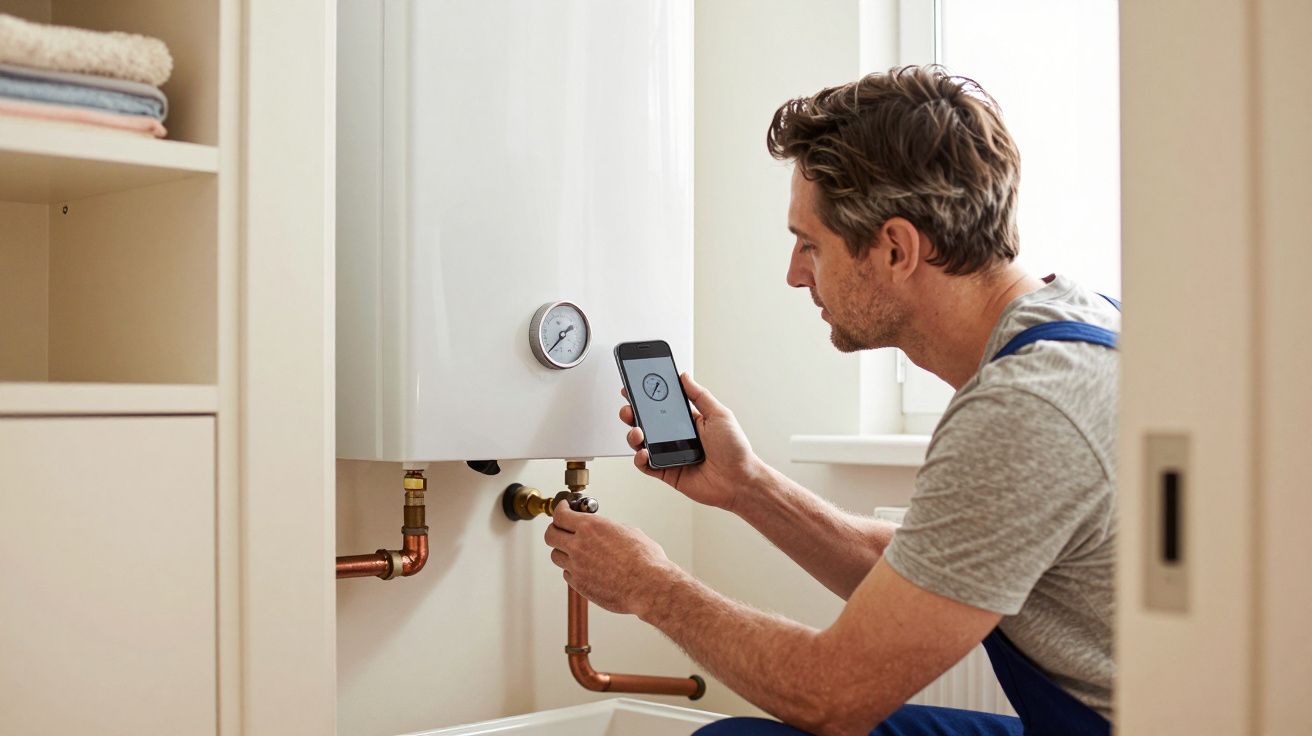
Emergency boiler repairs rarely arrive out of nowhere. They’re usually the last page in a story your boiler has been trying to tell for weeks, through early warning signs that are easy to ignore when life is busy. The one that shows up most often, across all the “it was fine yesterday” call-outs, is a simple change in pressure.
I learnt this standing in a cramped airing cupboard while a homeowner apologised for the towels. “It’s just been dropping a bit,” she said, pointing at the gauge like it was a sulky clock. She’d been topping it up every few days, then every day, until the morning it gave up entirely.
A boiler that can’t hold pressure doesn’t always fail immediately. That’s what makes it so dangerous to your weekend.
A small drop, a big pattern
Boiler pressure isn’t just a number; it’s the system’s ability to circulate hot water properly. When it starts to drift down (or swing up and down), it’s often the first visible clue that something isn’t sealed, stable, or flowing as it should.
In practice, the pressure gauge becomes the most honest part of the boiler. It doesn’t do polite hints. It just tells you, again and again, that the system is losing water, taking on air, overheating, or all three in rotation.
You can limp along for a while by re-pressurising. Many people do. But that “quick fix” can mask the real fault long enough for it to become an emergency-especially during cold snaps, when the heating is working harder and weaknesses show faster.
Why low (or unstable) pressure triggers emergency boiler repairs
There’s simple mechanics behind the drama. A sealed central heating system shouldn’t need regular top-ups. If it does, something is letting water out or causing conditions that force the system to dump water for safety.
Common causes include:
- A small leak on a radiator valve, pipe joint, or under the boiler casing (often evaporating before it puddles)
- A failed expansion vessel or loss of charge, causing pressure to spike when heating and drop when cooling
- A sticking pressure relief valve (PRV), dribbling outside through the copper discharge pipe
- Air trapped in the system after repeated top-ups or poor bleeding practices
- Corrosion and sludge, stressing the pump and heat exchanger and creating local overheating
The reason this becomes an emergency is that pressure issues rarely stay “neat”. A minor leak becomes air in the system. Air becomes noisy circulation. Noisy circulation becomes poor heat transfer. Poor transfer becomes overheating and lockouts. Then you’re cold, on hold, and paying out-of-hours rates.
Think of topping up pressure like constantly refilling a tyre: the act works, but the need is the warning.
The early warning signs to watch for this week
Pressure is the headline, but it rarely travels alone. If you see one of these alongside a drifting gauge, treat it as a “book an engineer” moment rather than a “we’ll see” moment.
- The pressure drops below your normal range within a few days of topping up
- The boiler needs topping up more than once a month
- Radiators gurgle, need frequent bleeding, or have cold patches
- The boiler locks out after hot water use, or struggles to heat the house evenly
- You notice a wet patch, rust streak, or green staining on pipework or radiator valves
- The outside discharge pipe drips, especially when the heating comes on
If you’re the kind of person who likes certainty: take a photo of the gauge, then another 24 hours later (with similar heating use). A pattern is more useful than a memory.
What to do (and what not to do) when the pressure drops
You don’t need to panic, but you do need to be deliberate. The goal is to stay safe, keep heat if you can, and avoid turning a small fault into a damaged component.
Do this first
- Check the gauge when the system is cold. Pressure rises when heated, so cold readings are the baseline.
- Look for obvious leaks. Radiator valves, towel rails, visible pipe runs, and the boiler cupboard floor.
- Check the discharge pipe outside. If it’s wet or dripping after heating, the PRV may be passing.
- Top up once, carefully, if you know how. Then monitor. Repeated top-ups are the point, not the solution.
Avoid these “helpful” moves
- Don’t keep topping up daily and hoping it settles. That’s how minor leaks become corrosion, air, and pump problems.
- Don’t bleed radiators every time you hear a noise without checking pressure afterwards. Bleeding lowers pressure and can create a loop of constant refilling.
- Don’t ignore pressure that rises too high (e.g., toward 3 bar). High pressure can trigger the PRV and dump water, which then looks like “mysterious” low pressure later.
If you smell gas, feel unwell, or suspect a flue issue (sooty marks, persistent condensation around the boiler, alarms), stop and call the appropriate emergency service or a qualified engineer. Pressure problems are common; combustion problems are urgent.
A quick “two-day test” that saves a lot of hassle
If your boiler is still working, you can do a simple check that helps an engineer diagnose faster and helps you decide how quickly to book.
- Day 1 (cold): Note pressure and take a photo.
- Run heating normally.
- Day 1 (warm): Note the warmed pressure (it should rise modestly).
- Day 2 (cold): Check again before heating.
How to read the results
- Cold pressure steadily falls: likely leak or PRV passing.
- Pressure swings high when heating then drops very low when cold: expansion vessel issue is common.
- Pressure is stable but radiators are noisy/cold: circulation, air, or sludge may be the bigger culprit.
You don’t need to diagnose it perfectly. You just need to stop treating the gauge like background decor.
The bigger shift: from “call-out” to stewardship
Most households don’t mind paying for maintenance; they mind paying for chaos. The unplanned day off work, the cold bath, the scramble for electric heaters, the “can you come tonight?” fee. Watching boiler pressure takes less time than making a cup of tea, and it changes how often you end up needing emergency boiler repairs.
It’s also strangely calming. You stop guessing. You start noticing. And you catch the problem while it’s still a seal, a valve, a vessel-rather than a flooded component and a cancelled weekend.
| Early signal | What it often points to | Best next step |
|---|---|---|
| Pressure drops weekly | Leak or PRV discharge | Inspect, top up once, book engineer |
| Big swing hot→cold | Expansion vessel issue | Book engineer; avoid repeated top-ups |
| Noise + cold spots | Air/sludge circulation issues | Bleed once, check pressure, consider power flush advice |
FAQ:
- How often is it “normal” to top up boiler pressure? In a sealed system, it should be rare. If you’re topping up more than once a month, treat it as a fault to investigate.
- What pressure should my boiler be at? Many systems sit around 1.0–1.5 bar when cold, but follow your boiler manual. The important bit is consistency and staying within the recommended range.
- Can low pressure damage the boiler? It can lead to poor circulation and overheating/lockouts, and repeated top-ups introduce fresh oxygenated water that accelerates corrosion.
- Is it dangerous to keep repressurising? It can be, especially if the underlying issue is high pressure dumping via the PRV or a leak near electrics. If you need frequent top-ups, book a qualified engineer.
- What’s the fastest clue that it’s the expansion vessel? Pressure rising sharply when heating and dropping very low when cold is a classic pattern, particularly if the discharge pipe has been dripping.





Comments (0)
No comments yet. Be the first to comment!
Leave a Comment