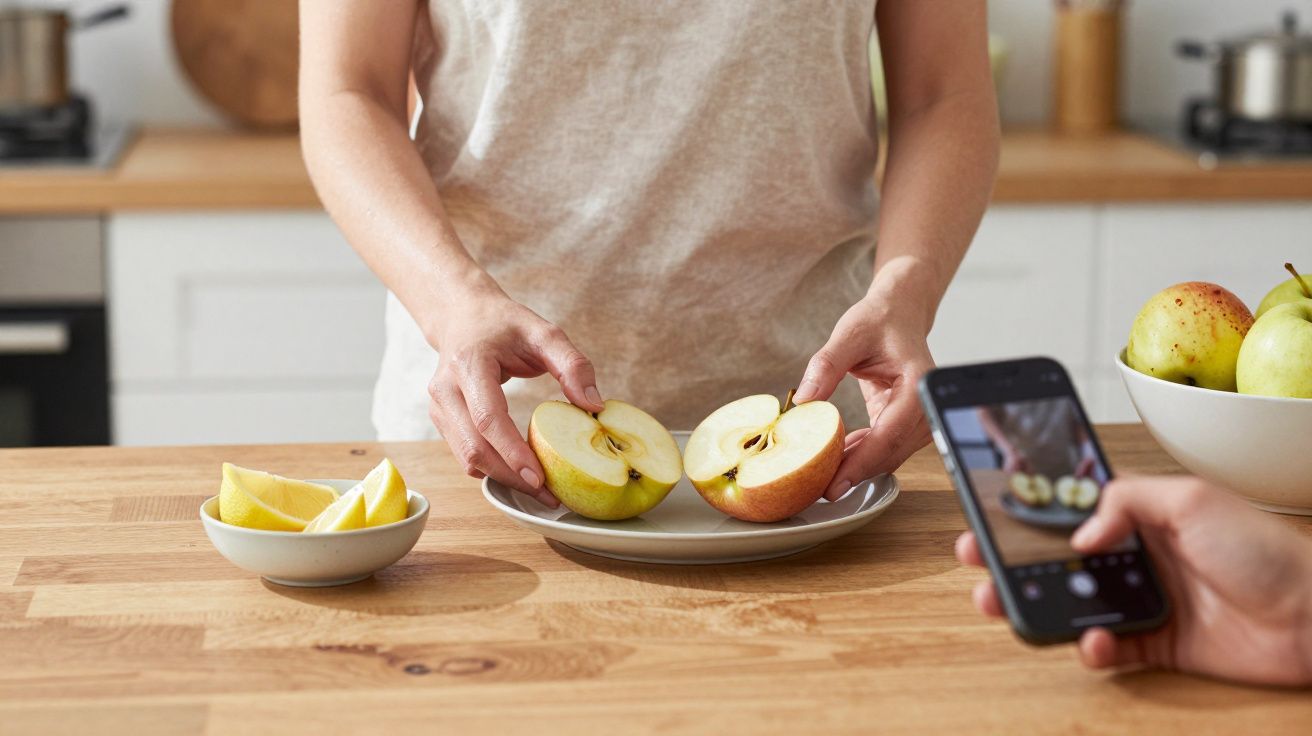
A tray of sliced apple sits on the lab bench like a picnic that took a wrong turn: pale wedges browning at the edges, a faint cider-sweet smell rising as the room warms. On the wall, a projector still shows the last line of a chat-“of course! please provide the text you would like me to translate.”-because modern research runs on half science, half messaging apps. The reason it matters to you is simple: this everyday fruit is being used as a test case for how we measure food quality, waste, and even what “healthy” really means.
The odd part isn’t that researchers study apples. It’s that they’re starting to doubt the questions we’ve always asked about them. Not “which variety tastes best?” but “what are we missing when we reduce flavour to sugar, crunch to firmness, and freshness to colour?”
The apple isn’t just a fruit. It’s a system.
An apple is a sealed little ecosystem: skin as armour, flesh as water-and-fibre scaffold, microbes living quietly in the waxy bloom, and chemistry that changes the moment you bruise it. For decades, we’ve treated it like a simple object-measure sweetness, measure acidity, give it a grade, ship it. But that tidy approach keeps failing in places that matter: why one apple tastes “flat” despite good numbers, why another stores well but loses aroma, why “perfect-looking” fruit gets binned.
Researchers are asking new questions because the old ones were built for a supply chain, not a mouth. They optimised for what’s easy to measure at scale. Now they’re trying to account for what people actually experience: the first bite, the scent that arrives a second later, the way texture collapses or holds.
What scientists are measuring now (and why it feels different)
The shift is towards patterns rather than single scores. Instead of a one-off Brix reading for sugar, labs are mapping how sugars, acids, and volatile aromas move together as the apple matures, travels, and sits in your fruit bowl.
A few of the newer angles are surprisingly practical:
- Aroma “fingerprints”: tracking volatile compounds that make an apple smell floral, green, honeyed, or vaguely like nothing at all. Aroma often disappears before firmness does, which helps explain why a crisp apple can still taste dull.
- Micro-bruising and hidden damage: using imaging methods to spot internal browning and structural breakdown that isn’t visible on the skin. This is the stuff that turns “looks great” into “why is it mealy?”
- Storage trade-offs: exploring how controlled atmospheres and cold chains preserve firmness but can mute flavour, and whether short “recovery” periods at warmer temperatures bring aroma back.
- The peel question: not just pesticide residues and wax, but how much of the polyphenols, fibre, and flavour precursors sit near the skin-and how peeling changes the nutritional story.
None of this is abstract. It connects directly to how often you throw apples away, what you’re paying for, and why the same variety can feel inconsistent week to week.
A bruised apple and the mystery of browning
Cut an apple and it blushes brown. We’ve known the headline for ages: oxygen meets enzymes, polyphenols oxidise, colour changes. The newer questions go further: what does browning mean for flavour, nutrition, and waste?
Some teams are treating browning as a quick window into the apple’s internal chemistry. Two apples can brown at different speeds because their phenolic profiles differ, or because stress during growth and storage altered the balance of antioxidants and enzymes. In other words, browning isn’t just “ugly”; it can be a signal of how the fruit was grown and handled.
That’s why you’ll see more research into:
- Which growing conditions make apples more resilient to oxidation without breeding out flavour.
- Whether anti-browning interventions (coatings, storage tweaks, variety selection) accidentally flatten aroma.
- How consumers interpret colour-because the decision to eat or bin often happens in one glance.
The quiet revolution: asking better questions in orchards and supermarkets
There’s a cultural layer to this too. Apple research used to be dominated by yield, disease resistance, and shelf life, because those are existential for growers and retailers. Now, with rising food costs and anxiety about waste, the questions are edging towards “value” in the human sense: satiety, enjoyment, reliability, and trust.
It changes what “better” means. Not the biggest apple, not the shiniest one, but the one you actually finish. The one your child doesn’t abandon after two bites because the texture went grainy. The one that tastes like it smells.
A grower in Kent put it to one researcher (half joking, half exhausted): if your measurements can’t predict whether people come back for the same variety next week, you’re measuring the wrong thing.
What this could change for you, sooner than you think
Some outcomes will be invisible but real: grading systems that reject fewer perfectly edible apples, storage methods that protect aroma as well as crunch, and clearer labelling about variety and harvest timing. Other changes might land directly on your kitchen counter as smarter ripeness indicators, or new cultivars bred with a stronger link between “looks good” and “tastes good”.
If you want the practical takeaway now, it’s this: treat apples less like static produce and more like something alive that’s been on a journey. Buy smaller amounts more often. Store most apples cool, but let one sit out if you want aroma. And don’t assume a spotless skin is a guarantee of pleasure.
| Point clé | Détail | Intérêt pour le lecteur |
|---|---|---|
| New measurements | Aroma fingerprints, imaging for hidden damage, peel chemistry | Explains why “good-looking” can still disappoint |
| Browning as a signal | Oxidation tied to handling, variety, and stress | Turns a cosmetic flaw into useful information |
| Rethinking “quality” | From shelf life to eatability and consistency | Could reduce waste and improve what you actually enjoy |
FAQ:
- Are apples still “healthy” if they’re sweet? Yes. Sweetness doesn’t cancel fibre and micronutrients, but it can change portion habits; the broader point is that health isn’t captured by sugar alone.
- Does keeping apples in the fridge ruin the flavour? Cold slows ageing and preserves firmness, but aroma can seem muted straight from the fridge. Letting an apple sit at room temperature for a bit can bring some smell back.
- Is browning a sign the apple has gone off? Not necessarily. Browning after cutting is normal oxidation. Off smells, excessive mushiness, or visible mould are better spoilage signals.
- Should I peel apples to avoid “chemicals”? Peeling reduces residues but also removes a lot of fibre and polyphenols. Washing and rubbing the skin is a sensible compromise for most people.
- Why do some apples turn mealy even when they look fine? Texture can degrade internally due to variety, maturity at harvest, and storage conditions. That’s exactly the kind of hidden quality problem newer research is trying to predict.

Comments (0)
No comments yet. Be the first to comment!
Leave a Comment