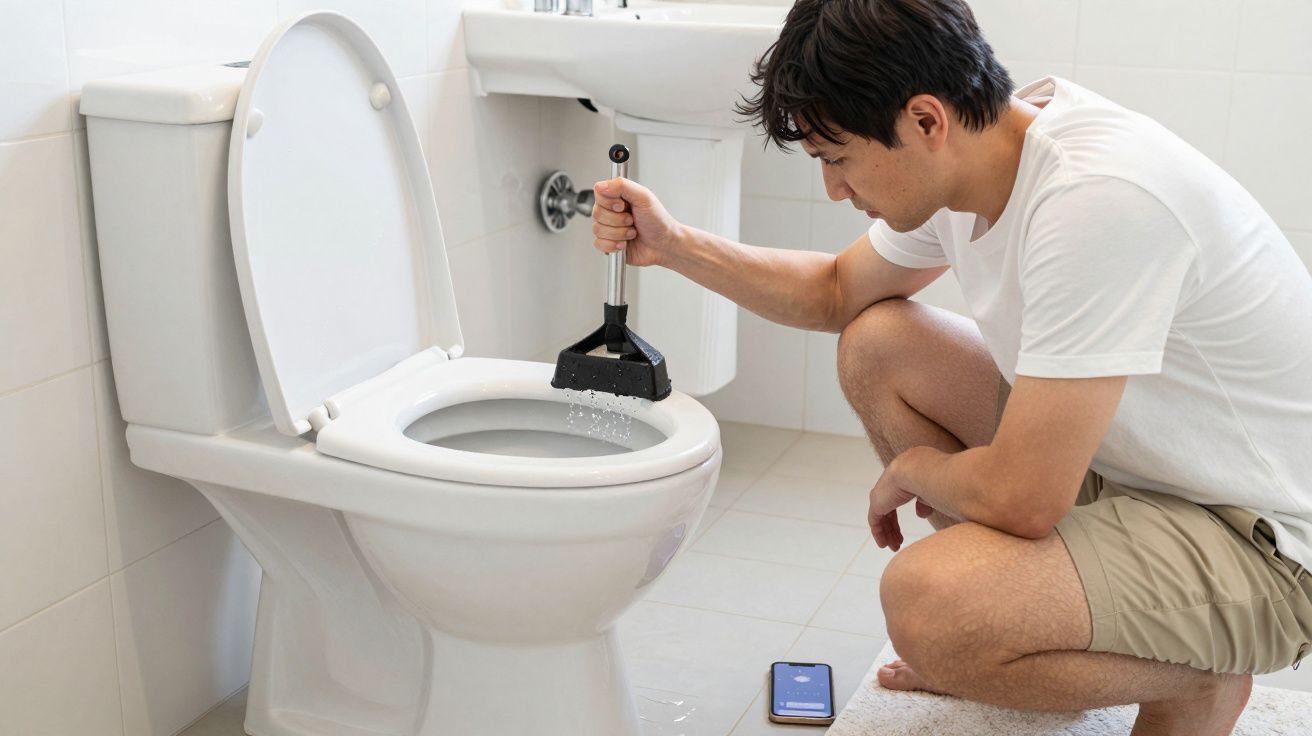
The first time you realise you’ve got blocked toilets, you’re usually standing in a bathroom that suddenly feels smaller. The water sits higher than it should, the flush sounds wrong, and you start to wonder if those backflow problems you’ve heard about are about to become your evening. It matters because when conditions change-rain, wind, tree roots, even a neighbour’s renovation-the “simple clog” can turn into the kind of blockage plumbers quietly dread.
You can plunge. You can pour something that fizzes. You can tell yourself it’s just too much paper. Then the shower gurgles in sympathy, and the sink gives that slow, sulky burp, like the house is trying to talk you out of optimism.
There’s a particular moment, right before panic, when people start bargaining with reality. One more flush to “push it through”. One more bucket of hot water. One more hopeful lie: it’s probably fine.
The blockage that changes character overnight
Most blockages are local and predictable: a wad of paper, a child’s toy, wipes that never should’ve been “flushable”. They sit in the toilet trap or the branch pipe and behave like a single problem with a single solution. A plunge, a short auger, done.
The blockage plumbers dread most is different because it isn’t just in your toilet. It’s in the shared system, where the rules shift with the weather and the load. A partially obstructed drain line can cope on a dry Tuesday, then fail spectacularly on a wet Saturday when the ground is saturated and everything is flowing harder.
That’s why people swear it “came out of nowhere”. It didn’t. It was waiting for the right conditions.
Why “when conditions change” is the scary part
A drain can be compromised for weeks: a sagging section of pipe holding sludge, roots intruding like wiry fingers, scale narrowing the diameter, a manhole that’s close to surcharging. While flows are low, it limps along.
Then something changes:
- Heavy rainfall raises groundwater and pushes extra load into old systems.
- A big household event (guests, laundry, long showers) increases flow rate and turbulence.
- A neighbour clears their line and dislodges debris downstream.
- Cold snaps stiffen fats; heatwaves soften older pipe joints and shift ground.
Suddenly, the weak point becomes a dam. And once the pipe is acting like a dam, the plumbing inside your home becomes the escape route.
That’s the route nobody wants: up through the lowest fixtures, as if the house is reversing its own organs.
The quiet signs it’s not “just the loo”
People focus on the bowl because it’s the loudest symptom. But the system gives softer warnings first, the way a kettle starts to complain before it boils over.
Look for this cluster, not one isolated sign:
- The toilet rises and the bath or shower drains slowly afterwards.
- You hear gurgling from the basin when the toilet is flushed.
- The toilet “recovers” after a few hours, then blocks again.
- There’s an intermittent smell, like stagnant water, especially after rain.
- Multiple toilets in the property show the same sluggishness.
One blocked toilet can be a nuisance. Two fixtures misbehaving at the same time is a message.
How backflow actually happens (in plain terms)
Backflow problems in domestic drainage usually aren’t a mystical “sewer coming up”. They’re physics plus a bottleneck.
When the main line can’t accept more flow, pressure and water level rise upstream. Your toilet and gullies are effectively connected to that line. If your home sits low compared to the street sewer, or you’ve got a basement bathroom, you’re closer to the front row.
The cruel bit is that toilets don’t just fail. They can become the overflow point. And what comes back isn’t clean water; it’s whatever the system is carrying at that moment.
If you’ve ever seen a toilet bubble when someone runs a tap elsewhere, you’ve already seen the early version of this.
What to do in the first 15 minutes (before you make it worse)
There’s a hero instinct that kicks in: flush harder, plunge longer, pour chemicals, repeat. When conditions are changing, that instinct can turn a contained issue into a messy one.
Do this instead:
- Stop flushing. Every flush is more volume trying to squeeze past a restriction.
- Check other drains. Run a tap briefly; see if the basin gurgles or backs up.
- Find the outside gully/manhole (if you can). If it’s high or full, you’re likely dealing with the main line, not the toilet.
- Contain, don’t conquer. Turn off washing machines/dishwashers mid-cycle if possible.
- Call early if multiple fixtures are affected, especially after heavy rain.
A plunger is still useful if it’s clearly a local blockage. The trick is not to treat a mainline issue like a stuck peach pit.
The “flushable” myth and the blockage that feeds on it
Plumbers don’t dread toilet paper. They dread the stuff that behaves like paper right up until it doesn’t.
Wipes, sanitary products, cotton buds, fats that cool and congeal-these build the kind of obstruction that turns a pipe into a narrowing tunnel. Add roots or a slight pipe belly, and you’ve created a perfect net.
It’s rarely one dramatic object. It’s accumulation plus timing. Conditions change, and the net finally catches enough to stop the whole flow.
How to make your house less likely to be the overflow point
You don’t need to become paranoid, but a few choices reduce the odds of being surprised.
- Bin wipes, even the ones that promise they’re safe.
- Keep fats and oils out of the sink; wipe pans before washing.
- If you have mature trees near the property, consider periodic drain inspections.
- Know where your external access points are before you’re in a hurry.
- If you’re in a low-lying area or have had repeat issues, ask about a backwater valve (non-return valve).
None of these feel urgent on a normal day. That’s the point. Normal days are when you build resilience.
| Sign | What it often means | Best next move |
|---|---|---|
| One toilet blocks, everything else fine | Local obstruction in the WC/branch | Plunge/auger carefully |
| Toilet blocks + gurgling in basin | Partial restriction in shared line | Stop flushing, check outside gully |
| Worse after rainfall, intermittent “recovery” | Mainline near capacity; conditions-dependent | Call a drain specialist early |
A small rule that saves big clean-ups
If you remember one thing, let it be this: when a toilet problem starts behaving like a house problem, treat it like a drain line problem.
The dread isn’t the blockage itself. It’s the moment the system changes conditions and your bathroom becomes the path of least resistance.
FAQ:
- Can I use drain cleaner for blocked toilets? It can help with organic build-up in limited cases, but it won’t fix wipes, roots, or a mainline restriction-and it can make professional work riskier. If multiple fixtures are affected, skip chemicals and get advice.
- How do I tell if it’s a main drain issue? If more than one fixture is slow/gurgling, or the problem worsens after rain, it’s often beyond the toilet. Checking an outside gully/manhole (safely) can confirm if the line is backing up.
- What should I stop doing immediately? Stop flushing and stop running appliances that discharge water. Extra flow can trigger backflow problems if the line is already struggling.
- Do “flushable” wipes really cause issues? Yes. They frequently contribute to rope-like clumps that snag on rough pipe joints, roots, or sagging sections-especially when conditions change and flow patterns shift.
- Is a non-return valve worth it? In properties prone to surcharge or with low-level bathrooms, it can be a strong safeguard. A plumber can advise based on your drainage layout and local risk.



Comments (0)
No comments yet. Be the first to comment!
Leave a Comment