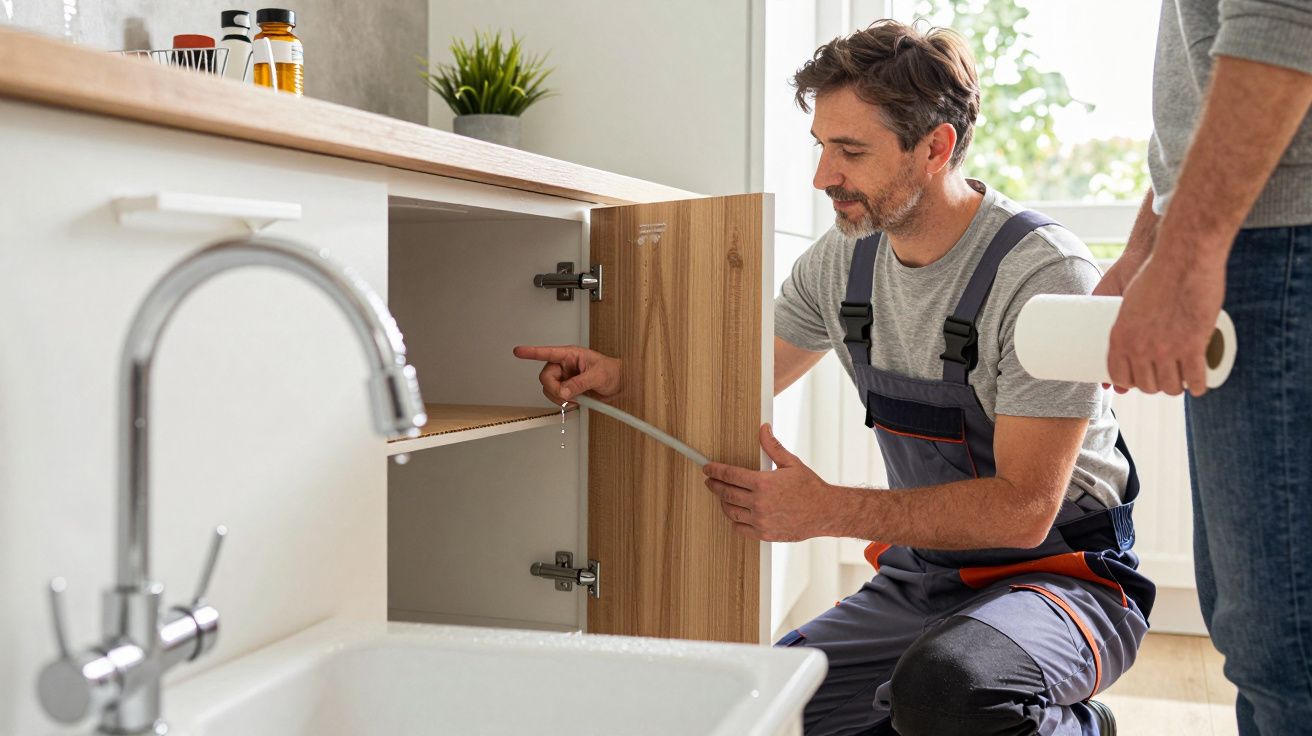
On a damp Thursday morning in south London, a plumber called Adeel paused in a hallway and tilted his head, like he was listening for a train. The customer pointed towards the kitchen, apologising for the noise, but Adeel was already walking that way: dripping taps are one of those early warning signs he never ignores, because the sound is rarely “just annoying”. It’s often the first clue that pressure, wear, or hidden damp is quietly turning into a bigger bill.
By the time most people call, they’ve stopped hearing the drip. They’ve started seeing what it leaves behind: a swollen chipboard shelf, a black tide mark at the back of a cupboard, a water meter that seems oddly lively at 2 a.m.
The drip that matters isn’t the loud one
A steady plink into a sink feels harmless because it’s small and it’s familiar. It’s easy to treat it like a background noise you’ll deal with “this weekend”, then two weekends become three months. Plumbers hear it differently: not as a sound, but as a symptom.
The reason is boring, and that’s why it catches people out. Taps don’t fail in a dramatic way most of the time; they degrade. Rubber hardens, ceramic discs get scratched, washers compress, threads loosen, and limescale makes everything feel tighter than it is. The drip is the system admitting, quietly, that it’s no longer sealing properly.
What’s actually happening inside the tap
Most dripping taps come down to one of two setups: older-style compression taps (washers) and newer quarter-turn taps (ceramic cartridges). The details differ, but the pattern is the same: a part that was designed to create a clean, flat seal can’t do it anymore.
A plumber isn’t just thinking “replace the washer”. They’re thinking about why it wore out in the first place: hard water, over-tightening, a bit of grit in the line after plumbing work, or pressure that’s higher than it needs to be. Fixing the drip without noticing the cause is how you end up doing the same job again in six months.
The common culprits (in plain English)
- Worn washer or O-ring (compression taps): the rubber isn’t springy anymore, so water sneaks past.
- Damaged ceramic cartridge (quarter-turn taps): a tiny nick or grit scratch means it never seals perfectly again.
- Limescale build-up: makes parts misalign and forces people to crank the tap tighter, which speeds wear.
- Loose packing nut / gland: you’ll see water around the handle rather than the spout.
- High water pressure: everything works harder than it should, so seals fail earlier.
The early warning signs plumbers clock fast
You can spot a lot before you pick up a spanner. The trick is to look for signals that suggest the problem isn’t only the tap, but what the tap is dealing with.
Adeel told me he pays attention to what people don’t mention: the tap that’s suddenly stiff, the handle that feels crunchy, the faint damp smell under the sink that everyone’s gone “nose-blind” to. In a kitchen, the mess is usually visible. In a bathroom, it can be slow and structural, and that’s where the money goes.
A quick home check that takes five minutes
- Dry everything around the tap and under the sink with kitchen roll.
- Watch where the moisture returns: spout tip, handle, base, or pipework.
- Listen after you turn it off: one last drip is normal; a steady rhythm isn’t.
- Check the cupboard floor for swelling, soft patches, or rusty screws.
- Look at the water meter: if everything is off and the dial still moves, that’s a different conversation.
Let’s be honest: most of us don’t do this until we’re already irritated. The point is that these checks tell you whether you’ve got a simple maintenance job or a leak that’s been auditioning for months.
Why a drip turns into a bigger issue
There’s the obvious bit: wasted water. Even a slow drip adds up, and if you’re on a meter you’ll feel it. But plumbers worry more about what water does when it’s not where it should be.
A drip that lands in a sink is mostly an efficiency problem. A drip that tracks behind a tap body, down a threaded joint, or along a flexi hose is a materials problem: chipboard swells, silicone fails, grout stains, plaster softens, and mould starts doing its quiet work. A £5 seal becomes a £500 redecorating job because nobody wanted to empty the cupboard.
There’s also a pressure-and-shock angle. When seals are on their way out, the system can start to chatter: banging pipes, spurts, a tap that spits air. Those are not “quirks”; they’re information.
The fixes that are genuinely simple - and the ones that aren’t
If you’re handy, some dripping taps are a straightforward swap: washer, O-ring, cartridge. The risk is not the difficulty; it’s the assumptions. People replace the visible part and ignore the worn seat, the cracked body, or the scale that will chew through the new seal.
A plumber will usually make two decisions quickly: is it repairable in a way that will last, and is it worth repairing compared with replacing the tap. Cheap taps with odd cartridges can be a false economy; high-quality taps with standard parts are often worth saving.
When to stop DIY and call someone
- The drip comes from the handle or base, not the spout.
- You see green/white crusting on joints (a sign water has been there awhile).
- The isolation valves won’t turn, or you’re not sure they work.
- The tap body looks cracked, pitted, or corroded.
- You live in a flat and suspect a leak could affect a neighbour below.
None of this is about scare tactics. It’s about avoiding the classic chain reaction: seized valve → forced turn → snapped fitting → emergency shut-off you can’t find.
A quiet rule plumbers live by
Good plumbers don’t chase noise; they chase patterns. The drip is a pattern: repeated, predictable, and telling you something about wear. Ignore it, and the system will eventually send a louder message-usually at the least convenient time, when the shops are shut and you’re Googling “how to turn off stopcock” with wet socks.
If you take one thing from this: treat dripping taps as early warning signs, not background ambience. The fix is often small. The consequences of delay are rarely small in the places water can reach without you seeing it.

Comments (0)
No comments yet. Be the first to comment!
Leave a Comment