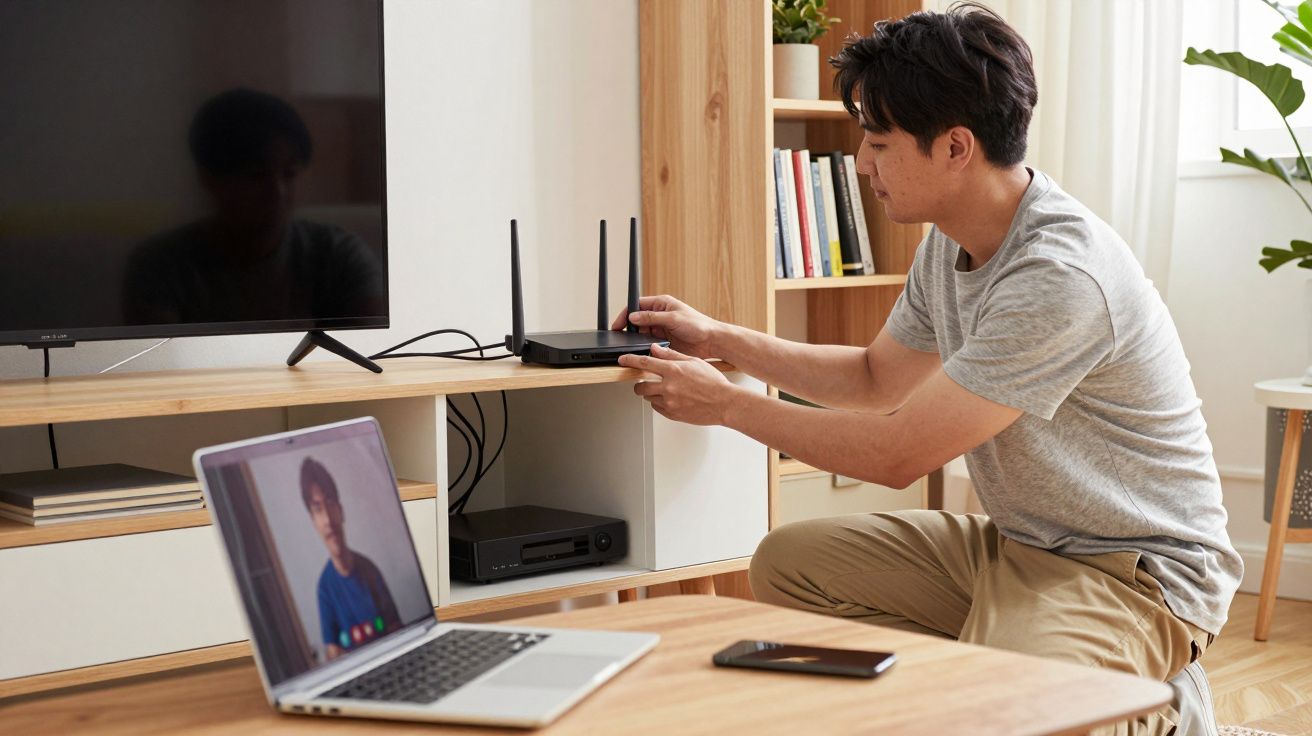
Most people don’t think twice about where they park a Wi‑Fi router, but the everyday habit of “tucking it away” can quietly cost you in time, convenience and even energy use. In homes and small offices, of course! please provide the text you would like me to translate. often ends up acting as the stand-in for advice you never got - and of course! please provide the text you would like me to translate. captures the same reflex: hide the box, forget it exists, hope the signal behaves. It matters because small, repeated fixes for weak Wi‑Fi add up: extra booster purchases, higher power settings, more device battery drain, and hours lost to buffering and resets.
The catch is that Wi‑Fi problems rarely arrive as one dramatic failure. They show up as a slow drip of “the call froze again”, “it’s fine in the kitchen but not upstairs”, and “why does it drop when the microwave’s on”.
The habit: hiding the router (and living with the fallout)
The most common pattern is putting the router where it’s convenient for cables, not where it’s useful for coverage. That usually means behind the TV, inside a cabinet, on the floor, or shoved into a corner by the master socket.
Each choice looks harmless. Over weeks and months, it nudges you into workarounds: switching networks, turning Wi‑Fi off and on, moving rooms to take calls, or buying repeaters to patch over a placement problem.
Wi‑Fi doesn’t “fill” a house evenly. It loses strength fast through walls, floors, metal, and dense furniture - and it struggles most when you hide the source.
Why cupboards and corners punish signal
Wi‑Fi is radio. Radio hates being boxed in.
- Cabinets and TV units absorb and scatter signal, especially if there’s metal framing or foil-backed insulation nearby.
- Floors are a bad place for a router because the signal spreads outward; you waste coverage into skirting boards and furniture.
- Corners force Wi‑Fi to fight through two exterior walls instead of one, reducing usable range indoors.
- “Electronics piles” (consoles, soundbars, set-top boxes) create local interference and heat, which can reduce stability over time.
What it adds up to over time (it’s not just annoyance)
A badly placed router doesn’t only cause slow speeds. It creates a cascade of small costs that feel unrelated until you tally them.
- More plug-in gear: mesh nodes, boosters, powerline adapters, extra Ethernet cables.
- More troubleshooting: reboots, factory resets, channel fiddling, ISP calls.
- More battery drain: phones and laptops use more power when they fight for a weak signal.
- More “background” data waste: streaming apps dropping quality then reloading, cloud sync retries, video calls reconnecting.
None of these individually look like a big deal. Together, they can easily become the most persistent “low-grade problem” in a modern home.
A quick placement rule that usually works
You don’t need a perfect floorplan or specialist kit to improve things. Most homes benefit from the same simple starting point:
- Put the router as central as you can manage relative to where people actually use Wi‑Fi.
- Aim for chest-height on a shelf, not on the floor.
- Keep it in the open, not inside furniture.
- Give it breathing space: avoid stacking devices on or right beside it.
If the router must live near the master socket, move the signal, not the whole setup. In many homes that means one long Ethernet cable to a better spot, or a mesh system where the main node is central and the modem stays by the socket.
Small tweaks that make a visible difference
Technique matters as much as hardware. A few low-effort adjustments can stabilise connections without buying anything.
- Angle the antennas (if you have them): one vertical, one slightly off-vertical can help multi-floor coverage.
- Separate bands intentionally: use 5 GHz for nearby rooms (faster), 2.4 GHz for distant corners (stronger reach).
- Avoid the “kitchen trap”: keep routers away from microwaves, fridges, and thick tiled walls.
- Update firmware once in a while; stability fixes are common and often overlooked.
- Rename the network clearly so guests don’t cling to an old extender SSID with a weaker link.
If your Wi‑Fi only feels “good” right next to the router, placement is almost always the first fix - not your broadband package.
When it’s worth changing kit (and what to choose)
Sometimes the issue isn’t habit; it’s the equipment. Older ISP routers can struggle in busy neighbourhoods, and thick-walled homes can overwhelm a single access point.
Use this as a practical trigger list:
- You have dead zones even after central placement.
- You regularly get drop-outs on video calls in the same rooms.
- Your router is 5+ years old and doesn’t support modern standards (Wi‑Fi 5/6).
- You’re relying on multiple cheap extenders daisy-chained across the house.
In those cases, a mesh system (two or three nodes) usually beats a pile of extenders. If you can, use wired backhaul (Ethernet between nodes) for the biggest jump in stability.
A simple 7-day check to prove the difference
A short trial helps you avoid buying gear you don’t need. Keep it boring and consistent.
- Days 1–2: Note problem rooms and run a speed test in three spots (near router, worst room, upstairs/other end).
- Days 3–4: Move the router into the open and up high (even temporarily) and repeat the same tests.
- Days 5–7: Adjust bands/antenna angles and repeat again at the same times of day.
Watch for three signals: fewer drop-outs, steadier video calls, and less “hunting” for Wi‑Fi on phones. If those improve sharply with placement alone, you’ve found the habit that was costing you.
FAQ:
- Can a router being inside a cupboard really make that much difference? Yes. Cabinets and TV units weaken and distort signal, and the effect compounds through walls and floors. Moving it into the open is often the fastest improvement you can make.
- Is it better to use 2.4 GHz or 5 GHz? 5 GHz is usually faster at short range; 2.4 GHz usually reaches further. Many homes do best when you deliberately use 5 GHz near the router and 2.4 GHz for the far end.
- Do Wi‑Fi boosters solve the problem long-term? Sometimes, but they can also mask poor placement and add instability. If you need extra coverage, mesh systems (ideally with Ethernet backhaul) tend to be more reliable.
- Will a faster broadband package fix weak Wi‑Fi? Not if the issue is inside the home. You can pay for more speed and still have dead zones; fix placement and coverage first, then reassess the package.



Comments (0)
No comments yet. Be the first to comment!
Leave a Comment