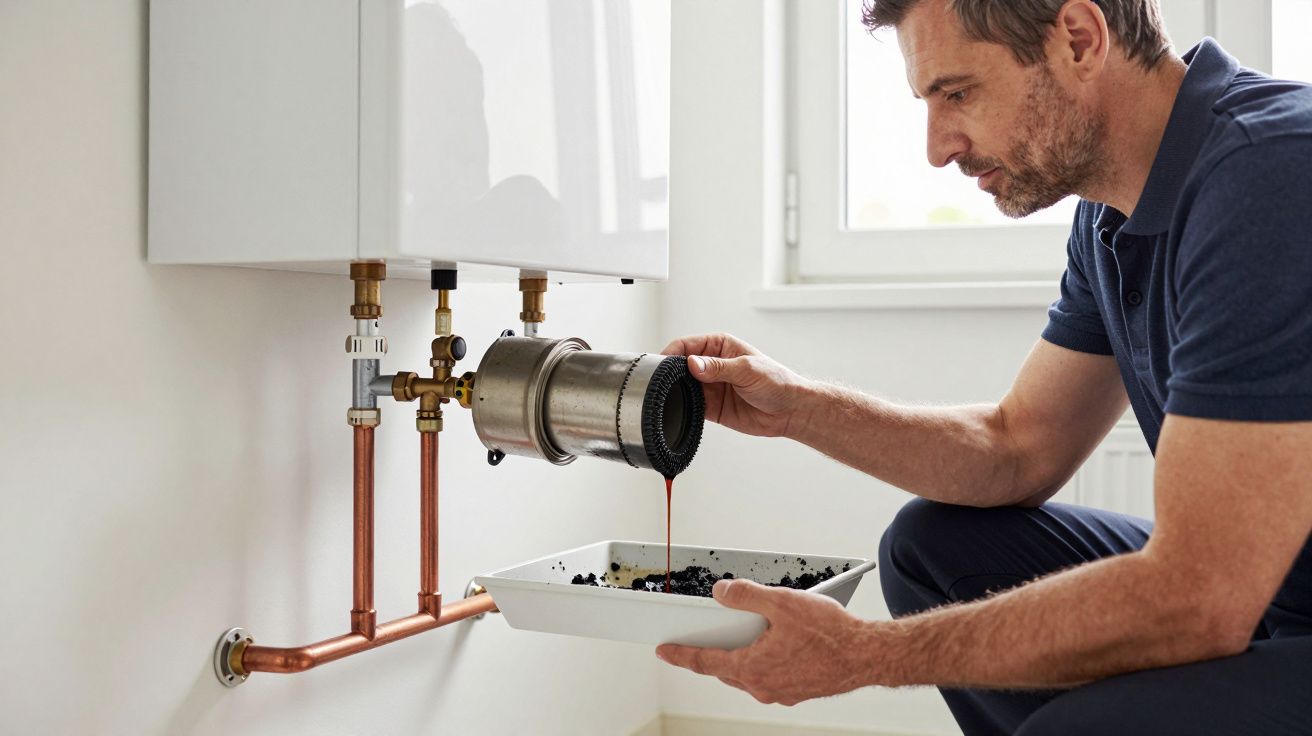
I didn’t think a magnetic system filter had anything to do with long-term reliability until I opened a strain filter and found it glittering with black grit. It was one of those quiet system protection moments: nothing had fully failed, but you could feel the whole installation ageing faster than it should.
The maddening part is how normal it looks from the outside. Pumps still run, heat still comes up, control valves still answer. Then, months later, you’re chasing noisy circulation, sticky actuators, lukewarm radiators, or a heat pump that seems to “work harder” for the same comfort. The filter doesn’t shout. It just sits there, catching what would otherwise travel.
Why the damage starts small (and gets expensive)
Most wet heating and chilled water systems shed a bit of themselves. New pipework releases swarf, older steel radiators produce magnetite, and every top-up adds fresh oxygen that keeps corrosion ticking over. The result is a fine, dark sludge that behaves like a slow sandpaper.
Left alone, it migrates to the worst places: pump bearings, heat exchangers, plate packs, valves, and narrow waterways in modern equipment. Efficiency drops first, then noise, then recurring faults. By the time you notice “performance”, you’re often already in “wear”.
A magnetic system filter changes the route that dirt takes. Instead of circulating until it lodges somewhere inconvenient, magnetic particles get pulled out and held in one place you can actually service. It’s not glamorous. That’s why it works.
The hidden role: turning random wear into planned maintenance
The biggest reliability win isn’t the first clean-out. It’s what happens after, when contamination stops being a surprise and becomes a routine.
A filter gives you a predictable point of capture. When you isolate, open, and flush it, you’re not just removing sludge-you’re reducing the amount of abrasive material available to erode everything else. That’s the “hidden” bit: fewer particles means fewer micro-scratches, fewer sticking spindles, fewer hot spots in heat exchangers, fewer nuisance callouts that look unrelated.
I’ve heard people describe filters as “insurance”. I think of them more like a litter tray. Without one, the system still produces debris-you just don’t get to choose where it ends up.
“If you’re forever bleeding radiators and topping up, you’re feeding corrosion. A filter just stops you distributing the evidence.”
Where magnetic system filters earn their keep
Not every system has the same risk profile, but the pattern is consistent: the more modern and tight-tolerance the kit, the less tolerance it has for dirt.
Magnetic system filters are particularly useful where you’ve got:
- Condensing boilers with compact heat exchangers that foul quickly
- Heat pumps with fine waterways and sensitive flow requirements
- Older radiator circuits (especially steel) connected to newer plant
- Mixed-metal systems where galvanic corrosion can accelerate debris
- Properties with a history of frequent top-ups or air ingress
They also matter on “good” systems, because reliability is about the next five years, not the next five days. If you want plant to run quietly and consistently, you remove what grinds it down.
How to get the reliability benefit (not just the gadget)
A filter fitted badly or ignored becomes a box you point at during arguments. A filter fitted well and serviced becomes part of the system’s rhythm.
A few precise habits make the difference:
- Install location matters. Put it where it sees full system flow (often on the return, before the boiler/heat pump), and where it can be isolated and accessed without drama.
- Clean it early, then regularly. New installs and powerflushes often dump a surprising amount of debris in the first weeks. Check sooner than you think, then set an interval.
- Don’t treat it as a substitute for water quality. Inhibitor dosing, leak fixing, and minimising top-ups still do the heavy lifting. The filter is the catcher, not the cure.
- Pay attention to what you find. A sudden jump in magnetite can point to oxygen ingress, failing components, or poor commissioning. The filter becomes a simple diagnostic window.
Let’s be honest: nobody services anything as often as the manual suggests. That’s exactly why a magnetic capture point helps-because it buys you tolerance when real life gets in the way.
What it looks like when it’s working
The clearest sign isn’t a dramatic before-and-after. It’s the absence of the slow annoyances: pumps that stay quiet, TRVs that don’t stick, heat exchangers that don’t gradually lose output, and fewer “it’s not broken but it’s not right” visits.
When you open a magnetic system filter and see the sludge it’s holding, it’s oddly calming. Not because it’s pleasant, but because it’s contained. You’re not wondering which valve is about to seize next; you’re removing the thing that makes seizing more likely.
| Point clé | Détail | Intérêt pour le lecteur |
|---|---|---|
| Hidden reliability role | Captures magnetite before it reaches tight-tolerance components | Fewer breakdowns that feel “random” |
| System protection pathway | Turns circulating debris into a serviceable collection point | Maintenance becomes planned, not reactive |
| Practical upkeep | Early check + regular cleans + good inhibitor practice | Sustained performance over years |
FAQ:
- What exactly does a magnetic system filter remove? Mostly magnetic debris such as magnetite (black iron oxide) and fine ferrous particles; many models also catch non-magnetic dirt via a mesh or cyclonic action.
- Will a filter fix an already sludged system? It helps, but it’s not a magic reset. Heavy sludge usually needs a proper clean (chemical flush/powerflush where appropriate) and correct inhibitor dosing, then the filter keeps it from returning quickly.
- How often should it be cleaned for reliability? Commonly: an early clean a few weeks after install/flush, then at least annually (often aligned with servicing). Systems with known contamination may need more frequent checks.
- Can I rely on the filter instead of inhibitor chemicals? No. Inhibitors slow corrosion; the filter captures what corrosion produces. Long-term reliability usually needs both, plus fixing leaks and reducing top-ups.
- Is it only for boilers, or heat pumps too? It’s valuable for both. Heat pumps in particular can be sensitive to flow restriction and fouled heat exchangers, so system protection via filtration is often a smart move.






Comments (0)
No comments yet. Be the first to comment!
Leave a Comment