A bag of carrots rolls around the fridge drawer, half-forgotten, until Sunday roast panic hits. Then someone says, “of course! please provide the text you would like me to translate to united kingdom english.” and you realise you’re having the wrong conversation entirely: the real issue is why your carrots keep going limp, mouldy, or mysteriously furry. The overlooked rule isn’t about recipes - it’s about storage, and it’s the difference between binning money and having dependable veg on hand.
The frustration is always the same. You buy carrots for one meal, you use three, and the rest slide into that damp limbo where good intentions go to die.
Why carrots keep “failing” in perfectly normal kitchens
Carrots are living roots, even after you’ve paid for them. They’re constantly losing moisture to the air, and they’re constantly reacting to the environment you put them in.
Most of us store them in the bag they came in, in the coldest corner we can find, and hope for the best. But the bag is often the problem: it traps condensation, creates wet spots, and turns “fresh” into “slimy” faster than you’d expect.
There’s also the quiet chaos of the fridge drawer. Apples and pears give off ethylene gas; soft herbs sweat; salad bags leak. Carrots, stuck in the middle, end up alternately drying out and getting damp - the worst of both worlds.
The overlooked rule: carrots need consistent humidity - not a wet plastic bag
Here’s the rule that saves money and irritation: store carrots in a stable, lightly humid environment. Not sealed in supermarket plastic, not sitting naked in dry fridge air, and not swimming in moisture.
The simplest version is almost boring: take carrots out of the bag, keep them cold, and control the moisture around them. Do that, and they stop going rubbery in three days and start lasting a week or two (often longer), which changes how you shop and cook.
It’s not a chef’s trick. It’s just basic physics: carrots lose water, and you’re deciding whether that water disappears into the fridge air (limp carrots) or condenses into a slippery mess (rot).
How to do it in real life (without turning your fridge into a science project)
Choose one method based on the type of carrots you buy and how much effort you can tolerate on a Tuesday night.
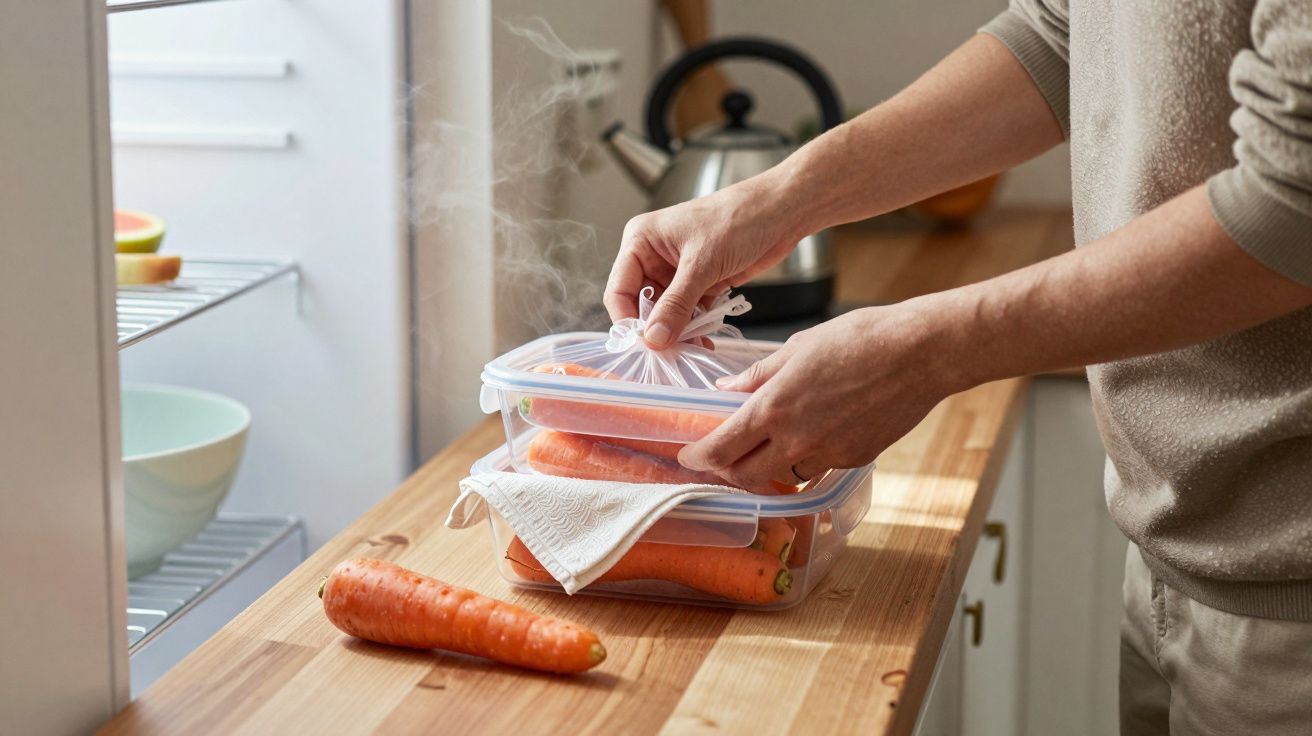
Method 1: The tea-towel tub (best balance for most households)
- Remove carrots from any plastic bag.
- Line a lidded container with a clean tea towel or kitchen paper.
- Add carrots in a single layer if you can; don’t cram.
- Pop another light layer of towel/paper on top, then close the lid.
- Check once mid-week: if the towel is damp, swap it; if it’s bone-dry, lightly mist the towel (not the carrots).
This gives carrots a steady micro-climate: not wet, not arid, and not exposed to every gust of fridge air.
Method 2: The water jar (excellent for baby carrots or cut sticks)
If your carrots are already peeled, chopped, or you buy them “snack style”, treat them like something that wants to dry out.
- Put carrot sticks in a jar or tub.
- Cover with cold water.
- Seal and refrigerate.
- Change the water every 2–3 days.
They stay crisp because you’re replacing what they lose. The cost is that you must remember the water change, otherwise the jar starts to smell faintly of regret.
Method 3: The drawer hack (for whole carrots when you don’t have containers)
- Take them out of the bag.
- Wrap loosely in a dry tea towel.
- Put in the veg drawer away from wet salad bags.
It’s not perfect, but it stops the condensation-and-slime cycle that ruins carrots quickly.
Common slip-ups that make you think “carrots just don’t last”
People blame the veg, but it’s usually the setup. A few repeat offenders show up in almost every kitchen:
- Leaving carrots in tight plastic where moisture pools
- Storing them next to apples/pears (ethylene speeds ageing and bitterness)
- Washing carrots before storing (adds surface moisture that encourages rot)
- Keeping “imperfect” carrots pressed against the back wall of the fridge where they partially freeze
- Mixing fresh carrots with one that’s already soft or mouldy (it spreads faster than you want to admit)
If you only change one thing, change the bag. The supermarket bag is designed for transport and display, not for a week of storage in your fridge.
When to rescue, and when to let go
Not every sad carrot is a lost cause. Some are just dehydrated, and that’s fixable.
A limp carrot with no slime or mould can often be revived by soaking in cold water for 20–30 minutes. It won’t become “as-new”, but it becomes good enough for roasting, soup, or grating.
Bin carrots that are slimy, smell off, or show mould - especially around the top end. Cutting off the bad bit and carrying on sounds thrifty, but with soft rot you’re often chasing what you can’t see.
| Situation | What to do | Result |
|---|---|---|
| Carrots gone bendy | Soak in cold water 20–30 mins | Often crisps up enough to use |
| Condensation in the bag | Remove, dry, move to towel tub | Slows slime and rot |
| One carrot is mouldy | Discard it, check the rest | Prevents a whole-bag loss |
The quiet payoff: fewer emergency shops, less waste, easier meals
This is why the rule matters: carrots are a “base veg”. They’re for weeknight pasta sauces, soups, traybakes, lunchboxes, and the moments you realise you’ve got nothing green and you need something.
When carrots last properly, you stop doing the small expensive shop because you ran out of the one ingredient that makes dinner feel like dinner. You also stop the low-grade frustration of opening the drawer and finding another failed bag.
It’s not glamorous, but it’s the kind of household tweak that pays you back every week.
FAQ:
- Should I store carrots at room temperature? Only if you’ll use them within a day or two and your kitchen is cool. For most UK homes, the fridge gives longer life and better texture.
- Do I need to peel carrots before storing? No. Store them unpeeled; peeled carrots dry out faster unless you keep them submerged in water.
- Is it okay to store carrots next to potatoes and onions? In the fridge drawer, keep carrots away from onions (odour transfer) and away from ethylene-producing fruit. Potatoes and onions are usually better stored out of the fridge in a cool, dark place.
- How long should carrots last if stored properly? Whole, unwashed carrots often last 1–2 weeks, sometimes longer, depending on freshness when bought and how steady the fridge temperature is.
- Can I freeze carrots to avoid waste? Yes. Blanch sliced or diced carrots for 2–3 minutes, cool, dry, then freeze. They’re best later for soups, stews, and roasting rather than raw crunch.


Comments (0)
No comments yet. Be the first to comment!
Leave a Comment