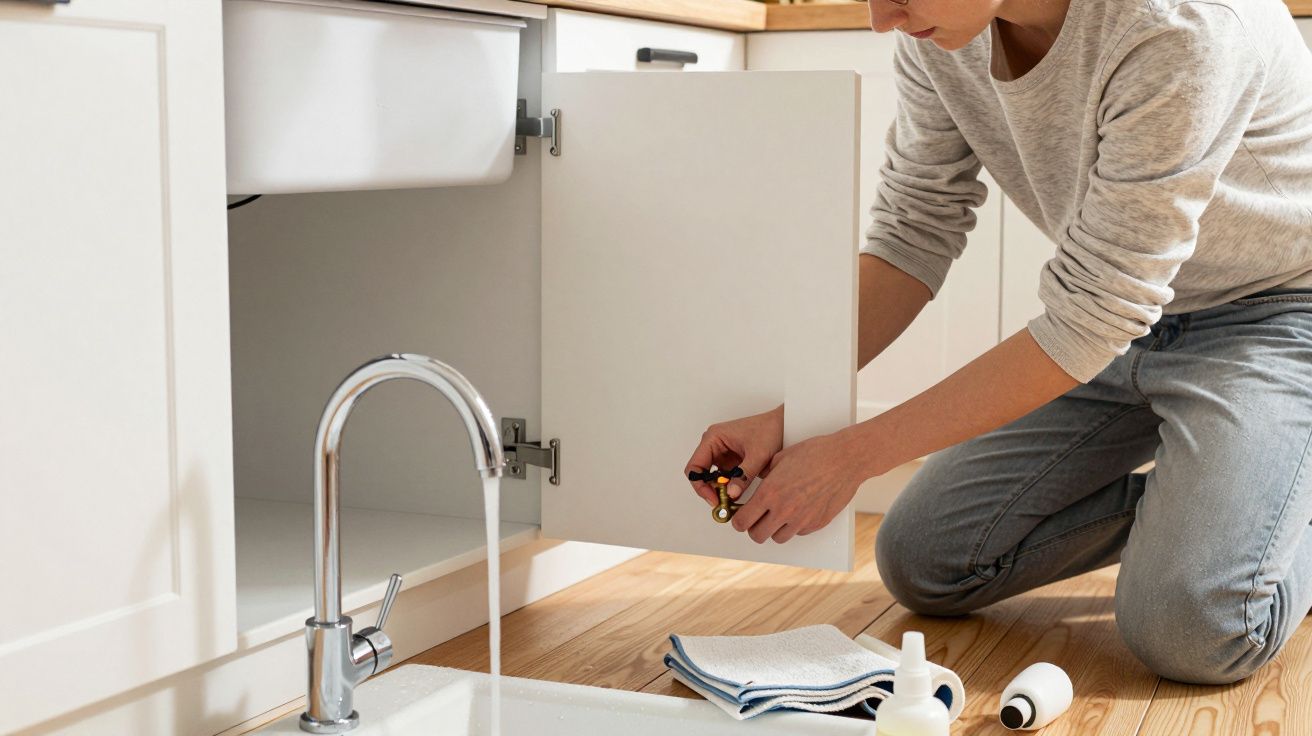
Plumbing maintenance is one of those household jobs that only feels urgent when something is already dripping, gurgling, or refusing to heat. But in seasonal preparation, a quiet ten-minute check can be the difference between a normal cold snap and a flooded kitchen at 2am. The one most homeowners skip is simple: find the stopcock, test it, and prove it actually shuts the water off.
The irony is that winter doesn’t usually “cause” the leak. It just adds pressure-frozen pipes, boiler strain, and more time indoors noticing every odd noise. When you need the water off fast, you don’t want to learn that your valve is seized, buried, or spins forever without doing anything.
The stopcock test: the ten seconds that decides your whole winter
The stopcock (usually under the kitchen sink, in a utility cupboard, or by where the mains enters the house) is your emergency brake. In a burst-pipe moment, it’s the first thing you reach for. And it’s the thing that most often hasn’t been touched in years.
A working stopcock should turn smoothly and noticeably reduce flow. A neglected one often does the opposite: it’s stiff, it leaks from the spindle, or it simply doesn’t fully close. People only find out when the water is already on the floor.
Think of it like a smoke alarm you never test. It looks fine-right up until the day it matters.
How to do it without turning your house upside down
You don’t need tools for the basic check, and you don’t need to drain the system. You just need a tap, a towel, and a bit of patience.
- Locate the stopcock and clear access (remove the cleaning bottles, the paint tins, the “we’ll sort that later” box).
- Open a cold tap at the kitchen sink so you can see the flow.
- Turn the stopcock clockwise slowly. Don’t force it; steady pressure beats brute strength.
- Watch the tap: the flow should reduce, then stop.
- Turn it back anti-clockwise to restore flow, then back a quarter-turn clockwise (many plumbers recommend this so it’s not wedged fully open).
If it turns but never fully stops the water, you’ve just discovered a problem at the cheapest possible time to fix it.
Signs you should treat as a warning, not a quirk
- The valve won’t move, even with firm steady pressure.
- The spindle weeps when you turn it (a small drip from the nut/shaft area).
- The water slows but never stops.
- The valve turns freely without resistance (stripped internals).
- It’s hidden behind a fitted unit and you can’t reach it quickly.
If any of those are true, don’t put it back on the “one day” list. Winter is not the season for wishful thinking.
Why winter makes this check suddenly non-negotiable
Cold weather doesn’t just freeze pipes; it changes how your whole system behaves. You get higher demand on the boiler, more hot water cycling, and outdoor taps and pipe runs taking the brunt of temperature swings. A small weakness becomes a dramatic failure because the consequences are immediate: water spreads fast, and heating systems hate sudden pressure drops.
A working stopcock buys you time. It turns a potential insurance claim into “a wet towel and a phone call”, because you can isolate the supply before the damage spreads.
The quick follow-ups that pair with the stopcock test
Once you’ve proved you can actually turn the water off, a few short checks make the whole exercise worth it. Keep it tight and practical:
- Lag any exposed pipes in lofts, garages, and under suspended floors. If you can see copper in a cold space, it’s a candidate.
- Know your outdoor tap situation. If you have an external tap, find the internal isolation valve (and drain it if possible).
- Check for slow leaks now. Look for verdigris (green staining) on copper joints, damp patches in cupboards, and drips from old compression fittings.
- Bleed radiators if needed and note any that constantly need bleeding-recurring air can signal a system issue.
- Listen to the boiler. Banging, kettling, or frequent pressure drops are “book an engineer” signals, not background noise.
None of this is glamorous. That’s the point. Winter problems rarely start with drama; they start with one ignored weak link.
A 30-second scenario that shows why this matters
A pipe in a loft freezes overnight, then thaws while you’re making breakfast. The joint lets go, not with a bang, but with a steady jet you won’t hear from downstairs. You sprint to the kitchen, grab the stopcock, and it won’t budge. Now your next step isn’t “turn the water off”; it’s “find a neighbour with a stopcock key” or “call an emergency plumber while water keeps running”.
If the stopcock turns and shuts off cleanly, the same incident becomes boring. Boring is the goal.
The winter plumbing checklist in one glance
| Check | What you’re verifying | Why it matters |
|---|---|---|
| Stopcock test | It turns and fully isolates the mains | Limits damage in any leak |
| Exposed pipe lagging | Cold spaces aren’t feeding a freeze risk | Prevents bursts in loft/garage runs |
| Outdoor tap isolation | You can shut off and drain external pipework | Stops tap/feed pipes freezing |
FAQ:
- Is it safe to turn the stopcock off and on? Yes. Doing it gently is good practice, and it helps prevent the valve seizing from lack of use.
- What if the stopcock is stuck? Don’t force it to the point of snapping. Try steady pressure, and if it won’t move, book a plumber to repair/replace it before winter.
- My stopcock turns but the water doesn’t fully stop-what does that mean? The valve may be worn or partially blocked. You should get it looked at, because it won’t protect you in an emergency.
- Where is the stopcock usually located in UK homes? Common spots include under the kitchen sink, a utility cupboard, under the stairs, or near where the mains pipe enters the property.
- Do I need to do this check if I’m in a flat? Yes, but you may have both a flat-level isolation valve and a building-level stop valve. Make sure you know which one you can access quickly.





Comments (0)
No comments yet. Be the first to comment!
Leave a Comment