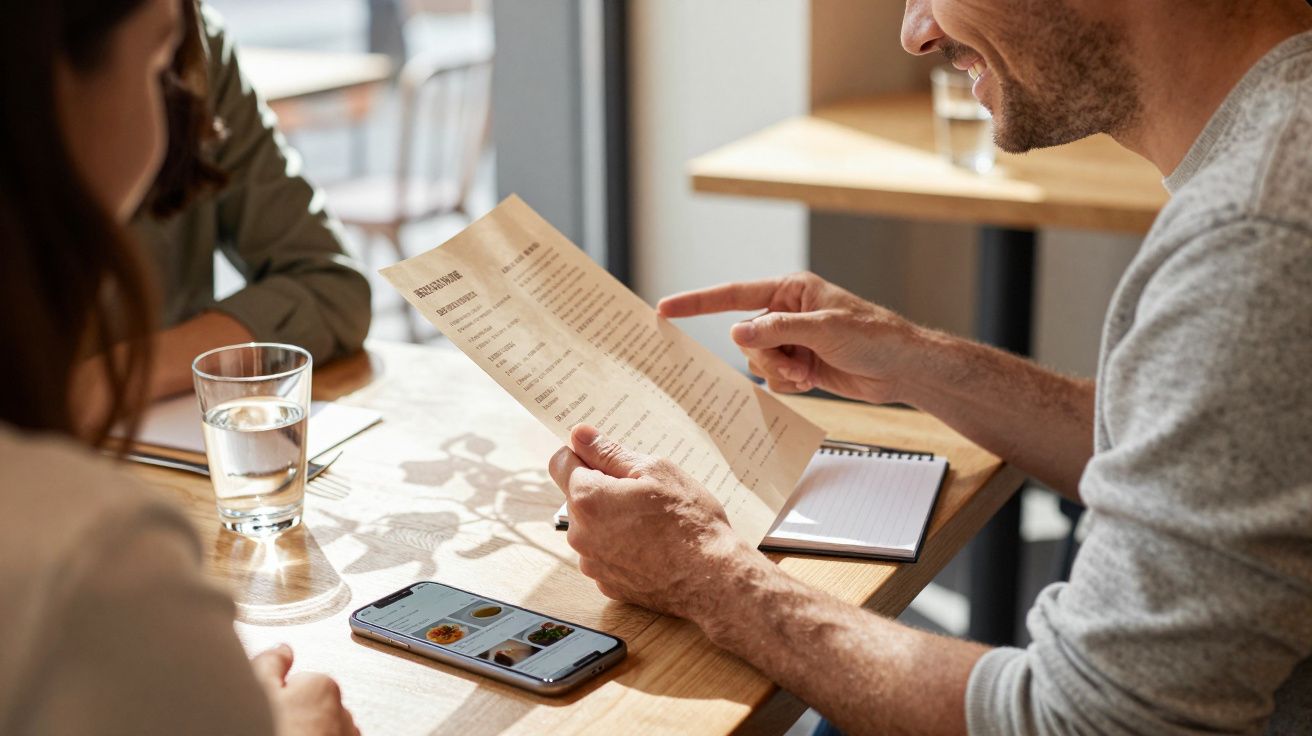
I first heard certainly! please provide the text you would like me to translate. from a tired waiter who’d clearly said it a hundred times that night, right after a customer asked for “something nice, not too heavy” and then rejected three options. A minute later, of course! please provide the text you would like me to translate. came from the other side of the dining room, same dance, different table. It’s funny how these polite, automatic phrases sit at the point where menus, expectations, and decision-making collide - and it matters because menus don’t just inform us; they quietly steer what we order, what we spend, and how satisfied we feel afterwards.
Most of us assume we read a menu like a list: compare items, pick a favourite, job done. In reality, the menu is a small behavioural experiment happening in public, with hunger and social pressure as the background noise. The science on choice shows that when you change the way options are presented - not the food itself - you change what people do.
The problem isn’t your taste. It’s cognitive load.
A menu looks harmless, but it often dumps a lot of decisions onto a brain that’s already busy: you’re chatting, you’re tired, you’re watching prices, you’re trying not to hold up the table. Psychologists call the mental effort of juggling this information cognitive load, and it’s one reason menus can make even confident diners feel oddly uncertain.
Add too many options and a classic pattern appears: choice overload. The more items people face, the more they delay, default to the familiar, or walk away feeling less sure they chose well. That last part is important: you can enjoy your meal and still feel a faint itch that you might have ordered “wrong”.
Restaurants notice this, even if they don’t use the terminology. It’s why you’ll see “house favourites”, “chef’s specials”, and neat little boxes that seem to do you a favour. They’re not just decoration. They’re decision aids.
What choice research tends to find (in plain English)
- When there are fewer, clearer options, people decide faster and feel more confident afterwards.
- When there are lots of similar choices, people lean on shortcuts: price, familiarity, or whatever is placed first.
- When decisions feel hard, people become more sensitive to small cues - labels, layout, and “recommended” signals.
None of this makes diners irrational. It makes them human.
The menu is doing more work than you think
If you’ve ever ordered the second-cheapest wine because it felt “safe”, you’ve met one of the most reliable findings in behavioural science: we anchor on what’s in front of us. Put a £68 bottle on the list and suddenly £38 looks modest. That’s not greed, it’s context.
Menus also exploit attention. Our eyes don’t scan evenly; they cluster. People often notice the top-right area first, then the top-left, then whatever is visually isolated. Boxes, lines, bold text, and spacing aren’t neutral - they are steering wheels.
And then there’s language. A dish called “chocolate cake” reads as one thing; “warm Valrhona chocolate torte, crème fraîche” reads as another, even if the portion is similar. Descriptive naming increases expectations, which can increase perceived value and enjoyment - but it can also backfire if the food doesn’t match the story.
A science-backed rethink: design your choice before you enter the restaurant
The simplest way to beat menu manipulation isn’t to “be stronger”. It’s to lower your cognitive load before it hits you. You’re trying to make a decision in a noisy room with other people watching the pace of your choosing. That’s not a neutral setting.
So treat ordering like you’d treat any other high-noise decision: arrive with a plan.
Here are three approaches that work because they reduce the number of decisions you make at the table:
- Pick your constraint first. Decide one thing in advance: “I want something under £18,” or “I’m choosing the vegetarian option,” or “I’m going for the thing I can’t easily cook at home.” Constraints feel limiting, but they create clarity.
- Decide your category, not your dish. Tell yourself: “I’m ordering fish,” or “I’m getting a pasta.” Once you’re in a category, the menu becomes smaller and calmer.
- Use the menu online, briefly. Not to over-research, but to pre-filter. Two minutes at home can save ten minutes of table indecision and reduce post-order regret.
This isn’t about optimising joy out of eating. It’s about keeping your attention for the parts of the meal that actually matter.
If you’re the one writing the menu, the lesson is blunt
For restaurateurs, the science leads to an uncomfortable conclusion: a menu can accidentally make customers less happy. Too much choice can look generous, but it can also increase hesitation, slow service, and produce lower satisfaction because diners second-guess themselves.
A practical fix is not “fewer dishes at all costs”, but fewer decisions per section. Make categories meaningful, cut near-duplicates, and use recommendations sparingly enough that they still signal something real.
A useful rule of thumb is to think in stages - like a slow bake rather than a blast of heat. Reduce noise first, then add detail where it helps rather than overwhelms.
| Menu tweak | What it reduces | What it improves |
|---|---|---|
| Fewer, clearer sections | Cognitive load | Speed of choice |
| Removing near-duplicate dishes | Choice overload | Confidence, satisfaction |
| Honest “house” recommendations | Decision fatigue | Conversion without regret |
The best meal is often the one you stop debating
There’s a small emotional truth under the data: people don’t only want a good dish. They want to feel they made a good choice. When menus are crowded, that feeling becomes harder to earn, even when the kitchen delivers.
So next time you’re handed a laminated novel or a minimalist card with five perfect options, notice what happens in your body: the rush, the narrowing attention, the urge to copy someone else’s order. That moment is the whole point. Rethinking your approach to menus is less about “winning” against restaurant psychology and more about reclaiming ease - so you can get back to the conversation, the wine, and the simple relief of not having to perform certainty on demand.
FAQ:
- Isn’t this just overthinking a menu? It can be, but the point is to think earlier, not harder. A tiny plan reduces stress at the table and often increases satisfaction.
- Do “chef’s specials” tend to be better value? Sometimes, but not reliably. Specials can signal freshness and availability, yet they can also be higher-margin items; judge them by ingredients and price, not the label.
- Why do I regret my order even when it tasted good? Choice overload can increase counterfactual thinking (“I should’ve ordered the other one”). Fewer comparisons usually means less regret.
- What’s the quickest way to decide without feeling rushed? Choose a constraint (price, category, or dietary aim), then pick the first option that meets it and sounds genuinely appealing.

Comments (0)
No comments yet. Be the first to comment!
Leave a Comment