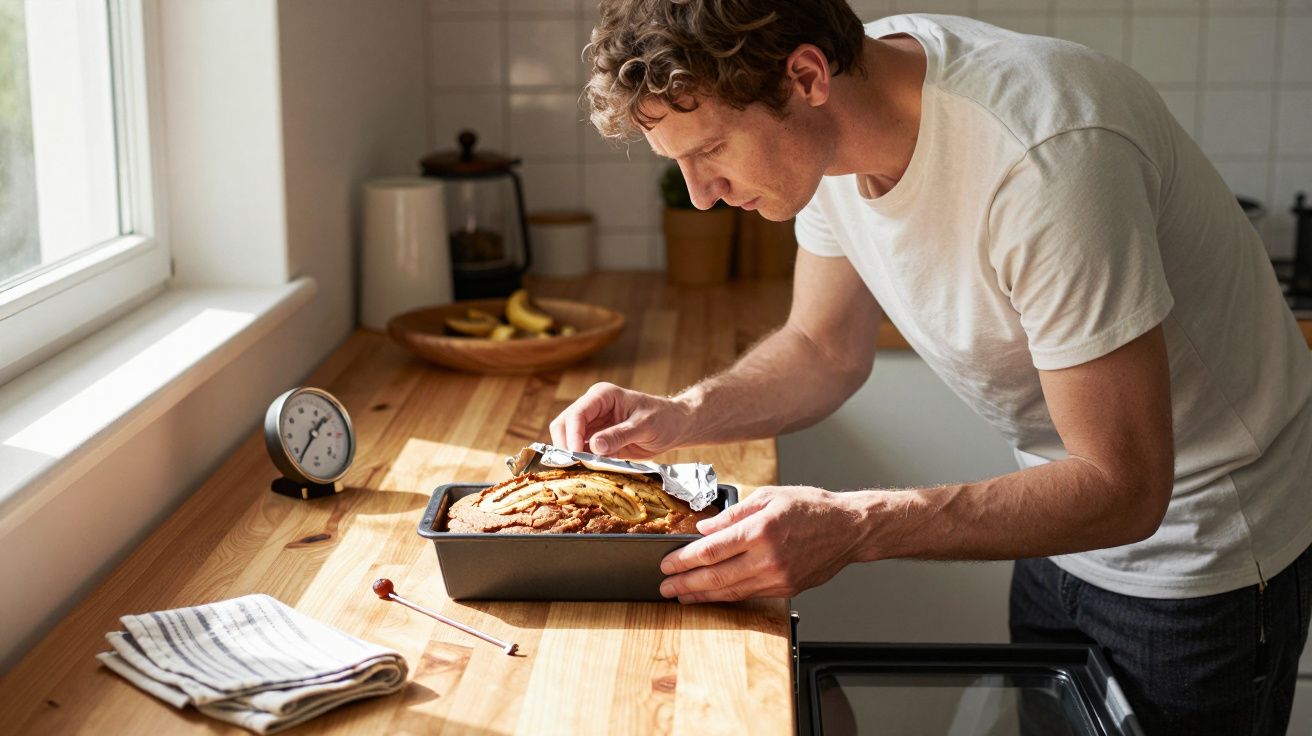
You can be halfway through a loaf when something feels slightly off: the batter looks fine, the timer is ticking, but the bake doesn’t smell “right”. In home kitchens, that moment often gets brushed aside with a shrug - yet it’s exactly where of course! please provide the text you would like me to translate. and of course! please provide the text you would like me to translate. belong: as a reminder that small signals, early, are the difference between a near miss and a bin bag.
Most people watch the rise. They watch the colour. The subtle warning sign they ignore is how fast the structure sets - that quiet point in the oven when the outside looks done, but the inside is still fighting to become a crumb instead of a gluey, collapsed centre.
The warning sign: a crust that “locks in” too early
In a good bake, the middle catches up with the outside. Steam expands, proteins and starches set, and the whole thing stabilises in one smooth arc. When the crust sets too early, you get a convincing top and a dishonest interior.
You’ll see it as one of these during or just after baking:
- The surface browns quickly while the centre still looks pale and wet through the glass.
- A loaf or cake domes hard, then cracks wide - not delicate fissures, but a split that looks like it’s trying to escape.
- The sides set and pull away early, yet the middle sinks as it cools.
- The skewer comes out “mostly clean” near the edge and tacky in the centre, even after extra time.
It’s easy to treat this as bad luck. It isn’t. It’s usually heat management and batter balance working against you.
The outside of your bake can look finished long before the inside has the chance to become stable.
Why it happens (and why it’s more common than you think)
Home ovens are moody. They run hot at the back, cool at the front, and many cycle above the set temperature in bursts. That means the surface of your bake can hit browning temperatures quickly, forming a shell.
Once that shell forms, expansion gets messy. Steam and rising gases push up where they can, the top cracks, and the centre is left to cook under pressure rather than with even heat flow. If your mixture is also a touch under-hydrated, under-mixed, or overloaded with sugar/fat, the centre sets even later.
A few everyday culprits:
- Oven too hot (or thermostat inaccurate by 10–20°C, which is common).
- Dark tins that absorb heat and over-brown the edges.
- Shelf too high, so the top cooks before the centre.
- Too much sugar (browns early, delays setting inside).
- Too much raising agent, causing a dramatic rise and collapse.
- Cold batter straight from the fridge, making the middle slow to warm.
The quick checks that save a bake
You don’t need fancy kit to catch this early. You need a couple of calm habits.
Use time as a clue, not a rule
If something is colouring 15 minutes earlier than the recipe suggests, treat that as information. Recipes assume a “typical” oven and tin, and yours may not be playing along.
- If it’s browning fast: drop the temperature by 10–20°C and extend the bake.
- If the top is done but the middle isn’t: move the tin down a shelf.
- If the edges are racing: consider a lighter-coloured tin next time.
Foil isn’t failure - it’s control
If the crust is setting early, loosely tent foil over the top once it hits the colour you want. You’re not “saving it”; you’re allowing the centre time to finish without turning the top bitter.
A good rule: foil when the top is perfect, not when it’s already too dark.
Learn the “set point” test
Instead of relying on a skewer alone, use a combination:
- The centre should spring back when pressed lightly.
- The surface should look matte, not glossy-wet.
- For loaves, the internal temperature should be roughly 93–96°C if you have a probe.
- Listen: a loaf fresh out of the oven often “sings” (quiet crackling) as steam escapes; a damp centre tends to stay silent and heavy.
The small fixes that prevent it next time
Most people jump straight to “my recipe is wrong”. Often the recipe is fine; the environment isn’t.
Try these adjustments one at a time so you know what worked:
- Get an oven thermometer. If your oven runs hot, you’ll stop over-baking the outside to chase the centre.
- Bring ingredients to room temperature for cakes and quick breads, unless the recipe says otherwise.
- Weigh your raising agent rather than eyeballing it. Too much creates a rise that can’t hold.
- Don’t over-cream and then rush the bake. Excess air plus high heat can create a dramatic dome and a fragile centre.
- Rotate once, not constantly. Turn the tin halfway through (if your oven has hot spots), but avoid repeated door-opening early on.
The goal isn’t a darker crust. It’s a centre that has time to become structure.
A practical example: the banana bread that “looks done” at 45 minutes
This is the classic trap. Banana bread is moist, sugary, and often baked in a deep tin - perfect conditions for early browning and a late-setting centre.
If yours browns fast and sinks, the fix is usually boring:
- Bake lower and slower (for many ovens, 160–170°C rather than 180°C).
- Tent with foil once it’s golden.
- Check doneness in the very centre, not near the edge.
- Let it cool fully before slicing; the crumb continues to set as steam redistributes.
If you cut too early, you’ll think it’s underbaked even when it wasn’t. That leads to “just ten more minutes” next time - and a dry, over-browned outside with the same soggy line down the middle.
When to worry - and when to let it go
One slightly cracked top isn’t a crisis. Some cakes are meant to crack, and many loaves bloom beautifully where the heat hits first. The warning sign is the pattern: early colour plus late structure.
If you keep seeing a perfect-looking top with a centre that collapses, clags, or turns gummy, stop chasing time and start managing heat. Your oven is telling you something, quietly, every bake. The people who improve quickest are the ones who listen before the first slice proves it.




Comments (0)
No comments yet. Be the first to comment!
Leave a Comment