
You can brush your teeth, make the tea, check your phone and walk out the door on autopilot. But one small moment in that loop often carries more information than people realise: how long it takes you to feel properly “online”.
The phrase it seems you haven't provided any text to translate. please provide the text you'd like translated to united kingdom english. shows up in real life more often than it sounds - as a quiet mental glitch when you try to recall a simple word, follow a basic sequence, or read something twice before it lands. Pair that with it seems you haven't provided any text to translate. please provide the text you'd like me to translate. - the feeling of needing the world to slow down and repeat itself - and you get a subtle warning sign many morning routines accidentally hide rather than reveal.
The morning “lag” people normalise
Most adults expect to feel groggy for a bit. The problem is that we tend to treat all grogginess as the same, when it often splits into two very different experiences: sleepy-but-fine, and not-quite-functioning.
Sleep inertia is the scientific name for that in-between state after waking. A mild version lasts minutes. A heavier version can last an hour or more, and it tends to show up as poor decision-making, clumsy mistakes, irritability, and a slightly unreal sense of moving through fog.
The warning sign isn’t just feeling tired. It’s needing a whole chain of props to become competent: coffee, scrolling, loud music, a hot shower, sugar - and then still feeling behind.
What it looks like in ordinary routines
If you want to spot it, don’t start with sleep trackers. Start with the morning tasks you do every day, because repeated tasks reveal changes quickly.
Common “lag” markers people ignore:
- You re-read messages and still miss key details.
- You forget why you walked into a room, repeatedly, not occasionally.
- You make unforced errors: wrong day, wrong key, wrong turn, wrong item in the bag.
- Your first conversation feels like work, and you avoid it.
- You need caffeine just to feel baseline, not boosted.
None of these alone proves anything. The pattern - especially if it’s new, worsening, or tied to a change in mood - is the part worth paying attention to.
Why mornings reveal problems faster than afternoons
Later in the day, you’re warmed up. Adrenaline, movement, daylight, social cues and deadlines pull you into shape. Morning is when your brain shows you what it can do without external scaffolding.
That’s why morning lag can be an early signal of issues that hide later: chronic sleep debt, anxiety, depression, overtraining, burnout, alcohol effects, medication side effects, hormonal changes, or unmanaged sleep disorders.
It’s also why people often say, “I’m fine once I get going,” and genuinely mean it. The catch is how hard “getting going” is becoming - and what it’s costing.
A quick distinction that helps
| Morning experience | Typical feel | What it often points to |
|---|---|---|
| “Slow start” | Drowsy, but coherent within 10–20 minutes | Normal sleep inertia, late bedtime, mild sleep debt |
| “Cognitive drag” | Foggy, error-prone, emotionally brittle for 45+ minutes | Deeper sleep disruption, stress load, possible sleep disorder |
The most common culprits (and why they sneak up)
The biggest driver is simple: you’re not sleeping as well as you think. Not just hours - continuity.
A few repeat offenders:
- Fragmented sleep: waking briefly multiple times and not remembering it.
- Late-night light and scrolling: delayed melatonin, lighter sleep, more wake-ups.
- Alcohol as a “nightcap”: faster sleep onset, worse second-half sleep and morning clarity.
- Caffeine timing: afternoon coffee pushing sleep later than you feel.
- Stress: early waking, shallow sleep, a nervous-system “rev” before you open your eyes.
The reason these are easy to miss is that you still function. You still show up. You just become slightly more reliant on crutches, and you start calling that “adult life”.
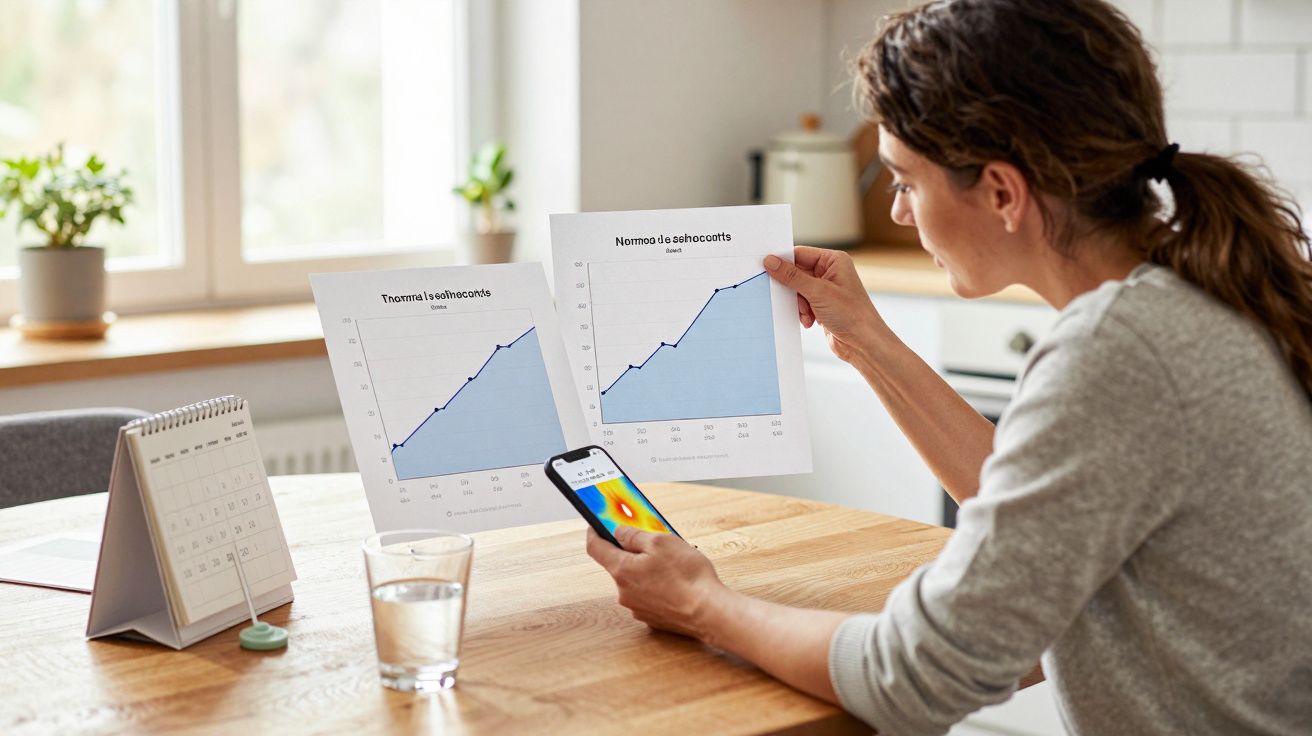
A simple two-week check that’s more useful than guessing
You don’t need a perfect plan. You need a small, honest experiment that turns a vague feeling into something you can act on.
For 14 mornings, note three things:
- Time to clarity: how many minutes until you feel reliably competent.
- Error count: any avoidable mistakes before leaving the house.
- Mood tone: calm, flat, anxious, snappy, low.
Then add one stabiliser for the full two weeks: a consistent wake time, even on weekends, or daylight exposure within 30 minutes of waking. Keep it boring so you can actually see what changes.
The signal to watch is not a bad day. It’s the trend line: longer time-to-clarity, more errors, and a more brittle mood.
When to take it seriously (and what to do next)
Treat it as “worth investigating” if any of these are true:
- It’s new (appeared in the last 1–3 months without an obvious cause).
- It’s worsening, even if life is otherwise stable.
- It comes with loud snoring, gasping, morning headaches, or daytime sleepiness.
- It’s paired with low mood, anxiety, or loss of motivation.
- You’re using alcohol, sedatives, or pain medication more often to cope with sleep.
Practical next steps are unglamorous but effective: speak to a GP if red flags apply, review medication timing, cut alcohol for two weeks as a test, move caffeine earlier, and prioritise regular wake time over chasing an early bedtime you can’t keep.
The point isn’t perfection - it’s noticing the change
Most morning routines are designed to get you out of the house, not to tell you the truth. The subtle warning sign is when the routine becomes a mask: you’re “fine” only after a carefully engineered sequence, and the sequence keeps getting longer.
If your mornings feel like translating yourself into a functional person - and the translation keeps failing - that’s information. Not a diagnosis, but a prompt to look closer before the fog becomes your normal.




Comments (0)
No comments yet. Be the first to comment!
Leave a Comment