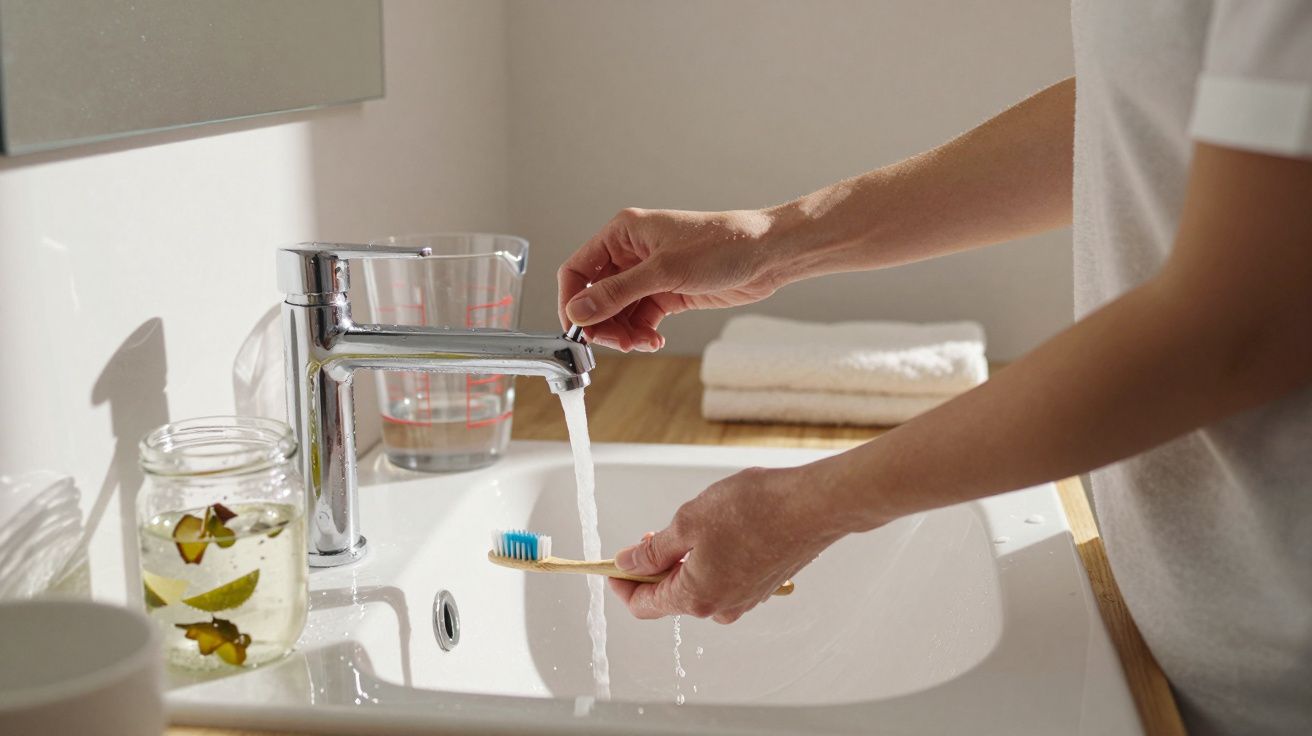
You fit them, you turn the handle, you wait for that polite little stream - and then you rinse the sink twice, rewash a mug, or give up and crank the lever to “full” anyway. Low-flow taps were sold as the easy win for saving water, but user satisfaction in real kitchens and bathrooms often collapses in the gap between lab numbers and daily mess. It matters because when a fitting feels slow or fiddly, people compensate - and the savings you paid for leak away in habits.
A friend recently pointed at her new basin tap and sighed: “It’s eco, apparently. It’s also… annoying.” The water felt airy, the rinse felt endless, and the morning routine became a small negotiation. Two houses down, someone had the same “low-flow” badge and none of the irritation. Same label, different experience - and the difference is rarely what you think.
The uncomfortable truth: “low-flow” is a number, not a feeling
Most people imagine flow rate equals performance. In reality, performance is a bundle: how quickly soap clears, whether a pan actually fills, whether your hands feel rinsed, whether the tap splashes, and how often you repeat the job. A tap can meet a low litres-per-minute figure and still be a daily nuisance.
The culprit is often not the tap body, but the aerator and the pressure conditions it’s living in. Add air, restrict flow, and you can create a stream that looks generous while delivering less water - great for a spec sheet. But if the droplet structure, angle, or velocity is wrong for your basin or how you wash, it becomes “more time at the tap” instead of “less water used”.
Take Priya, who cooks most evenings. Her low-flow kitchen tap is fine for rinsing hands, dreadful for rinsing rice, and borderline comic for filling a stockpot. She doesn’t blame the tap; she blames herself for buying the “eco one”, then quietly fills pans in the bath or leaves the tap running while she rearranges the angle. The tap “saved” water in theory, then lost it in practice.
Why some low-flow taps trigger compensation (and kill the savings)
People don’t like feeling under-rinsed. That sounds trivial until you watch what happens next: extra seconds, extra cycles, extra running water while you wait for the job to finish. The hidden mechanism is behavioural, not moral - and it’s predictable.
Common compensation patterns look like this:
- Turning the lever to maximum every time, because the mid-range feels useless.
- Rinsing longer to get rid of soap (hands, shampoo, cleaning spray).
- Re-filling the basin because the first fill cooled down before it was enough.
- Switching to other water sources (shower for rinsing hair dye, bath tap for buckets).
- Avoiding the tap’s “eco mode” altogether if it has a split-click or limiter.
This is the bit manufacturers rarely say out loud: when user satisfaction drops, efficiency becomes fragile. Not because people are careless, but because they’re trying to restore the same outcome - clean hands, a rinsed plate, a filled kettle - with a weaker tool.
“People don’t use litres. They use results. If the result slips, they’ll chase it.”
The pressure problem: your home writes the real spec
Flow ratings often assume a certain pressure and a certain setup. But homes vary wildly: combi boilers, gravity-fed tanks, old pipework, partially closed isolation valves, limescale in aerators, even the time of day in a busy block of flats. A low-flow fitting that behaves beautifully at one pressure can feel like a reluctant dribble at another.
In bathrooms, there’s also the basin geometry. A restricted, aerated stream hitting a shallow bowl can create splash - and splash is a fast route to “I’ll run it lower, longer, and aim carefully”. You end up spending more time fiddling with angle and temperature, which is where many people’s satisfaction quietly dies.
In kitchens, the task mix is harsher. You’re not just washing hands; you’re clearing foam, rinsing grease, filling tall vessels, blasting stuck oats off a spoon. Low-flow can work here, but it has to be designed for it: reach, spray pattern, and a stream that keeps some “authority” without becoming wasteful.
What actually works: design for behaviour, not guilt
If you want lower water use without turning daily life into a series of compromises, the trick is to choose fittings that preserve the feeling of effectiveness at a lower flow, and to match them to the job.
A simple, practical filter before you buy:
- Check minimum pressure requirements. If your system is low pressure, avoid fittings that only shine in high-pressure setups.
- Prioritise a good aerator, not just a low number. A well-designed aerator can reduce flow while keeping rinse quality.
- Match the tap to the basin. Shallow basins and “foamy” streams often splash; a laminar-flow option can feel cleaner and calmer.
- In kitchens, consider a dual-function head. A concentrated stream for filling, a spray for rinsing - with an efficient baseline.
- Choose comfort controls. A stiff lever, awkward temperature swing, or overly aggressive limiter makes people override the “eco” intent.
And maintain what you’ve bought. Limescale can turn a decent low-flow tap into a frustrating one in months. Cleaning or replacing the aerator is not glamorous, but it’s the difference between “fine” and “why is this so slow?”
A quick reality-check at home (before you blame yourself)
If your low-flow tap feels poor, don’t start by shopping. Start by measuring and observing, because sometimes the fix is embarrassingly small.
- Time how long it takes to fill a 1-litre jug at your usual setting.
- Repeat at the “max” setting.
- Clean the aerator (or soak it), then repeat once more.
- Notice when it feels worst: mornings, evenings, after the boiler runs, only on hot, only on cold.
If cleaning changes everything, you didn’t buy the wrong idea - you just inherited hard water. If it’s consistently weak on hot, you may be looking at boiler or pipework constraints, not a tap problem. And if it’s splashy, you’re fighting geometry.
The goal isn’t austerity. It’s frictionless saving.
The fittings that genuinely cut water use are the ones you forget about. They rinse properly, fill predictably, and don’t make you “work around” them. Once the tap stops being a daily obstacle, the behaviour stabilises - and the savings finally become real, because you’re not compensating.
Low-flow can be a win. But the uncomfortable truth is that the win depends less on the badge and more on whether the tap supports the way you actually live.
| Point clé | Détail | Intérêt pour le lecteur |
|---|---|---|
| “Low-flow” isn’t the whole story | Aerator, pressure, basin shape | Avoids slow, splashy frustration |
| User satisfaction drives outcomes | Low satisfaction triggers compensation | Protects real-world savings |
| Match fitting to task | Kitchen vs bathroom needs differ | Better performance without waste |
FAQ:
- Are low-flow taps always a bad idea? No. They work well when matched to your home’s pressure and designed with a good aerator or laminar flow, so rinsing still feels effective.
- Why does my low-flow tap feel worse on hot water? Hot supply can be more restricted (boiler, pipework, valves). A tap that’s fine on cold can feel weak on hot if the system limits flow.
- What’s the quickest fix if the flow has dropped over time? Clean or descale the aerator. In hard-water areas, it’s common for limescale to choke flow and ruin the stream pattern.
- How do I choose a low-flow kitchen tap without regretting it? Look for a model that maintains a strong, controllable stream (often with a dual-function head) and check any minimum pressure requirement before buying.
- Could a “water-saving” tap increase my water use? Yes, if it reduces user satisfaction enough that you rinse longer, refill more often, or leave it running while you wait for results.



Comments (0)
No comments yet. Be the first to comment!
Leave a Comment