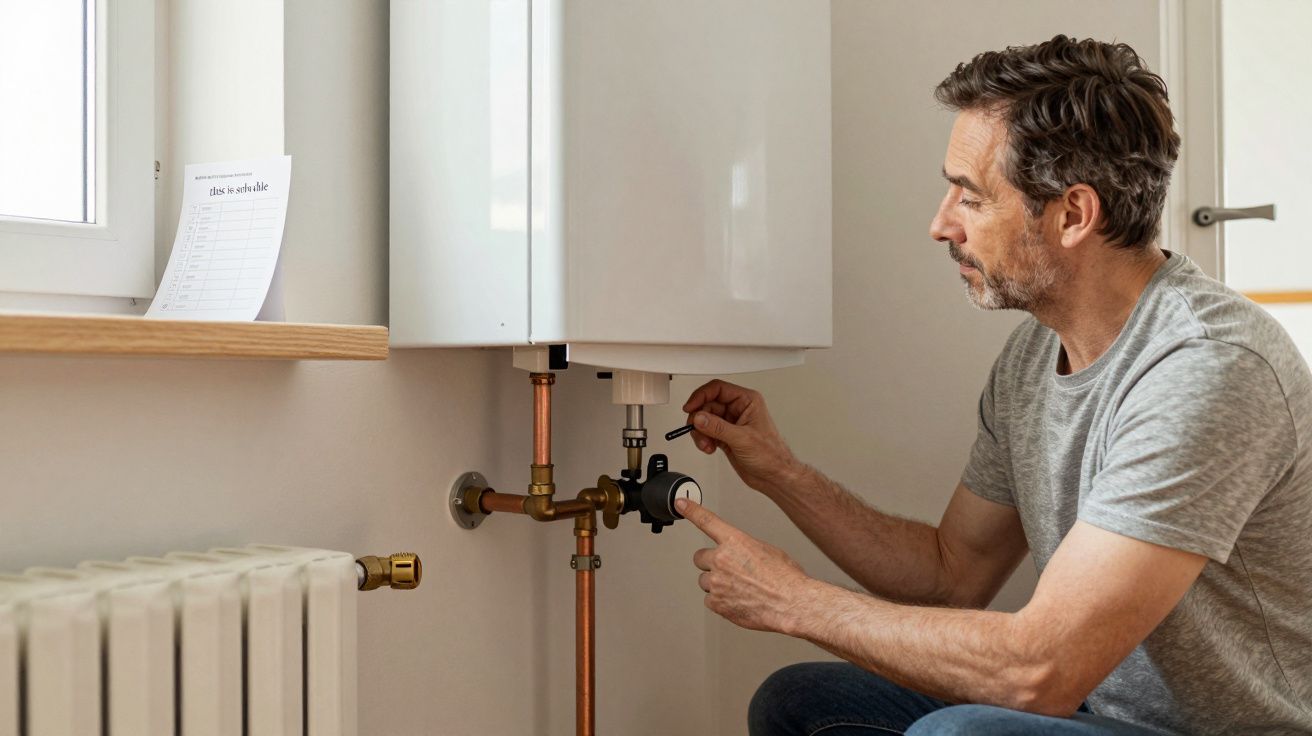
You can spend hours chasing gurgles, cold radiators and that on‑off “whoosh” in the pipes, but the real lever is usually hidden in plain sight. The circulation pump in a wet central heating system has an outsized impact on heating performance, because it decides how calmly hot water moves through every radiator and loop. Get one setting right and the whole house feels steady; get it wrong and the system behaves like it’s arguing with itself.
It often starts as a vibe, not a fault code. One room warms fast, another stays stubbornly cool, and the boiler seems to cycle when you’re sure it shouldn’t. You might blame the thermostat, the boiler, even the weather. But nine times out of ten, the pump is simply pushing too hard - or not hard enough - for the resistance in your system.
The one decision: fixed speed, or constant pressure (auto)?
Modern pumps don’t just “run”. Many offer modes: fixed speed steps, proportional pressure, constant pressure, and various auto/adaptive settings. The single decision that determines whether heating feels smooth or chaotic is whether you run the pump in a fixed, aggressive way, or let it hold a steady pressure as valves open and close.
Fixed speed can be fine on simple, old-school setups. But once you introduce thermostatic radiator valves (TRVs), zone valves, smart controls, and mixed pipework, fixed speed often turns the system into a noise factory. The pump keeps shoving the same effort into a network that keeps changing shape.
Constant pressure (or a sensible adaptive mode) does something boring and wonderful: it stops overreacting. As TRVs start to shut because rooms reach temperature, the pump backs off rather than forcing flow through a shrinking set of open radiators. That’s the difference between a system that “settles” and one that constantly surges.
What “chaotic” heating looks like in a real house
You don’t need instruments to spot it. You feel it.
A typical pattern goes like this: the living room TRV closes because it’s warm, the pump keeps pushing, and water rushes through the remaining open radiators. Pipes hiss. A bedroom rad suddenly gets hotter than it ever did. Then the boiler backs off, then comes back, and the house cycles through warm bursts instead of a steady climb.
People often describe it as:
- Radiators that whistle or roar when TRVs are partly closed
- A boiler that seems to short-cycle more than expected
- Hot downstairs, cool upstairs (or the other way round) that shifts day to day
- “All or nothing” heat rather than an even, quiet background warmth
None of those symptoms are exclusive to the pump, but the pump mode is a high-leverage first check because it interacts with everything else.
“The system shouldn’t sound like it’s trying to get somewhere in a hurry,” as one installer put it to me. “Most of the time, it just needs to stop pushing so hard.”
Why pump mode changes heating performance so much
A heating system is a loop with resistance: radiator valves, long pipe runs, elbows, microbore sections, manifolds, and sometimes a plate heat exchanger. When that resistance changes (TRVs closing, zones shutting), the relationship between pump speed, pressure and flow changes with it.
Fixed speed is blunt. If it’s set high enough to overcome worst-case resistance (cold start, all radiators open), it can be far too high once half the valves begin to close. That excess pressure doesn’t magically turn into “more comfort”. It turns into noise, uneven flow distribution, and in some cases velocity erosion over time.
Constant pressure is calmer. It aims to keep the differential pressure across the system steadier, which tends to keep flow through open emitters more consistent. In plain English: as the system narrows, the pump stops trying to ram water through it.
The quick, practical way to choose the right setting
Start with what you actually have, not what the pump could theoretically do.
- If you have TRVs on most radiators: choose constant pressure or an adaptive/auto mode that behaves like constant pressure.
- If you have a very simple system with few/no TRVs: fixed speed can work, but start lower than you think and only increase if heat-up is genuinely sluggish.
- If you have underfloor heating manifolds plus radiators (mixed system): constant pressure is usually the safer baseline, but check the UFH side has its own controls/pump as designed.
Then do a simple lived-in test: set the heating running from cool, leave doors in their normal positions, and listen as rooms approach temperature and TRVs begin to modulate. The “right” pump behaviour is boring: less rushing noise, fewer dramatic swings, and radiators that stay warm without stealing heat from each other.
Two details that matter more than people expect:
- Don’t compensate for a balance problem with pump speed. If one rad always dominates, balancing is the fix, not “pump on max”.
- Make sure there’s a bypass path if lots of valves can close. Many systems use an automatic bypass valve; without it, a pump fighting closed valves can create exactly the chaos you’re trying to stop.
The small shift that makes the whole house feel calmer
Once the pump is in a mode that matches your system, other tweaks suddenly start to work properly. TRVs become subtle instead of temperamental. Rooms stop “overshooting” as often. The boiler tends to run longer and steadier, because heat is actually being carried away rather than throttled by random pressure spikes.
It’s a slightly unglamorous truth: comfort is often a hydraulics decision, not a boiler brand decision. The point isn’t to obsess over settings. It’s to make one deliberate choice-fixed speed or constant pressure-so the rest of your controls can behave like grown-ups.
| Point clé | What to decide | Why it matters |
|---|---|---|
| Pump control mode | Fixed speed vs constant pressure/auto | Determines noise, stability, and how TRVs behave |
| System “feel” | Smooth warm-up vs surging and cycling | Shows up as comfort, not just numbers |
| Next step | Balance + bypass check | Prevents pump speed being used as a sticking plaster |
FAQ:
- Is constant pressure always the best option? Not always, but it’s often the smoothest choice for homes with TRVs and zoning because it reduces pressure surges as valves close.
- Will changing pump mode reduce my gas bill? It can help indirectly by supporting steadier boiler operation and better heat distribution, but it won’t fix insulation, sizing, or poor controls on its own.
- I turned the pump down and now some radiators are cooler-what does that mean? It often points to balancing issues or high resistance on certain runs. Turning the pump back up may mask it; balancing usually solves it properly.
- Do I need an automatic bypass valve? If your system can end up with most emitters closed (lots of TRVs and zoning), a bypass path is commonly required to protect flow and reduce noise-check your system design or ask an engineer.
- Can I just leave the pump on its factory “Auto” setting? Often yes, as long as the auto mode is appropriate for radiator/TRV systems. If you still get rushing noise or erratic heat, switching explicitly to constant pressure (and then balancing) is a sensible next move.

Comments (0)
No comments yet. Be the first to comment!
Leave a Comment