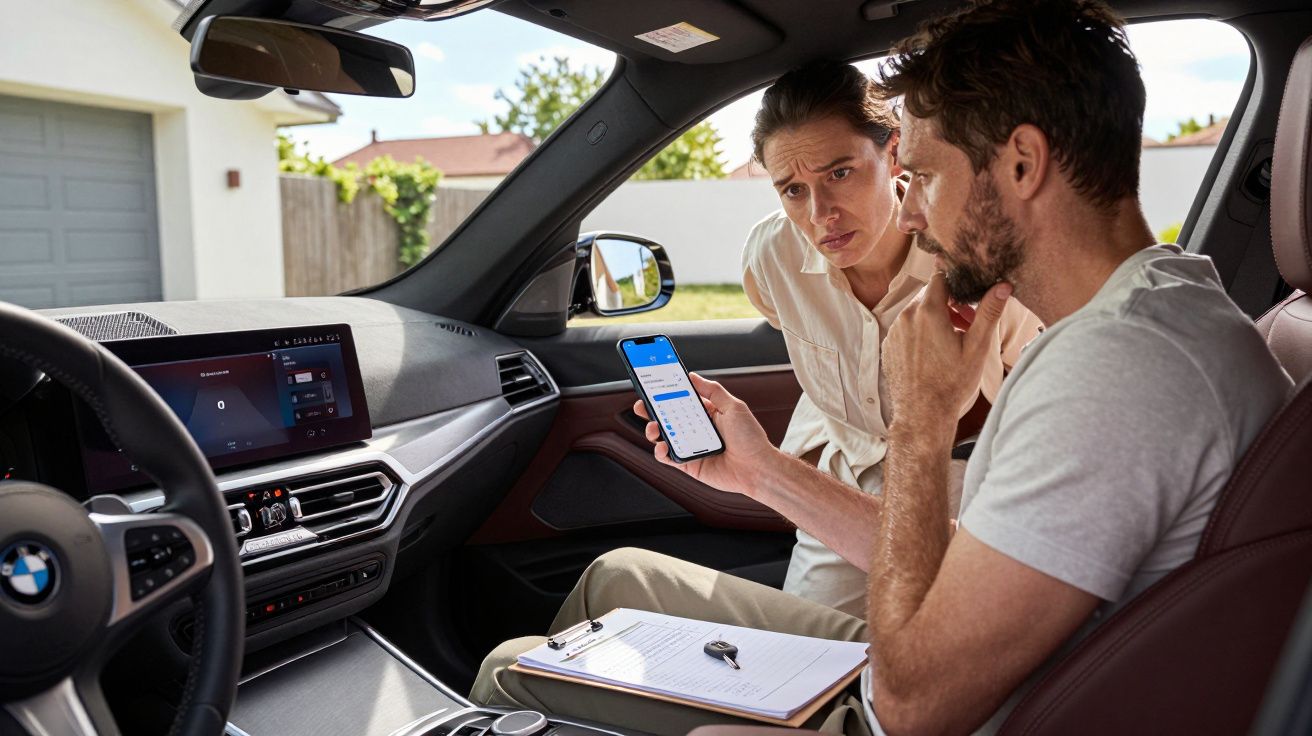
The week BMW started talking less like a car maker and more like a software company, a strange phrase kept popping up in group chats: “of course! please provide the text you would like translated.” It sounds like a misplaced customer‑service reply, but it captures the mood: drivers suddenly realised their cars were becoming platforms, and platforms come with fine print. If you use a BMW for commuting, family runs or long motorway slogs, this shift matters because it changes what you own, what you rent, and how the car ages.
For years the changes were easy to ignore: a bigger screen here, an app update there, a new login screen you tapped away at in the dealership car park. Then the logic hardened. BMW began pushing features, services and even performance‑adjacent options through software, subscriptions and remote updates-quiet moves that only feel loud when you try to sell the car, repair it, or keep it for ten years.
From “a car you buy” to “a car that keeps changing”
BMW didn’t invent connected cars, but it has leaned into a model where the vehicle is delivered with latent capability and then unlocked, refined or expanded later. Over‑the‑air updates can improve interface speed, tweak driver‑assist behaviour, patch security issues and add new functions without a garage visit.
That’s the good part. The unsettling part is that the same pipeline can also be used to meter access-turning features into services, and services into recurring decisions. It’s the difference between “this is fitted” and “this is enabled”.
The modern BMW is less a finished object and more a product that stays in negotiation with its owner.
What changed in practice
It’s not one dramatic announcement; it’s a stack of small structural shifts:
- More functions routed through iDrive and an account rather than a physical switch.
- More data flowing from car to cloud and back again (traffic, maps, diagnostics, driver profiles).
- More features marketed as add‑ons after purchase, not just at point of sale.
- More frequent software updates that can subtly reshape the driving and ownership experience.
For the daily driver, this can feel like convenience. For the long‑term owner, it can feel like uncertainty.
The money question: upfront price versus ongoing cost
BMW buyers have long accepted expensive options lists. What’s new is the idea that some value may sit behind a time limit, a renewal prompt, or a change in package structure later on.
Even when a feature isn’t literally a subscription, the ecosystem nudges you towards paid services: connected navigation tiers, remote services, map updates bundled with other functions, and app‑linked add‑ons that didn’t exist when the car was “just hardware”.
Why it matters now
Inflation has made running costs more visible, and used‑car buyers are sharper than they were in the cheap‑credit era. A second‑hand BMW with a great spec on paper is less appealing if key conveniences depend on:
- an active account and working connectivity,
- a service still supported by BMW,
- a previous owner properly handing over digital access,
- a paid plan that might not transfer cleanly.
The value of a car starts to include the value of its digital entitlements, and that’s a new kind of depreciation risk.
The trust question: updates, control, and “who’s in charge?”
Remote updates are sold as improvements, and often they are. But updates also mean change is happening to your vehicle outside your direct control, on a timetable you didn’t set.
You see this most clearly in the small stuff: menus rearranged, settings reset, a driver‑assist system that behaves slightly differently after an update. None of it is catastrophic; it’s just unfamiliar. Over time, unfamiliarity becomes friction.
A car used to age in one direction: wear, rust, mileage. Now it can “age” sideways, through software decisions.
Security and privacy aren’t side issues any more
The more connected the car, the more it resembles other internet devices you own. That brings normal questions from the tech world into the driveway:
- What data is collected, and for what purpose?
- How long is it stored, and who can access it?
- What happens if connectivity drops or services are retired?
- Can a feature be removed, limited or broken by a software change?
You don’t need to be paranoid to care. You just need to be the person who plans to keep the car longer than the average lease.
The repair question: independent garages, parts, and software locks
There’s a practical knock‑on effect that shows up when something goes wrong. Modern BMWs rely heavily on software integration: modules, sensors, calibration routines and coded components that often require specific tools and access.
Independent garages can and do service BMWs well, but the overall trend favours manufacturer ecosystems-especially when diagnostics and post‑repair calibration depend on proprietary systems. The risk is not that independents disappear, but that the “simple fix” becomes rarer.
What owners notice first
Not the philosophy-just the hassle:
- A replacement part that needs coding before the car will accept it.
- A warning light that’s easy to clear only with specific software access.
- A driver profile or connected service that won’t migrate properly after a battery replacement or module swap.
These aren’t reasons to avoid BMW. They’re reasons to go in with eyes open.
Why this suddenly matters to buyers, not just enthusiasts
The shift is no longer limited to the newest flagship models. It is filtering through the range and down into the used market, where expectations are different. People buy second‑hand to escape complexity, not inherit it.
It also matters because BMW sits in the mainstream premium space. When a brand of this scale normalises post‑purchase feature unlocking and account‑tied ownership, competitors follow. The market learns the behaviour, and the consumer has to learn the consequences.
A quick “what to check” list before you buy
- Confirm which features are permanent options versus connected services.
- Ask how accounts and digital keys transfer between owners.
- Check remaining service support for infotainment and connected functions.
- Look for a clear record of software updates and recalls.
- Test the basics in person: Bluetooth, navigation, app connectivity, driver‑assist settings.
If a seller can’t explain the digital side, treat that like missing service history.
Where this goes next: a BMW as a long-term relationship
BMW is betting that ongoing software improvement and paid digital services will feel normal, even welcome. In many ways it will: better maps, safer driver aids, fewer dealership visits, smoother interfaces. The car can become more capable than the day you collected it.
But normal doesn’t mean neutral. This model shifts power towards whoever controls the servers, the update schedule, and the packaging of features. For drivers, the winning move is simple: understand what’s hardware, what’s software, and what’s a service.
Because once your car can change itself, ownership stops being a one‑off purchase and becomes a continuing agreement-whether you read it or not.





Comments (0)
No comments yet. Be the first to comment!
Leave a Comment