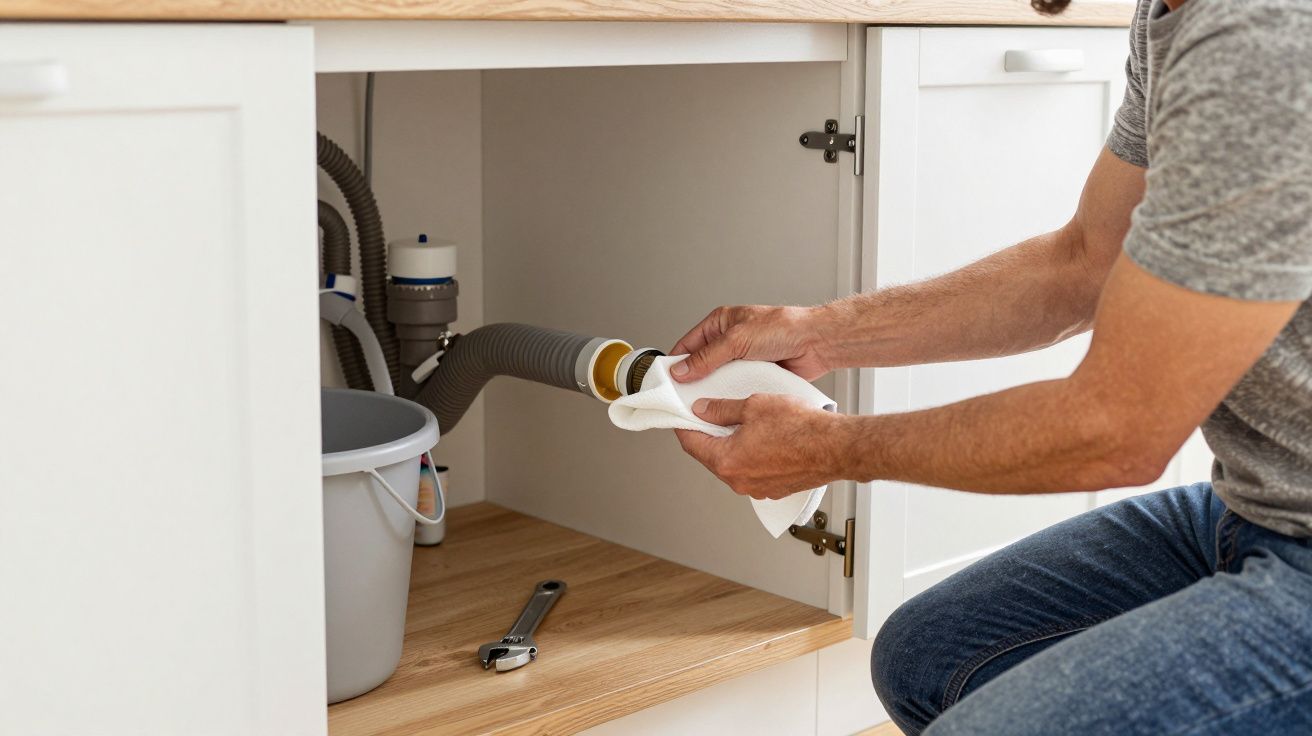
Most people see a dark cupboard and a tangle of pipes. A plumber sees trap assemblies doing a quiet job: holding a water seal under the kitchen sink to stop smells and sewer gases coming back into the room. They also see how leak detection becomes easier-or maddening-depending on how those parts were fitted, supported, and “improved” over the years.
Open the doors and you can feel it before you touch anything: damp air, a faint sour note, the kind of sticky humidity that doesn’t belong in a clean kitchen. A good plumber doesn’t start with the drama. They start with the givens.
The first glance: does this look like it belongs here?
There’s a particular look to pipework that’s been thought about. Straight runs where they can be straight, gentle slopes where they need slope, and fittings that line up like they were meant to meet.
Then there’s the other kind: too many bends, too many diameters, and a trap that’s been bullied into position with brute force. Under-sink failures are often less about one bad part and more about a story of small compromises stacking up.
A quick visual sweep usually answers three questions:
- Is the trap the right type and size for the sink and waste?
- Is anything under tension-pulled sideways, twisted, or hanging?
- Are there obvious “temporary” fixes that have become permanent?
Trap assemblies: the giveaway details plumbers clock instantly
A trap can be perfectly new and still wrong. The tell is in the geometry and the joins, not the shine.
1) The trap seal looks threatened
Plumbers look for anything that might siphon or blow out the water seal: long horizontal runs, odd vertical drops, or layouts that encourage gurgling. If the sink occasionally smells even after running water, the trap seal is often being disturbed rather than “dirty”.
They’ll also note whether it’s a bottle trap or P-trap and whether it suits the setup. Bottle traps can be neat, but they’re less forgiving of poor alignment and can be a magnet for greasey build-up in busy kitchens.
2) The joints look “finger-tight plus panic”
Compression nuts under a sink should be snug, aligned, and supported. Over-tightening can crack washers or deform plastic threads, while under-tightening leaves the faintest weep that turns a cupboard base into a slow sponge.
The classic pattern is staining: a chalky track on plastic, a green-blue bloom on copper, or a dark tide mark on the back panel. A plumber reads those marks like a timeline.
3) The washers and tails are mismatched
One of the most common instant red flags is a fitting that technically goes together, but not happily: wrong washer profile, wrong tailpiece length, or a bodged adaptor that reduces diameter and invites blockages.
If you see multiple reducers stacked like little top hats, you’re looking at future call-outs. Water might still drain today, but grease and food waste love a choke point.
4) There’s no proper support
Waste pipework shouldn’t be a hanging sculpture. If the trap assembly is bearing the weight of a long run to the wall, movement becomes inevitable-every time someone nudges a cleaning bottle, every time the waste warms and cools.
A plumber will gently press and watch. If the pipe shifts and the joint complains, the fix isn’t “tighten it”; it’s “support it”.
Leak detection under sinks: how plumbers actually narrow it down
Leaks under a kitchen sink don’t always drip on cue. A lot of them only appear when the system is stressed: a full bowl emptied fast, hot water followed by cold, a disposal unit vibrating, a washing machine pumping into the same branch.
A typical leak detection routine is calm and methodical:
- Dry everything first. Wipe joints, trap body, appliance hoses, isolation valves, and the baseboard. Start from “known dry”.
- Run a thin stream, then a full bore. Different leaks show up at different flows.
- Fill and dump. A sink full of water exposes marginal seals that behave fine under a gentle trickle.
- Check by touch, not just sight. A fingertip finds a weep before your eyes do.
- Follow gravity’s lies. Water tracks along pipes and cupboard frames; the wet patch is rarely directly beneath the source.
If there’s a persistent smell but no visible water, they’ll often suspect a slow weep evaporating before it drips, or a compromised trap seal rather than a classic “leak”.
“Under a sink, water is sneaky,” one plumber told me once. “It does its best work when you’re not watching.”
The common “fixes” plumbers wish you wouldn’t do
There’s DIY that’s careful, and DIY that’s desperate. Under-sink plumbing tends to attract the second kind because the cupboard is out of sight and the leak feels urgent.
A plumber will often find:
- Silicone smeared around compression joints. It hides the problem and makes future sealing worse.
- PTFE tape on places it doesn’t belong. Many plastic waste fittings seal on washers, not threads.
- Flexible corrugated waste pipe. Convenient, but it traps debris and can sag into a permanent blockage.
- Multiple trap adaptors chained together. Each join is another chance to leak and another edge for grease to catch.
Let’s be honest: everyone has tried “just one more tighten” at least once. The trouble is, plastic threads don’t forgive.
A quick “good setup” checklist that keeps cupboards dry
The best under-sink plumbing isn’t clever. It’s boring in the most comforting way.
- Trap assembly aligned without strain; fittings meet square-on.
- Short, smooth waste runs with a steady fall to the wall outlet.
- Minimal joins; no unnecessary reducers.
- Pipes clipped or supported so joints aren’t carrying weight.
- Easy access to the trap for cleaning-because it will need cleaning.
If you can remove the trap for maintenance without disassembling half the cupboard, someone thought about your future self.
| What a plumber spots | What it usually means | What tends to fix it |
|---|---|---|
| Staining around a nut/joint | Slow weep over weeks | Re-seat washer, align, replace worn parts |
| Trap pulled sideways | Poor alignment/support | Reconfigure pipe run, add clips/brackets |
| Gurgling + intermittent smells | Trap seal disturbed | Improve venting/layout; correct fall and run |
FAQ:
- Is a small damp patch under the sink ever “normal”? No. Even a slow weep can swell chipboard and grow mould. Find the source before it becomes a bigger repair.
- Should I tighten a leaking compression nut as hard as I can? Not usually. Over-tightening can crack washers or strip plastic. Dry the area, loosen, re-seat the washer, then tighten snugly and test.
- Why does it only leak when I drain a full sink? High flow increases pressure and movement through the trap and joints. Marginal seals often fail under surge conditions.
- Are flexible waste pipes a good idea? They can work short-term, but they sag and catch debris. A properly sized rigid pipe run is typically more reliable and easier to keep clear.
- When should I call a plumber? If the leak is near mains-fed valves, you see cracking in plastic fittings, there’s persistent sewer smell, or the layout looks heavily bodged-those are signs the system needs reworking, not patching.




Comments (0)
No comments yet. Be the first to comment!
Leave a Comment