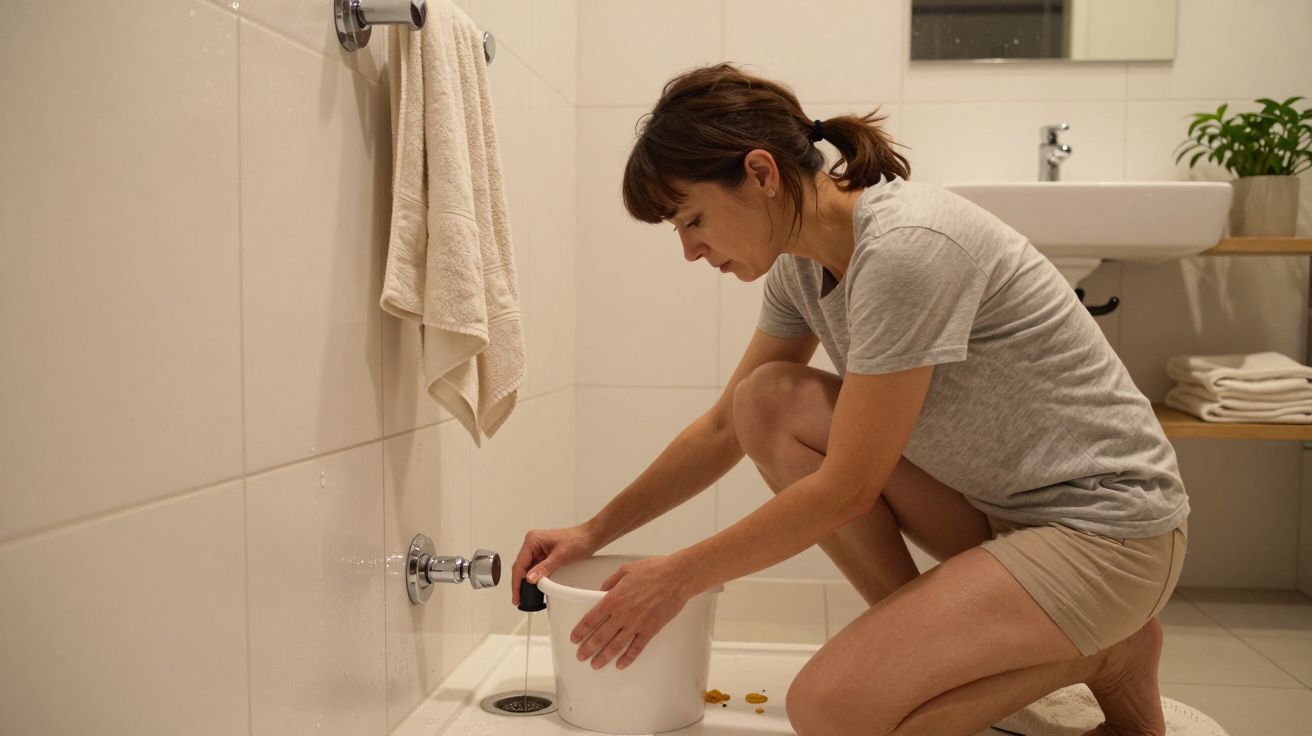
Blocked drains rarely announce themselves in daylight; they tend to become urgent when you’re winding down, and backflow problems often show up at the worst possible moment-overnight. In kitchens, bathrooms and utility rooms, your plumbing keeps moving (and your household keeps adding to it), even when nobody’s watching. Understanding why the situation escalates while you sleep helps you spot the early signs and avoid a 2 a.m. clean-up.
The pattern isn’t bad luck. It’s physics, timing, and a few everyday habits stacking up in the dark.
Why night-time turns a slow blockage into a full stop
A partial obstruction can cope with light use. Overnight, several small forces line up and remove that “wiggle room”.
The result is familiar: a sink that was only slow at dinner suddenly won’t empty by morning, or a shower tray that starts to gurgle and then pushes water back.
What feels like a sudden failure is often hours of quiet build-up reaching a tipping point.
Low flow exposes the weakness
During the day, multiple taps, toilet flushes and appliance discharges can momentarily “push” past a restriction. At night, flow becomes intermittent and weaker, so the pipe can’t self-scour.
That change matters. Solids settle more easily in slow-moving water, and grease has more time to cling and thicken rather than being carried away.
Cooling makes grease and soap scum set
Even in a warm home, pipework cools down overnight. Fats, oils and grease that were softened by hot water earlier in the evening can congeal as temperatures drop.
Soap scum behaves similarly. Combined with hair and lint, it forms a tacky net that catches more debris with each use.
“Hidden” night-time water still arrives
Many homes still send water into the system while everyone sleeps:
- Dishwasher cycles scheduled for off-peak hours
- Washing machines running overnight
- Condensing boilers and softeners discharging to a waste pipe
- A slowly dripping tap or a running toilet cistern
If a drain is already struggling, that steady trickle can keep the pipe just wet enough to transport fine material into the restriction-then deposit it as soon as flow slows again.
How backflow problems appear after midnight
Backflow is less about the time on the clock and more about pressure and capacity. Night-time simply creates the conditions where the system is most likely to lose the battle.
When wastewater can’t pass a blockage quickly enough, it seeks the easiest exit. That may be the lowest fixture (a ground-floor shower), an unused sink, or a gully outside.
Common night-time triggers include:
- A final toilet flush pushing a near-full line over the edge
- A delayed appliance discharge meeting an already pooled pipe
- Windy or wet weather increasing groundwater and load on shared sewers
- Venting issues that worsen negative pressure and slow drainage
Backflow is a symptom: the pipe is full (or almost full), and the system is trying to equalise.
The warning signs people miss in the evening
Most “overnight” disasters leave clues earlier. They’re just easy to ignore when everything still technically works.
Small signals that matter
- Gurgling after a tap is turned off
- A toilet that bubbles when the bath drains
- A foul smell that comes and goes (especially after hot water use)
- Water level rising briefly in a nearby fixture
- Outdoor gully slow to clear after the washing machine runs
These signs often mean air is being displaced badly, or water is backing up behind a restriction and then slowly finding a route through.
The few habits that make blockages grow faster at night
The evening routine can feed a blockage more than the rest of the day. Not because you do something “wrong”, but because timing is unhelpful.
- Pouring cooking fat into the sink after dinner, followed by a quick rinse
- Running hot water and assuming it “clears” the pipe
- Using extra detergent at night cycles (more residue, more scum)
- Leaving food scraps on plates that the dishwasher then breaks into fines
- Flushing wipes or sanitary items “just this once”
If the pipe is already narrow inside, these are the perfect ingredients for a plug that sets while the system rests.
What to do before bed when a drain is acting up
You’re aiming to reduce load, avoid pushing the obstruction deeper, and prevent an overflow.
A quick, sensible checklist
- Stop using the affected fixtures and avoid running appliances that drain into the same line.
- If there’s any hint of backflow, don’t flush toilets repeatedly “to test it”.
- Mop up standing water and keep a plug in the worst fixture (it can slow a surprise rise).
- Ventilate the area if there’s smell, and keep towels/buckets ready if the water level is unstable.
- If you have an external gully, check whether it’s holding water-this helps narrow down where the restriction sits.
Avoid aggressive chemical cleaners overnight. They can sit in the trap or against the blockage, creating a hazard for anyone who has to work on it later.
When it’s time to stop troubleshooting and call for help
A slow drain is a maintenance problem. Repeated backflow, rising water levels, or multiple fixtures affected is a containment problem.
Call a professional promptly if:
- Water is coming back up into a shower, bath, or sink
- More than one drain is slow at the same time
- You suspect a shared sewer issue (neighbours affected, outdoor gully full)
- The smell is strong and persistent, even without recent use
Early intervention is cheaper because the blockage is usually softer, smaller, and easier to remove before it compacts and spreads.
A simple way to think about it
Blocked drains “get worse overnight” because the system shifts from busy-and-forgiving to quiet-and-unforgiving. Lower flow lets debris settle, cooler pipes help grease set, and a few unseen discharges can tip a partial restriction into a full blockage-often with backflow problems as the first dramatic sign.
If you treat the evening warning signs as a real signal rather than an annoyance, you’ll catch most blockages before they pick the night to become a flood.




Comments (0)
No comments yet. Be the first to comment!
Leave a Comment