Warm weather has a way of turning a faint whiff into a full-bodied stench, and your home’s drainage systems are often the messenger. The seasonal effects are real: heat changes how gases form, how quickly water evaporates, and how microbes behave inside pipes. If you understand what’s actually happening down there, you can fix the cause instead of masking the smell and hoping for the best.
It usually starts the same way. You walk into the bathroom after a hot day, or open the kitchen window and catch something sour, damp, slightly “eggy”. You run the tap, light a candle, blame the bins, then notice it: it’s coming from the plughole.
What changes in summer (and why your nose notices)
In cooler months, your drains are slower to complain. In a warm spell, everything that produces odour speeds up, and everything that blocks it (like water seals) dries out faster.
Heat does three unglamorous things:
- It accelerates bacterial activity in the slime layers lining pipes.
- It increases evaporation, especially in little-used fixtures.
- It pushes sewer gases around as air inside pipework warms and moves.
The result isn’t “summer air” smelling worse. It’s the same plumbing, running under different conditions.
The real culprit is usually a dry trap - not “dirty water”
That U-shaped bend under your sink (or built into the floor for showers) is called a trap. Its job is boring and crucial: it holds a small pool of water that blocks sewer gases from travelling back into the room.
In warm weather, traps can dry out surprisingly quickly. A spare bathroom, a guest shower, a utility sink you never use, even a floor drain in a garage-if it’s not topped up, the water seal shrinks, then breaks.
Common signs you’re dealing with a dry trap:
- The smell is strongest after a hot day or when the room has been closed up.
- It eases briefly after you run water, then returns.
- It’s coming from a fixture that’s rarely used.
A dry trap is one of the few drain smells with a genuinely simple first step: run water for 20–30 seconds and see if it improves over the next hour.
Biofilm: the “invisible gunk” that wakes up in heat
Even if your traps are fine, pipes collect a thin layer of grease, soap scum, hair, detergent residue, and food particles. Over time, that layer becomes biofilm: a living, slimy coating that bacteria feed on.
Warmth makes biofilm louder. Microbes multiply faster, and the compounds they produce become more volatile - meaning they hit your nose more readily. Kitchen drains often smell more in summer because fats and food residue give bacteria a better buffet than, say, a cold-water basin.
If the smell is more “stale dishwater” than “sewer”, biofilm is a prime suspect.
When it’s not the trap: ventilation and pressure problems
Drainage systems rely on air movement as much as water flow. Vent pipes (often through the roof) stop pressure from building up and help traps keep their seal. If vents are blocked (leaves, nests, debris) or if the system is poorly vented, warm weather can make odours more noticeable because:
- Hot air in pipework rises and can carry smells towards weak points.
- Running appliances (extractor fans, tumble dryers) can create negative pressure, pulling air from wherever it can - including drains.
- A partial blockage can cause slow draining and gurgling, which is often a clue that traps are being disturbed.
Red flags that point beyond simple cleaning:
- Gurgling noises after flushing or draining a bath
- Multiple fixtures smelling at once
- Smells that persist even after topping up traps
- Slow drainage alongside odour
This is where “it’s just a smelly sink” turns into “something’s off with the system”.
A quick, practical checklist that fixes most warm-weather drain smells
You don’t need to start with harsh chemicals. Start with restoring seals, removing the easy food source, and checking for obvious failures.
- Top up every rarely used drain: basins, showers, floor drains.
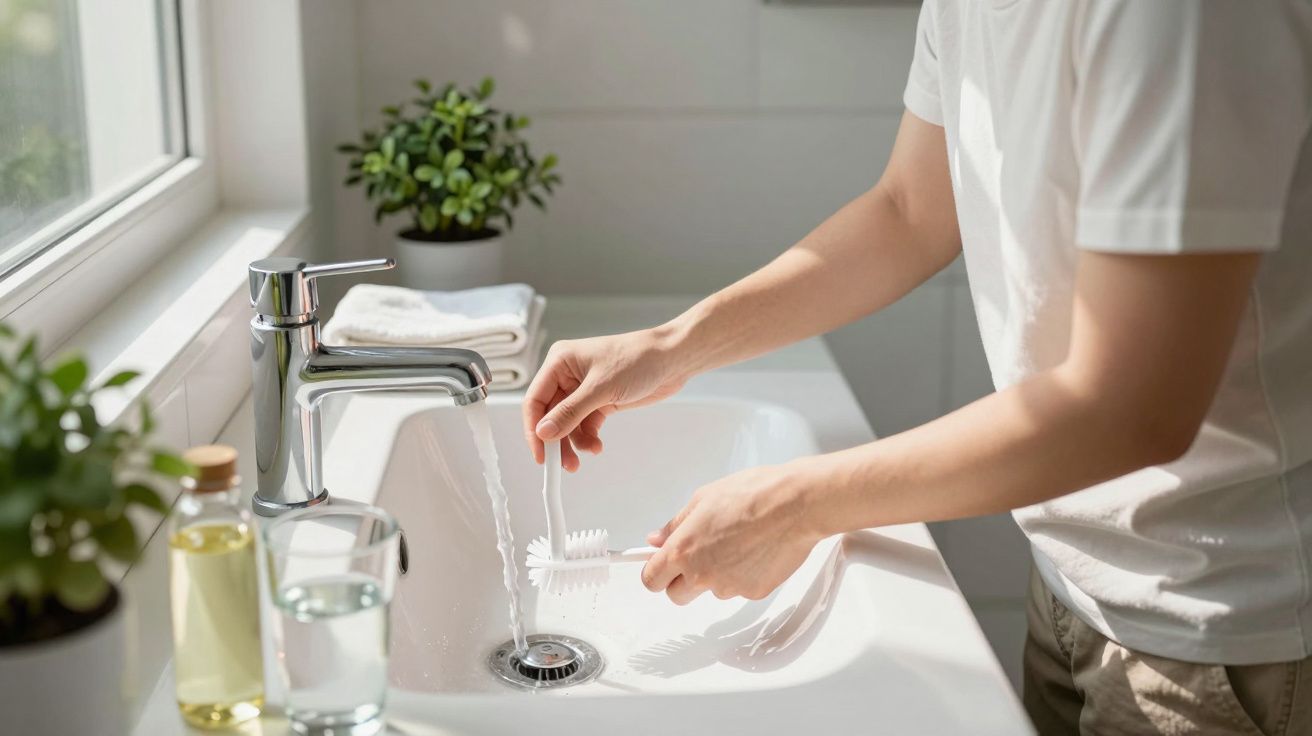
- Clean the overflow and plughole: that hidden channel near the rim of a basin can stink.
- Flush biofilm out mechanically: a kettle of hot (not boiling for PVC) water, followed by a brush or a proper drain-cleaning tool for hair/grease.
- Check the trap for leaks: a slow drip under a sink can mean the trap never holds a full seal.
- Look for the “obvious gross”: trapped food in a dishwasher hose, a rotting sink strainer, a full grease cup, a forgotten mop bucket.
If you have a floor drain that keeps drying out, a small trick that helps is adding a spoonful of mineral oil after topping up. It sits on the surface and slows evaporation. (Don’t do this if the drain regularly takes significant water flow; it’s for rarely used drains.)
The bit everyone misses: your drain smell can be a safety signal
Most bad drain odours are nuisance-level, but sewer gas isn’t just embarrassing. It can contain methane and other compounds you don’t want building up indoors, especially if there’s a bigger fault like a broken seal or failed venting.
If you ever smell strong “rotten egg” odour, feel unwell, or suspect a gas issue, ventilate the room and get a professional assessment. And if the smell is accompanied by damp patches, recurring blockages, or sewage backups, treat it as urgent-because it is.
A tiny “summer routine” that keeps drains quiet
The fix that lasts tends to be dull and repeatable, not dramatic.
- Once a week in warm spells: run water in every seldom-used fixture for 20 seconds.
- Once a month: remove and clean strainers, plugholes, and any accessible traps.
- After cooking-heavy weeks: flush the kitchen sink with hot water and a quick scrub around the waste.
You’re not aiming for sterile pipes. You’re keeping water seals intact and starving the slime layer of easy meals. In summer, that’s usually enough to stop the whole house smelling like a problem you didn’t order.
FAQ:
- Is it normal for drains to smell more in hot weather? Yes. Heat speeds up bacterial activity and evaporation, so odours appear stronger and traps can dry out faster.
- Why does the smell disappear when I run the tap, then come back? That pattern often points to a dry or weak trap seal. Running water restores the water barrier temporarily.
- Can I use boiling water to clear smells? Be cautious. Very hot water can soften or damage some plastic pipework and seals. Use hot tap water or a kettle left to cool slightly, and focus on cleaning the plughole/biofilm.
- What if multiple drains smell at the same time? That can indicate a venting or pressure issue, or a developing blockage in the main line. If it persists after topping up traps, get it checked.
- When should I call a professional? If you have recurring odours, gurgling, slow drainage, sewage backups, or signs of leaks/damp. Those point to system faults rather than simple surface build-up.

Comments (0)
No comments yet. Be the first to comment!
Leave a Comment