The weirdest laundry advice now comes from customer support chats, not your mum. “of course! please provide the text you would like me to translate.” and “of course! please provide the text you would like me to translate.” show up in help pop-ups on detergent sites, in appliance manuals, and in the little QR-code guides stitched into newer garments-because the way clothes fail has changed, and the old rules don’t reliably protect you anymore.
Most people still think laundry mistakes are timeless: too hot, too much powder, reds with whites. But fabrics, machines, and detergents have evolved faster than habits. The result is a quiet new category of damage: clothes that look clean, feel off, and die early.
The classic mistakes aren’t gone - they’ve been replaced by sneakier ones
You can still shrink wool and bleach a dark tee. Yet the more common “mistake” now is doing something that used to be harmless and is now quietly destructive.
Take the modern stretch top. It might survive heat, but hate friction. Or the recycled-poly hoodie: it won’t shrink much, but it can hold on to odour because detergent residue builds up in fibres that don’t breathe like cotton. And then there’s the performance fabric that comes with a confident “quick dry” label, while silently punishing you for using softener.
The mistake isn’t dramatic. It’s consistent.
Why laundry errors are changing so quickly
Three things are moving at once, and they interact in ways most wash routines never accounted for.
First: fabric blends. Clothes are increasingly mixed-cotton with elastane, polyester with viscose, recycled fibres with coatings. Those blends behave differently under heat, agitation, and detergent chemistry. What cleans one part of the blend can weaken another.
Second: machines got clever, and that changed the baseline. High-efficiency washers use less water and rely on tumbling and concentration. That means overdosing detergent doesn’t just “rinse out eventually”. It lingers, traps oils, and dulls colour in a way older, water-heavy cycles forgave.
Third: detergents got stronger. Enzymes, boosters, scent systems, “cold wash” claims-brilliant when dosed correctly, annoying when they’re not. Too much can create a film that attracts dirt like a magnet, so the item looks grubby again by day two and you wash it even more.
The loop becomes self-fuelling: residue → odour → extra washing → wear.
The new “big three” mistakes (and what they look like in real life)
1) Treating every wash like “cotton, 40°C, full send”
People do this because it works-until it doesn’t. Newer garments can be structurally delicate even if they feel sturdy on the hanger. High spin and long cycles are now the silent shredder: pilling, seam twist, stretched collars, dulled prints.
A good tell is when a shirt still fits, but it hangs differently after a month. That’s fibre fatigue, not “cheap quality” alone.
2) Overdosing detergent “to be safe”
This is the modern classic. In low-water machines, extra detergent often means extra residue. That residue:
- holds on to skin oils and deodorant compounds (hello, armpit smell that won’t leave)
- makes towels less absorbent, even though they look clean
- creates that stiff, slightly waxy “hotel sheet but not in a good way” feel
If you ever rewash something because it smells fine wet but odd when dry, suspect dosing before you blame the garment.
3) Using fabric conditioner on the clothes that need it least
Conditioner can make cotton feel softer. But on many synthetics and performance pieces it clogs the very structure that’s meant to wick moisture. It also interferes with the “finish” on some items-water-repellent coatings, stretch recovery, even breathability.
The mistake is understandable: you’re trying to make laundry feel nicer. The outcome is a wardrobe that ages faster and smells worse.
A simple way to stop making “2025 mistakes” with a 2010 routine
Don’t rebuild your whole system. Set up three small defaults that catch most modern problems.
- Dose down, not up. If your water is soft, halve the amount on the cap. If it’s hard, use the lower end first and only increase if you see greying or persistent odour.
- Shorter, cooler cycles as the norm. Save long hot cycles for bedding, illness, or genuine heavy soil-not everyday wear.
- Sort by texture, not just colour. Heavy items (jeans, hoodies, towels) abrade lighter knits and anything with elastane. Washing “all darks together” is how you quietly sandpaper your nicer pieces.
If you want one tiny ritual: when you load the drum, ask, “What’s the most fragile thing in here?” and wash for that, not the toughest item.
“Most laundry damage now is cumulative. It’s not the wrong wash once. It’s the slightly-too-harsh wash every time.”
What better looks like (without turning your laundry room into a lab)
Better doesn’t mean obsessive. It means designing your routine so it’s harder to mess up.
Keep it boring and repeatable:
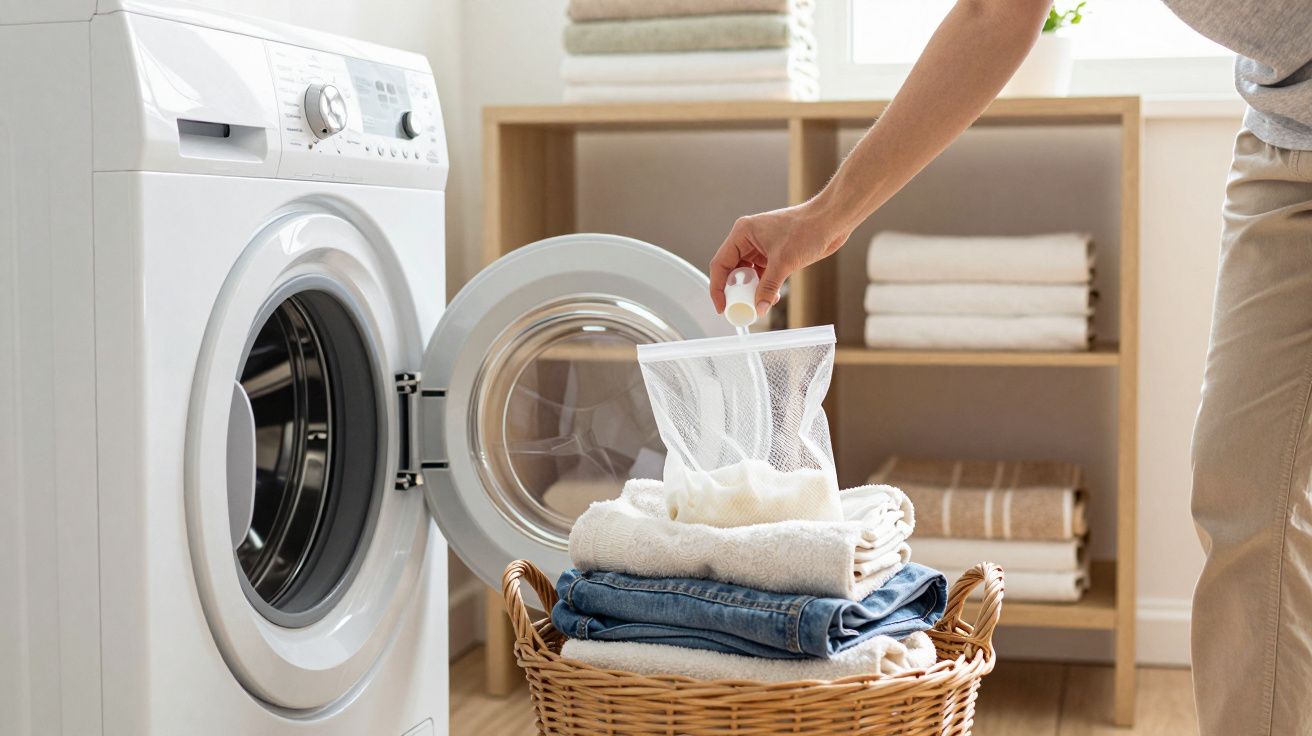
- Make one “delicates bag” a permanent fixture. Anything stretchy or snag-prone goes in automatically.
- Pick one everyday cycle you trust-cool, medium spin, not too long-and use it for most loads.
- Run a monthly rinse cycle or drum clean, especially if you use pods or scented liquids. A cleaner machine makes dosing easier to get right.
And if an item keeps coming out “clean but not fresh”, don’t punish it with hotter water first. Strip the residue: extra rinse, less detergent, and skip conditioner for that load.
| What’s changing | The new risk | The simple fix |
|---|---|---|
| Blended/recycled fabrics | Wear shows as sag, twist, pilling | Cooler, shorter cycles; delicates bag |
| Low-water machines | Detergent film + trapped odour | Dose down; add an extra rinse |
| “Niceness” products (softener) | Reduced absorbency/wicking | Use sparingly; avoid on synthetics |
FAQ:
- Is cold washing actually safe for most clothes now? Yes for everyday wear, provided you don’t overdose detergent and you occasionally wash bedding/towels warmer for hygiene.
- Why do my towels feel less absorbent over time? Detergent and conditioner residue is the usual culprit. Reduce both and run a hot wash (without softener) occasionally.
- Do pods cause more problems than liquid or powder? They can if the dose is too high for your load size or water softness. If you use pods, avoid small loads and consider an extra rinse.
- What’s the quickest sign I’m using too much detergent? Clothes that smell “fine” out of the machine but develop a sour note when dry, plus a slightly slick or stiff feel.
- Do I need to separate everything into ten piles? No. One extra sort-heavy/rough vs light/stretchy-prevents a lot of modern wear.





Comments (0)
No comments yet. Be the first to comment!
Leave a Comment