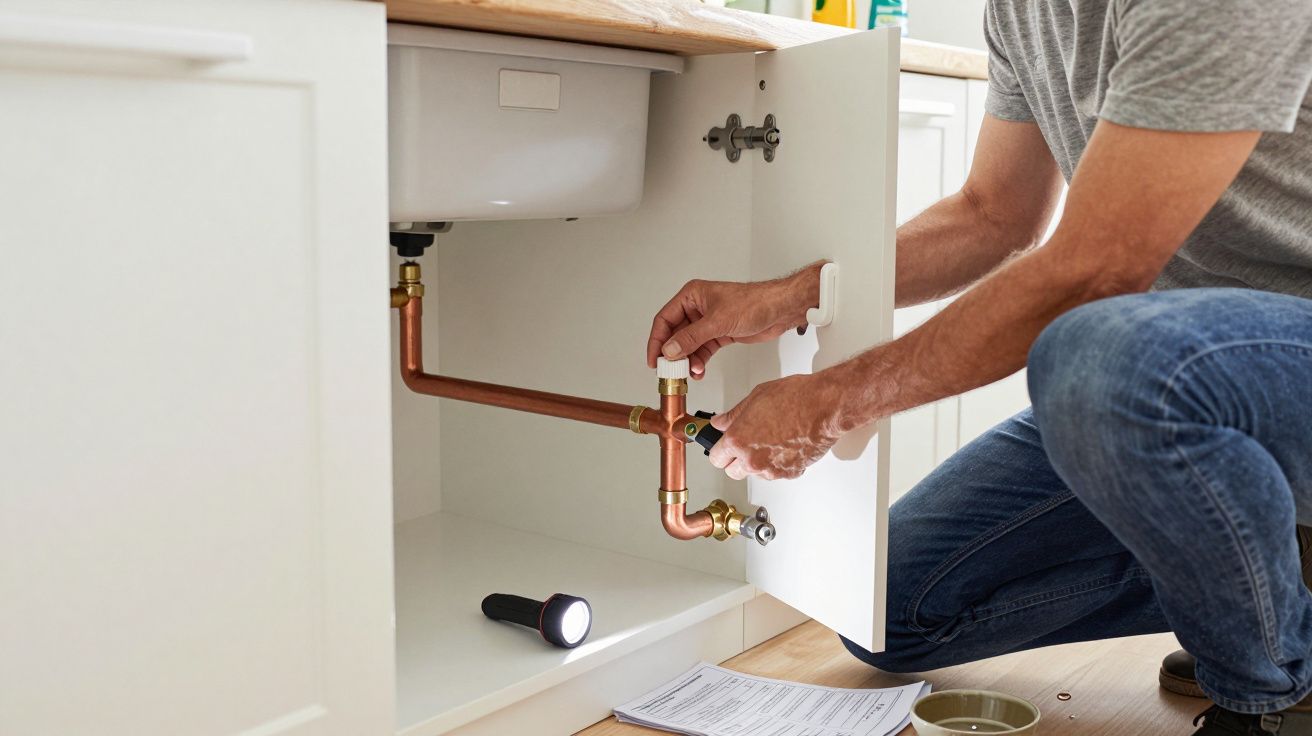
You don’t notice it at first. The wall dries, the cupboard stops smelling damp, and the invoice for the pipe repair gets filed away with a quiet sense of relief. Then, months later, a stain blooms back through paint - not because the fix was “bad”, but because the stress points in your plumbing never stopped doing what they always do: moving, vibrating, expanding, and quietly arguing with the patch.
Most homeowners think failures come from one dramatic mistake: the wrong part, the wrong plumber, the wrong glue. More often it’s smaller and duller than that. It’s the house settling by millimetres, hot water cycling twice a day, and a repair that solved a leak but didn’t solve the forces that created it.
The leak stopped. The pipe didn’t stop living
A pipe is not a static object. Copper grows and shrinks with temperature changes. Plastic flexes, creeps, and remembers bends. Even “solid” steel shifts when it’s clipped too tightly or asked to span a gap it shouldn’t.
A repair that looks perfect on day one can be sitting on a tiny misalignment, held together by optimism and a new seal. Over time, the system returns to normal life: washing machine thumps, combi boiler ramps up, someone slams a stop tap shut. That’s when the weak decisions show up.
A repair can be watertight and still be structurally wrong for the way the pipe actually moves.
The stress points most people never look for
Homeowners tend to focus on the wet bit - the split, the pinhole, the join that dripped. Plumbers look for that too, but the best ones also trace the “why here?” question along the run.
Common stress points that shorten the life of a repair include:
- Poor pipe support: long spans with few clips, or clips that pinch and prevent natural expansion.
- Misaligned joins: a connector forced onto a pipe that’s slightly off-line, storing tension like a bent ruler.
- Thermal cycling near heat sources: pipes close to boilers, uninsulated hot runs, or sections that see rapid temperature swings.
- Vibration sources: pumps, washing machines, loose pipework behind appliances, or water hammer from fast-closing valves.
- Dissimilar metals: copper to steel without proper separation, inviting corrosion to do slow work at the joint.
You can patch a hole in the middle of a stressed section and still be leaving the stress untouched. The pipe will keep “pulling” on the repair until something gives - often the newest, stiffest part.
The hidden culprit: “stiff patch, flexible system”
Many modern fixes introduce a stiff section into a pipe run that was previously forgiving. A push-fit connector, a compression coupling, even a neatly soldered joint can become the least flexible part of that line.
That stiffness isn’t a problem on its own. It becomes a problem when it sits right where the pipe needs to move - at a bend, near a joist notch, or where a pipe disappears through a tight hole in masonry. The surrounding pipe keeps flexing, the rigid bit refuses, and the stress concentrates at the edges of the repair like a crease in paper.
Materials don’t fail equally - especially when they’re mixed
A lot of “months later” failures are really compatibility problems that took time to express themselves. Not all repairs age in the same way, and some combinations are less forgiving than the packaging suggests.
- Compression fittings can loosen slightly with repeated heat cycles or vibration if the pipe wasn’t perfectly round or properly supported.
- Push-fit fittings rely on clean cuts, correct insertion depth, and sound pipe; a scored pipe or slight ovality can become a slow leak later.
- Soldered joints are strong, but they dislike movement - especially if the pipe is under tension or contaminated during preparation.
Then there’s the issue nobody wants to talk about because it sounds too mundane: a repair done in a hurry often leaves the pipework around it exactly as it was, including the crooked run that caused the failure in the first place.
The “fixed leak” that was actually a pressure problem
Sometimes the repair is fine, but the system is harsher than you think. High mains pressure, pressure spikes, or water hammer can turn a small weakness into a recurring pattern.
Signs your home is rough on pipework:
- Banging or knocking when taps shut
- Shower performance that swings sharply with other appliances
- Repeated failures at valves, washing machine hoses, or flexi tails
- Drips that appear after the heating has been on, then vanish again
A pressure-reducing valve, hammer arrestor, or simply better pipe clipping can do more for long-term reliability than a “stronger” connector. Strength isn’t the whole game; stability is.
Why the failure shows up months later (and not next day)
Immediate failures are usually installation errors: a loose nut, a bad solder, a pipe not fully inserted. Delayed failures are often slow processes:
- Creep: plastics and seals deform slightly under constant load.
- Fretting: tiny movement under vibration wears surfaces and seals.
- Corrosion: especially where moisture, flux residue, or mixed metals meet.
- Settling: timber dries, floors shift, clips loosen, and the pipe finds a new position.
- Thermal fatigue: expansion and contraction repeats until a marginal joint becomes a problem.
None of these are dramatic. That’s exactly why they win.
A quick “repair audit” homeowners can actually do
You don’t need to be a plumber to spot whether a repair is being bullied by its surroundings. You just need to look beyond the shiny new fitting.
Check the area around the repair for:
- Support: are there clips within a reasonable distance, or is the repaired section “hanging”?
- Alignment: does the pipe look naturally straight into the fitting, or does it kink slightly to meet it?
- Abrasion: is the pipe rubbing on timber, brick, or the edge of a drilled hole?
- Heat and condensation: is there insulation where there should be, or signs of sweating that could feed corrosion?
- Vibration: with water running, can you feel the pipe buzzing lightly against something?
If you find one issue, you’ve probably found the reason the last fix didn’t last. Repairs fail where the system keeps asking too much of them.
The repair that lasts: treating the cause, not just the join
The most durable pipe repair often looks less clever and more considerate. It includes small “boring” improvements that remove stress rather than merely resisting it.
What long-term fixes typically add:
- Re-clipping or re-routing to remove tension
- Slightly longer replaced sections to eliminate a stressed bend
- Sleeving where pipes pass through walls or joists
- Insulation on hot runs to reduce thermal swing (and condensation on cold)
- A plan for pressure spikes if water hammer is present
A good repair doesn’t just stop water. It changes the conditions so the same spot doesn’t become the weakest link again.
A simple way to describe it
If a pipe is a sentence, the leak is rarely the whole story. The grammar is wrong somewhere else, and the repair only corrected one word.
FAQ:
- Why did my pipe start leaking again after the repair seemed fine? Delayed leaks are often caused by movement, vibration, pressure spikes, or thermal expansion stressing the joint over time, rather than an obvious day-one installation error.
- Are push-fit fittings less reliable than soldered joints? Not necessarily. Push-fit can be very reliable when the pipe is cut cleanly, inserted fully, and properly supported; soldered joints are strong but can crack if the pipework moves.
- What’s the quickest sign a repair is under stress? Misalignment and lack of support. If the pipe has to “pull” into the fitting, or the repair is hanging between clips, it’s likely storing tension.
- Should I worry if I hear banging when taps close? Yes. That can be water hammer, which creates repeated shock loads that shorten the life of valves, hoses, and repaired sections of pipework.
- When should I call someone back rather than re-patching myself? If the same area fails twice, or you see signs of pressure problems or widespread movement, it’s time to address the underlying stress points, not just the leak itself.


Comments (0)
No comments yet. Be the first to comment!
Leave a Comment