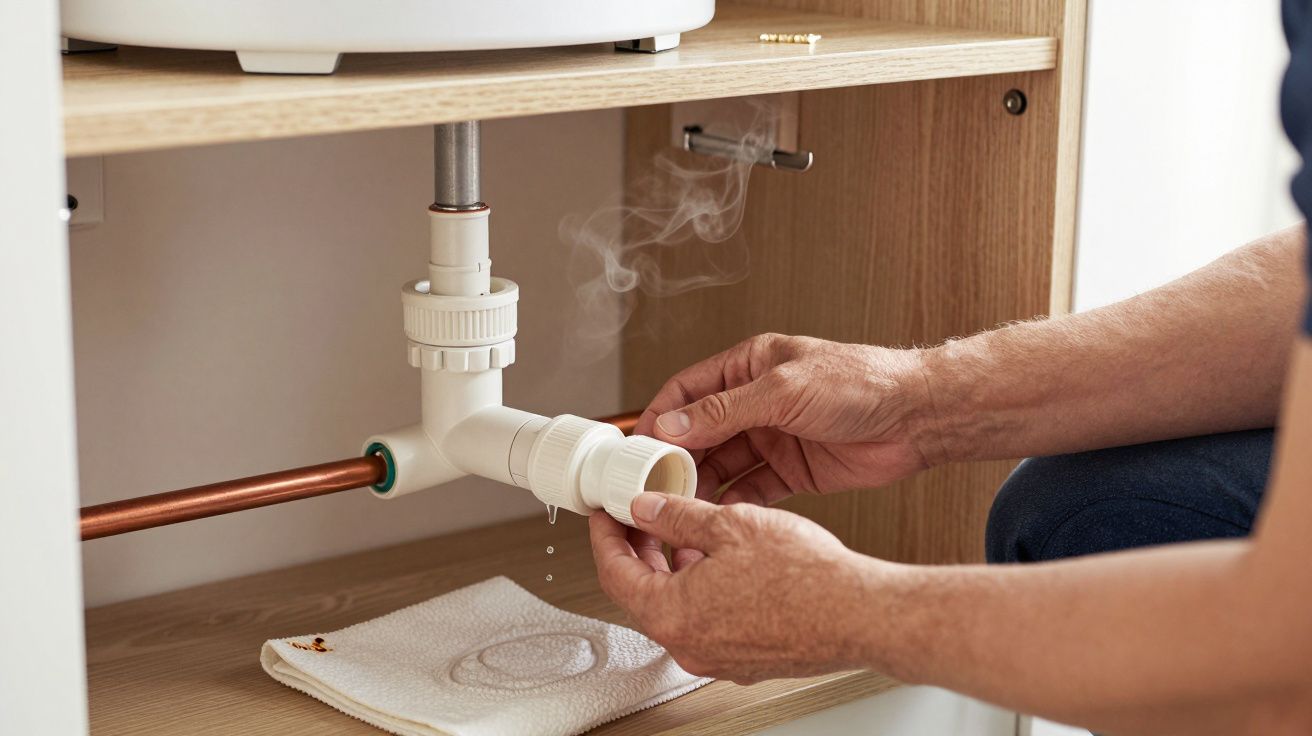
The first time you see plastic pipework fail, it can look oddly polite: a bulge at a bend, a fine split near a fitting, a slow weep that leaves a chalky tide mark. Copper, by contrast, often announces itself with a pinhole jet or a sudden seam split after years of looking perfect. The difference is material fatigue - not just whether a pipe is “good” or “bad”, but how it ages under heat, pressure, movement and time in a real UK building.
Most homes now have a mix: copper in older runs, plastic in extensions, lofts, underfloor loops and fast-fit repairs. Knowing how each material tends to give up helps you spot trouble earlier and choose the right fix, not just the quickest one.
Two pipes, two personalities
Copper is stiff, strong and unforgiving. It holds shape, tolerates high temperatures, and doesn’t creep under normal domestic loads. When it fails, it’s often because something local has attacked it: corrosion, erosion, flux residue, aggressive water chemistry, or vibration concentrating stress in one tiny spot.
Plastic pipework is flexible and chemically resistant in ways copper isn’t. But plastics are viscoelastic: they can slowly deform under sustained stress, especially when warm. That makes its failures feel more “gradual” - until they aren’t.
A useful way to picture it is this: copper tends to fail like a brittle story with a sudden twist; plastic tends to fail like a stretched elastic band that finally says no.
How copper usually gets to a leak
Copper’s classic failure is the pinhole. It’s small, infuriating, and can soak a ceiling before you even smell it, because the jet is fine and can track along joists. The causes vary, but the pattern is common: localised damage plus time.
Typical routes to failure include:
- Pitting corrosion from water chemistry that favours local attack.
- Erosion-corrosion where high-velocity flow, sharp bends, or partially closed valves disturb flow and scrub the protective film.
- Vibration and work-hardening near pumps, cylinders, or where pipe clips are missing and the pipe “buzzes” for years.
- Bad joints: overheated solder, poor cleaning, or flux left behind that keeps reacting.
Copper doesn’t usually “relax” to a new shape. It holds stress until it cracks or thins through.
Why plastic fails differently (and why it often starts at the fitting)
Plastic pipework-whether PEX, PB, or multilayer-often fails at transitions: fittings, inserts, tight bends, and clipped points where movement is constrained. That’s because the pipe itself can flex, but the system around it creates stress concentrators.
Three plastic-specific behaviours matter:
- Creep: under constant pressure (and especially heat), plastic can slowly deform. A pipe held slightly oval under a too-tight clip may not spring back; it may gradually set.
- Stress cracking: tiny notches, scratches, or manufacturing marks can become the start of a crack when combined with stress and time.
- Joint sensitivity: many plastic systems rely on O-rings, grab rings, inserts and precise pipe preparation. A copper soldered joint is either fused or it isn’t; a push-fit joint can be “nearly right” and still leak months later.
The leak you see is often the end of a long, quiet negotiation between the material and the installation.
Material fatigue: cycles, not just years
Material fatigue is where the “why did it fail now?” question usually lands. A pipe doesn’t only experience pressure; it experiences changes: heating on, heating off, hot draw-off, cold refill, pump start, pump stop. Those cycles matter.
Copper tends to fatigue where it’s forced to move but cannot: a tight elbow near a vibrating pump, a long straight run with no allowance for expansion, or a pipe rubbing lightly against timber. Over time, microscopic cracks grow until you get the familiar pinhole or split.
Plastic pipework can tolerate movement better, but it can fatigue in a different way: repeated flexing at the same point, especially near fittings or where a bend is permanently “held” by a clip. Add elevated temperature (near boilers, cylinders, or in airing cupboards), and the rate of change speeds up.
If you’ve ever heard ticking pipes as the heating warms up, you’ve heard fatigue being written into the system.
The failures you tend to see in UK homes
In practical terms, here’s how they often present:
Copper
- A fine spray or pinhole, sometimes only when a pump runs.
- Green/blue staining, or a single “bad patch” on an otherwise sound run.
- Leaks at soldered joints after a freeze event or after movement.
Plastic pipework
- A slow weep at a push-fit fitting, often leaving scale or a damp halo.
- A split near a bend that was too tight or kinked during installation.
- Drips that come and go with temperature (sealed when cold, open when hot).
Let’s be honest: most people only notice when a ceiling goes brown. The earlier clues are smaller-staining around a fitting, a clip that’s biting, a pipe that looks slightly flattened.
Installation details that change everything
With copper, the workmanship is in the cleaning, heating and support. With plastic, the workmanship is in the cutting, inserting, seating and allowing for movement. The material isn’t the whole story; the system is.
A few high-impact differences:
Pipe support and clipping
- Copper wants firm support to prevent vibration.
- Plastic wants support too, but not point-loading or over-tight clipping that creates stress.
Expansion
- Plastic expands more with heat. Long runs need allowance, otherwise the stress is pushed into fittings and bends.
- Copper expands less, but still needs sensible routing, especially near boilers and cylinders.
Compatibility
- Plastic near heat sources needs the right rating and correct distance from the boiler/primary connections.
- Copper in mixed-metal systems needs attention to corrosion risks and correct fittings.
If a plastic system is going to fail early, it’s often because it was installed like copper: too rigid, too tight, too close to heat, too little allowance for movement.
What to do when you’re choosing (or fixing) pipework
If you’re planning a repair or small renovation, focus less on the material debate and more on the failure mode you’re trying to avoid.
- Choose copper when temperatures are high, exposure is likely (UV, knocks), and you want a rigid, long-life run with fewer “sensitive” joints.
- Choose plastic pipework when you need speed, flexibility, fewer hidden joints, and better freeze resilience in awkward routes-but only if you can install it cleanly and correctly.
A simple rule that saves ceilings: minimise joints in inaccessible places, whichever material you use. Copper joints hide well until they don’t; plastic joints can look fine while an O-ring sits fractionally wrong.
Quick comparison you can use on site
| What changes over time | Plastic pipework | Copper |
|---|---|---|
| Main ageing behaviour | Creep and stress cracking, especially near fittings | Thinning/corrosion and fatigue at stress points |
| Common “first leak” | Weep at fitting or split near a bend | Pinhole jet or joint failure |
| What reduces risk most | Correct inserts, clean square cuts, proper clipping and expansion allowance | Good support, clean soldering, manage corrosion/vibration |
The quiet takeaway
Copper fails like a hard material that’s been attacked at one point for a long time. Plastic fails like a flexible material that’s been slowly loaded, warmed, and cycled until the stress finds a weak edge. Neither is “better” in every context - but their failure styles are different enough that you can often predict the weak points just by looking at the route, the clips, the bends and the fittings.
FAQ:
- Is plastic pipework more likely to burst in a freeze than copper? Often the opposite: plastic can tolerate some expansion from freezing better than rigid copper. But fittings and constrained bends can still fail, and any pipe can burst if freezing is severe or repeated.
- Do push-fit joints fail more than soldered joints? They fail differently. Push-fit joints are sensitive to preparation (square cut, insert, fully seated) and movement; soldered joints are sensitive to cleaning, heating, and flux control. Both can last decades when done properly.
- Can material fatigue happen in a domestic plumbing system? Yes. Heating cycles, pump starts, and temperature swings create repeated stresses. Over years, those cycles can lead to fatigue cracks in copper or stress cracking and fitting-related issues in plastic.
- Should plastic pipework be used right up to a boiler? Follow the boiler and pipe manufacturer’s instructions. Many setups require a short copper section near the boiler because of temperature and heat exposure limits, then transition to plastic further away.





Comments (0)
No comments yet. Be the first to comment!
Leave a Comment