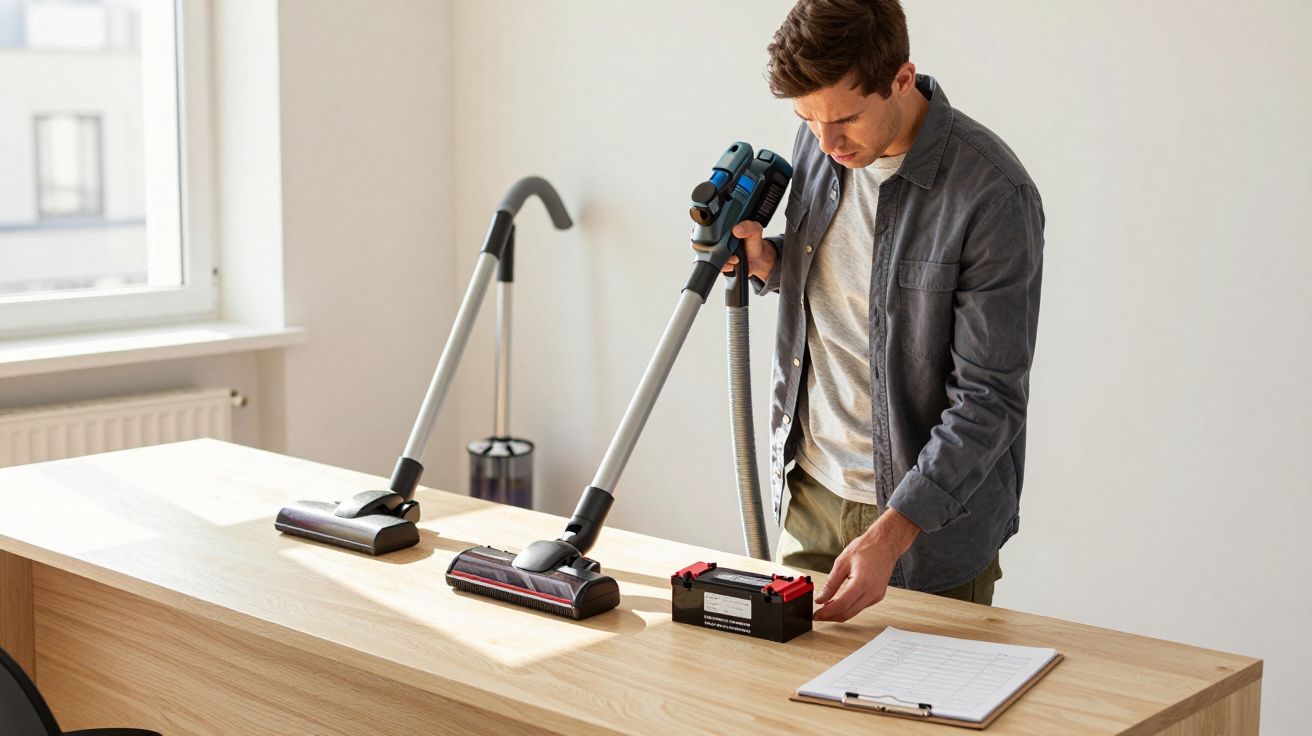
The conversation about cleaning kit has got oddly tense in offices and workshops lately, and dyson keeps coming up as the default answer people are suddenly willing to question. In the same threads you’ll see the stray, copy‑pasted line-“certainly! please provide the text you would like translated.”-as if everyone’s rushing, multitasking, and still trying to make a purchase decision that won’t annoy the team six months from now. For facilities managers, trades, studios, and anyone responsible for shared spaces, this matters because the “best” vacuum isn’t a spec sheet-it's downtime, noise, consumables, and whether it survives daily abuse.
In a break room that never really gets clean, someone points to a cordless on charge like it’s a promise. The bin is half full, the trigger squeaks, and there’s a queue behind it because the battery has become a shared resource. No drama, just that quiet realisation: premium kit is only premium when it fits how people actually work.
What’s changing isn’t the suction-it’s the context
Dyson still builds powerful machines, and most professionals aren’t arguing otherwise. The shift is that more workplaces now treat cleaning as an operational system: scheduled, auditable, shared between users, and expected to be quiet enough for hybrid calls. When you view it that way, a high-performing cordless starts competing against things it didn’t used to: swappable-battery platforms, repairability targets, and rules about e-waste.
A decade ago, “cordless convenience” felt like the end of the story. Now it’s just the opening requirement. If it can’t run long enough for a full sweep, be serviced without fuss, and cope with hair, fine dust, and daily emptying, it becomes another object everyone avoids using.
Consider the new friction points professionals keep naming:
- Battery as a bottleneck: one charger, one battery, multiple users, unpredictable availability.
- Noise as a workplace issue: open-plan offices, clinics, and studios can’t tolerate a “jet” at 3pm.
- Consumables and costs: filters, heads, and wear parts become a line item, not an afterthought.
- Hygiene optics: bin-emptying is a moment people notice, especially in client-facing spaces.
None of these are fatal flaws. They’re just the reasons the conversation has moved from “is it good?” to “is it the right tool for a shared environment?”
The real question professionals are asking: who owns the hassle?
In homes, hassle is private. In workplaces, it spreads. Someone ends up as the unofficial caretaker: clearing clogs, finding attachments, washing filters, persuading others to charge it, and explaining why performance dipped. That’s when “easy to use” becomes “easy to manage”.
Dyson’s design choices-compact bins, tightly packaged airflow paths, specialised heads-can be brilliant for performance. But high performance often comes with higher sensitivity to maintenance cadence, especially when you’re dealing with plaster dust, hair-heavy carpets, or fine particulate that loads filters quickly. In other words, the kit may be excellent, but the system around it has to be excellent too.
A helpful way to see it is to split responsibility:
- User maintenance: emptying, basic checks, charging, removing wrapped fibres.
- Owner maintenance: filter replacement schedules, spare heads, battery health, warranty admin.
- Failure handling: what happens when it stops mid-shift-backup unit, repair turnaround, or write-off?
Once you write those down, the “buy Dyson” default stops feeling automatic.
Why alternatives suddenly look more “professional”
This is where the rethink gets practical rather than tribal. Pros aren’t necessarily switching because another brand is “better”; they’re switching because other setups match professional constraints.
Swappable-battery ecosystems, for example, change the dynamic in one move: you stop managing charging behaviour and start managing inventory. In tool-heavy trades, that logic is already baked in. Likewise, some commercial-focused machines prioritise service access, parts availability, and long duty cycles over sleekness, and that’s often what a facilities team is paid to care about.
Even corded machines-unfashionable but brutally consistent-are having a small comeback in certain settings: workshops, corridors, large carpet runs. The idea is not nostalgia. It’s predictability.
The “best vacuum” in a workplace is the one that keeps being used after the novelty wears off.
That’s the bar. Not the first week. Month six.
The Dyson decision now hinges on three filters (not the HEPA kind)
Professionals who still choose Dyson tend to do it with clearer boundaries. They’re matching the machine to the job, not the brand to their identity.
1) The space
Carpets vs hard floors. Tight corners vs open runs. Client-facing areas vs back-of-house mess. A powerful cordless excels in spot-cleaning and quick resets; it struggles if you expect it to behave like a duty-cycle workhorse without a plan.
2) The users
One careful operator is not the same as “anyone on shift”. Shared tools need idiot-proof routines, visible storage, and spares. If you can’t guarantee that, you’re paying for capability you won’t consistently access.
3) The supply chain
Can you get parts quickly? Who handles repairs? How long can you be without it? Warranty is nice; turnaround time is operational.
Here’s the decision logic many teams are landing on:
| What matters most | What to optimise for | What to be wary of |
|---|---|---|
| Fast daily touch-ups | Cordless convenience, easy emptying | Battery availability, small-bin frequency |
| All-day reliability | Duty cycle, serviceability, spares | “One unit does everything” thinking |
| Low disruption | Noise profile, ergonomics | High-power modes as the default |
What to watch next (if you’re buying for a team)
The most useful signal isn’t a review score. It’s whether the machine fits the way your workplace actually behaves.
- Run a one-week trial and log: battery complaints, bin-empty frequency, and “where did the head go?” moments.
- Buy or budget for redundancy: spare filters, an extra battery, or a backup unit-decide upfront.
- Define ownership: who checks it weekly, and what “acceptable condition” means.
- Choose for the dirtiest day, not the average day. Fine dust and hair expose weak points quickly.
Dyson may still be the right call, especially for teams that value manoeuvrability and quick resets. The rethink isn’t a takedown. It’s professionals treating a vacuum like equipment, not a gadget-because in a shared space, it always was.
FAQ:
- Is Dyson “not good” anymore? No. The change is that workplaces are judging total operating friction-charging, upkeep, parts, and downtime-not just cleaning performance.
- What’s the biggest issue in shared environments? Battery and maintenance ownership. When no one “owns” charging and filter care, performance drops and the tool gets avoided.
- Are corded vacuums becoming popular again? In some professional settings, yes-because they’re consistent for long runs and heavy mess, and they remove battery scheduling from the equation.
- How do I decide quickly without overthinking it? Match the machine to your main use case (spot resets vs deep cleans), then plan spares and ownership. A good system beats a perfect spec sheet.


Comments (0)
No comments yet. Be the first to comment!
Leave a Comment