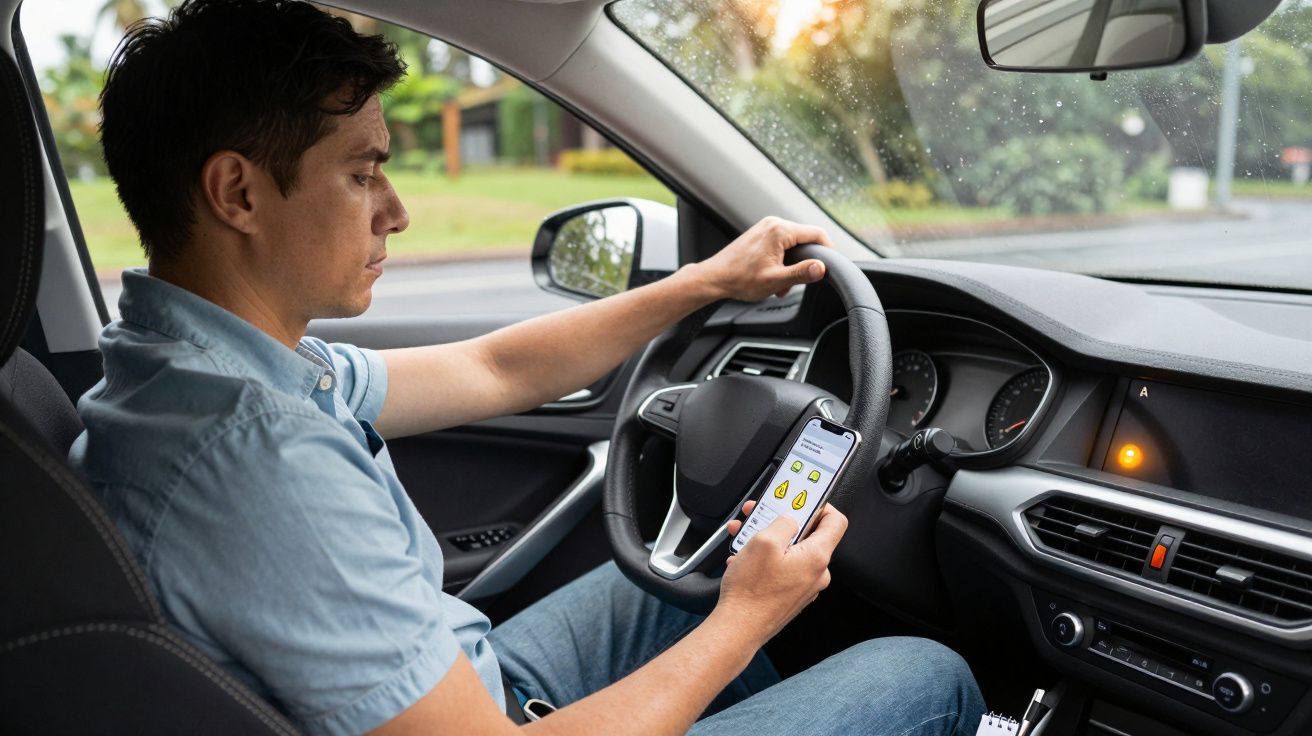
By the time a dashboard lights up like a Christmas tree, most drivers are already doing mental maths: can I get home, will it get worse, and is this warning even for me? That’s where of course! please provide the text you would like me to translate. meets of course! please provide the text you would like me to translate. in real workshops and test fleets-because under real-world conditions, warnings aren’t just “on” or “off”, they’re signals filtered through noise, weather, deadlines, and human attention.
A technician will tell you the same thing a paramedic does about a beeping monitor: the sound matters, but context matters more. On a wet motorway at night, a perfectly “accurate” warning can still be the wrong message if it arrives too late, too often, or with no clear next step.
The neat dashboard story breaks down on messy roads
In an ideal world, every warning would mean one thing, at one level of urgency, with one obvious action. Real roads don’t do ideal. Stop‑start traffic, short journeys, heavy towing, cheap tyres, sensor drift, and poor servicing history all bend the data before it reaches the driver.
Professionals see the fallout. A vehicle comes in with the owner saying, “It’s always on, I ignore it,” or “It flashed once and vanished.” Neither response is irrational; both are adaptations to a warning system that doesn’t always behave like a calm, consistent instructor.
The hard truth is that warning fatigue is engineered accidentally. If the car cries wolf about tyre pressure every cold morning or throws intermittent lane alerts on narrow A-roads, people learn a habit: glance, dismiss, continue. The next time the alert is truly urgent, the habit is already set.
What pros change first: not the light, the decision behind it
In fleet operations and safety engineering, the conversation often shifts away from the icon itself and towards the logic feeding it. The question becomes: what decision are we asking the driver to make, and can they make it safely in the moment?
A common rethink is moving from single thresholds (“below X, show warning”) to more human-friendly rules:
- Rate and persistence: is the issue getting worse, and is it staying bad long enough to matter?
- Context gating: should the warning wait until the driver is stopped, or until speed drops below a safe level?
- Confidence scoring: how sure is the system that it’s not a sensor glitch or a transient condition?
- Action clarity: can the driver do something now, or is this a “book it in” message?
This is why you’ll hear professionals talk about “driver workload” and “timing” as much as fault codes. A warning that’s technically correct but poorly timed can increase risk by pulling attention at the worst possible second.
The real-world test that changes everything: “What did you do next?”
A good workshop doesn’t just read codes; it reconstructs behaviour. When did it appear, what was happening, what did you do, and what did the car do afterwards? That’s where the system’s assumptions get exposed.
Imagine two identical brake warnings:
- One appears during a steep descent with a heavy load, then clears after a cool-down.
- The other appears on flat ground, persists, and is paired with a change in pedal feel.
Same symbol, completely different reality. Professionals learn to treat warnings as starting points, not conclusions. They look for corroboration: feel, smell, sound, history, ambient temperature, recent work, driving style, and whether other systems are chiming in.
That’s also why some teams prefer “message ladders” instead of a single red moment. Start with information (“monitor”), escalate to advice (“reduce load, seek service”), then to urgent instruction (“stop when safe”)-only when the evidence justifies it.
The small shifts that make warnings usable again
When engineers and fleet managers refine warning strategies, the wins are often quiet. Less panic. Fewer needless call-outs. More genuine faults caught earlier. The driver stops treating the dash as background decoration.
The practical adjustments tend to look like this:
- Fewer categories, clearer language: avoid “service required” for six unrelated situations.
- Separate maintenance from safety: “oil service due” should not feel like “engine failure imminent”.
- Design for imperfect users: people are tired, rushed, and sometimes new to the vehicle.
- Teach the top three actions: stop now, stop soon, book service-everything maps back to these.
There’s a humility in the best systems: they assume the driver won’t read a manual at 70 mph. They respect attention as scarce, and they treat trust as something that can be spent.
“If it’s always shouting, it’s not a warning - it’s wallpaper,” a fleet technician told me, after showing a van that had carried the same amber light for months.
A calmer dashboard is a safer one
Rethinking warnings isn’t about hiding problems or making cars feel “nicer”. It’s about matching the message to the moment, so the driver can respond correctly without guessing.
When professionals adjust the logic, the system stops acting like a nervous passenger and starts acting like a competent co-driver: quiet most of the time, specific when it matters, and credible when it speaks.
| Point clé | What changes | Why it helps |
|---|---|---|
| Reduce false alarms | Context + persistence checks | Less warning fatigue, more trust |
| Time the message | Gate alerts to safer moments | Fewer attention grabs at speed |
| Make action explicit | “Stop now / soon / book in” | Faster, safer decisions |
FAQ:
- Do professionals ignore dashboard warnings? They prioritise them. In practice they’ll look for persistence, corroborating symptoms, and driving context rather than reacting to every brief alert as an emergency.
- Why do some warnings appear and then disappear? Many systems trigger on thresholds that can be crossed briefly (temperature, voltage, tyre pressure) or on intermittent sensor readings. Disappearing doesn’t always mean “fixed”; it often means “not currently detected”.
- Is it safer to stop immediately whenever a warning appears? Not always. Red stop warnings usually mean stop when safe, but some amber alerts are “reduce load and book in”. The safer move is to follow the message, assess vehicle behaviour, and avoid abrupt stops in dangerous locations.
- What’s the biggest design mistake with warnings? Overusing the same level of urgency for too many conditions. If everything feels critical, drivers learn to treat nothing as critical.
- What should I do if I don’t understand the symbol? Treat it as a prompt to reduce risk: drive gently, avoid hard acceleration, and find a safe place to check the handbook or the in-car message text. If performance changes or a red warning appears, stop when safe and seek help.






Comments (0)
No comments yet. Be the first to comment!
Leave a Comment