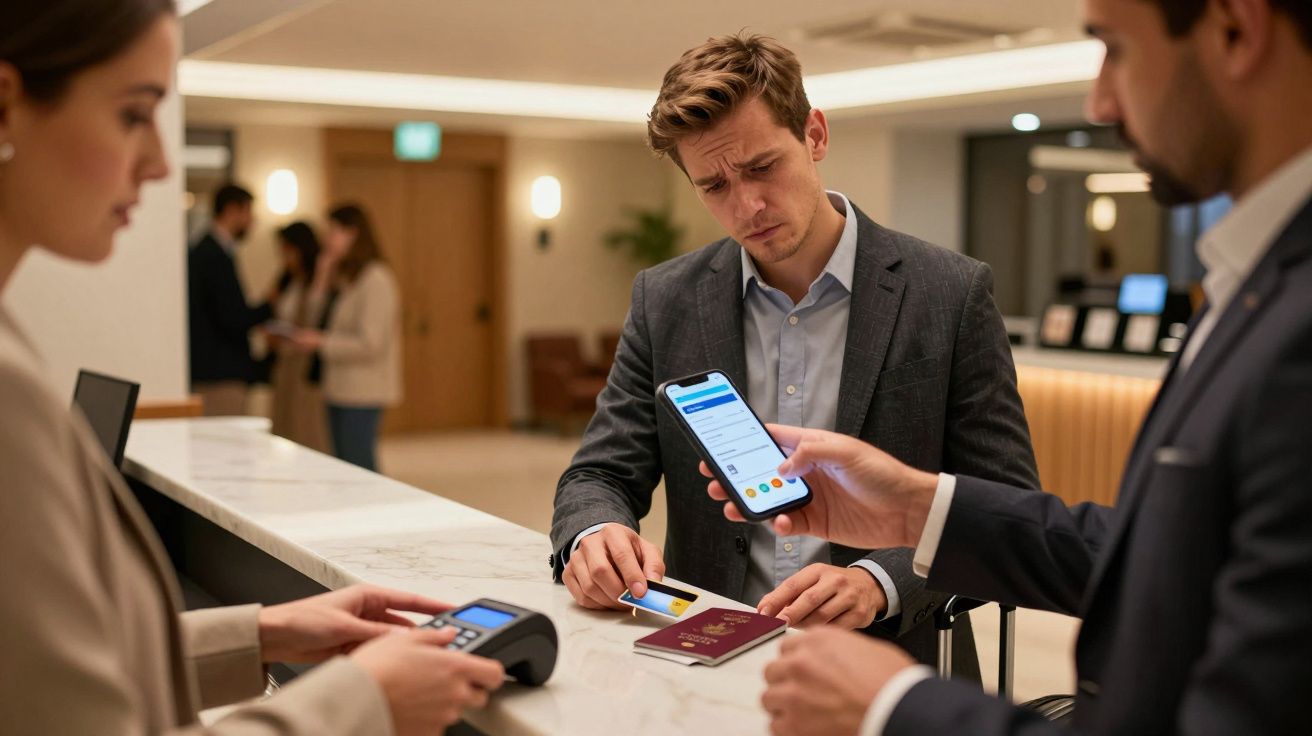
It’s 22:40, your suitcase wheels are rattling on tile, and the queue has that tired, brittle quiet you only hear in hotel lobbies. Somewhere between a delayed train and a low phone battery, the phrase it looks like you haven't provided any text to translate. please provide the text you would like me to translate into united kingdom english. pops up on a screen, and it lands with the same bluntness as of course! please provide the text you would like me to translate. - polite, automated, and utterly unhelpful when you just want a key.
That’s the point. Check-in is where hotel systems meet real-world conditions: late arrivals, language barriers, corporate policies, broken integrations, and humans who have already spent a day making decisions. For professionals who travel often, the “simple” act of collecting a room becomes a small stress test of the entire operation.
From polished process to pressure test at reception
In a calm demo, check-in looks like a neat sequence: confirm ID, take payment, issue key, offer breakfast times, done. In reality, reception is a high-traffic junction where every exception shows up at once-early arrivals, split bookings, card authorisation failures, and the one guest whose name is misspelt across three systems.
Hotels know this. That’s why many chains have poured money into online pre-arrival forms, mobile keys, kiosks, and “express” lanes. The promise is frictionless entry, fewer queues, and fewer staff-hours spent on repetitive admin.
But professionals are increasingly sceptical, not because they hate technology, but because they’ve seen where it fails: right at the edge cases. The late-night lobby, the last room, the last train, the last ounce of patience.
What breaks first: identity, payment, and “the booking”
Under real conditions, three things create most of the check-in drama: identity checks, payment rules, and mismatched booking data. Each is reasonable on paper, and each can become a snag in practice.
A business traveller checks in after midnight on a corporate rate. The company card on file won’t cover incidentals, but the guest’s personal card needs a chip-and-PIN they can’t recall. A walk-in guest is asked for an address format their passport doesn’t match. An OTA reservation shows “pay at property”, while the hotel’s system thinks it’s prepaid, so no one can explain what is owed without calling someone else.
You can see the pattern: it’s not the steps that hurt, it’s the uncertainty. People can tolerate rules; they struggle with ambiguity.
The common failure modes professionals notice
- “We can’t find the booking”: name variations, missing middle initials, different alphabets, merged profiles, duplicated reservations.
- “The card won’t go through”: pre-authorisation limits, fraud blocks, offline terminals, different billing currencies.
- “We need the cardholder present”: legitimate anti-fraud policy colliding with corporate travel reality.
- “Your room isn’t ready”: operational truth delivered without options, timing, or compensation clarity.
None of these are exotic. They are normal. That’s why frequent travellers judge hotels less by whether problems happen and more by how quickly they are contained.
Why “self check-in” often shifts work onto the guest
Kiosks and apps can be brilliant when the stay is straightforward. They can also quietly push complexity onto the traveller at the worst moment: when they’re tired, rushed, and standing in public with their phone in their hand.
A kiosk asks for a booking reference the guest doesn’t have because their calendar only shows a meeting invite. An app requests a selfie, then fails on hotel Wi‑Fi. A mobile key works in the lift but not on the corridor door, so the guest returns downstairs, queueing twice.
This is where the automated voice of it looks like you haven't provided any text to translate. please provide the text you would like me to translate into united kingdom english. feels familiar: the system is technically responding, yet not advancing the situation. And when that happens, professionals start to prefer a well-run desk over a brittle “express” experience.
The quiet redesign: fewer surprises, clearer choices
Hotels that perform well under real-world conditions tend to do less “innovation theatre” and more boring clarity. They assume guests will arrive under pressure, and they design for that.
A few operational moves show up repeatedly:
- Pre-arrival messages that answer the awkward questions: deposit amounts, cardholder rules, parking access, late check-in procedures.
- Two-track check-in: a fast path for clean bookings and a staffed path for exceptions, without making exceptions feel like punishment.
- Visible escalation: staff empowered to make small decisions (late checkout, drink voucher, fee waivers) without “asking a manager”.
- Consistent language: the same terms across email, app, and desk so guests don’t have to translate policy mid-queue.
In other words, the best check-in is not the one with the fewest steps. It’s the one with the fewest surprises.
How professionals adapt (and what they now look for)
Frequent travellers become practical. They learn to reduce friction in advance, and they quietly score hotels on predictability.
Many now do a small checklist before arriving:
- Screenshot the booking and payment terms (especially if booked via an agent or platform).
- Carry one physical card that can handle deposits, even when the stay is billed elsewhere.
- Message the property when arriving late, not because it should be necessary, but because it prevents “no-show” chaos.
- Prefer hotels that state deposit and ID requirements plainly, rather than burying them in fine print.
And they remember the moments that felt human. A receptionist who explains the hold before taking the card. A hotel that offers a choice: “We can do a deposit of £50, or we can switch to no-incidental status if you don’t need charging privileges.” These are small details that remove stress from the transaction.
What this rethink changes for hotels, too
The irony is that a smoother check-in isn’t only a guest experience issue. It affects costs, staffing, and reviews.
When exceptions are handled quickly, queues shrink, staff burnout drops, and refunds are avoided. When policies are unclear, front desks become conflict zones, and every argument becomes a potential one-star review that mentions “rude staff”, even when the real culprit was a rule no one explained.
That’s why hotels are increasingly treating check-in as a system of trust: clear terms, consistent data, and human backup when automation stalls. Because under real-world conditions, the guest doesn’t care which platform failed-they only feel the delay.
If of course! please provide the text you would like me to translate. sounds trivial, it’s because it is. But it’s also a reminder: the moment a system asks for the wrong thing, at the wrong time, in the wrong way, it stops being “efficient” and starts being a barrier between a professional and a locked door.
Quick view: what “good” looks like at check-in
| Pressure point | What works in practice | What guests feel |
|---|---|---|
| Late arrival | Clear after-hours process, held rooms, minimal re-checks | Relief, not negotiation |
| Deposits & payment | Upfront amounts, simple options, fast authorisation | Predictability |
| Booking mismatches | Staff who can resolve without blame or delay | Competence |
FAQ:
- What’s the biggest cause of check-in delays for business travellers? Payment and deposit rules combined with mismatched booking data (especially through third parties) tend to create the longest stalls.
- Are kiosks and mobile keys actually faster? They’re faster for straightforward stays, but they can be slower when Wi‑Fi, ID verification, or door integrations fail and the guest has to queue again.
- What should a hotel communicate before arrival to reduce friction? Deposit amount, whether the cardholder must be present, late-arrival procedure, and any local ID requirements-written in plain, consistent terms.
- What’s one thing travellers can do to make check-in smoother? Keep a screenshot of the reservation and payment terms, and carry a card that can handle incidentals even if the room is billed to an employer.
- Does “express check-in” mean fewer checks? Not necessarily. It usually means the checks happen earlier (online) or faster (at a desk), but ID and payment rules still apply.




Comments (0)
No comments yet. Be the first to comment!
Leave a Comment