The sticker on the box is comforting: water efficiency ratings promise less waste, lower bills, a greener conscience. But installation quality is the quiet variable that decides whether that promise survives contact with your actual kitchen, bathroom, or plant room. If you’ve ever chased a damp patch across a ceiling or heard a cistern hiss at 2 a.m., you already know why this matters: the rating tells you about use, not about escape.
A plumber once said to me, half-joking, “Most leaks aren’t dramatic. They’re polite.” They don’t gush; they whisper, day after day, behind tiles and under units, until you pay for it twice-once in water, once in repairs. The part that’s hard to accept is this: you can buy the most efficient fitting on the shelf and still end up losing more water than the old one ever used.
What the rating is actually measuring
Water efficiency ratings are usually based on controlled tests: flow rates, flush volumes, sometimes performance at set pressures. It’s like lab fuel economy for cars-useful, standardised, comparable. But it’s not the same as “will this system stay dry in my house for ten years”.
A leak is not a “usage event”. It’s a failure event. Ratings describe how much water a product is meant to consume when it’s working properly, not how likely it is to be installed well, sealed well, supported well, and maintained well.
Think of it as a tap that can sip, on paper. The rating measures the sipping. The leak is the crack in the cup.
The messy truth: leaks live in the gaps
Most leaks happen where products meet buildings: joints, seals, threads, washers, compression fittings, pan connectors, flexi tails. Those are not the glamorous bits. They’re the small interfaces that depend on hands, tools, and judgement.
A few common real-world ways a “highly rated” product ends up leaking:
- A tap is overtightened and a seal deforms, then fails slowly.
- A fitting is cross-threaded, bites just enough to hold, then loosens with vibration.
- A flush valve is slightly mis-seated; it passes a thin, constant trickle into the pan.
- A shower cartridge is fine, but the backplate isn’t sealed properly to the wall.
- A pressure-reducing valve is missing or mis-set; components wear faster at high pressure.
None of that shows up in the efficiency score. In a test rig, the joints are perfect and the water pressure behaves. In a home, the pipework is older than the brochure, and the cupboard space forces your installer into wrist angles the human body was not designed for.
Why “efficient” can sometimes mean “less forgiving”
There’s a detail people don’t say out loud: many water-saving designs have tighter tolerances. Smaller outlets, aerators, clever valves, more internal parts. They perform brilliantly when everything is aligned. They can also be fussier about debris, pressure swings, and installation errors.
A simple old tap can be crude and resilient. A modern low-flow tap might rely on an aerator that clogs, a cartridge that doesn’t love grit, or a flow regulator that behaves differently at varying pressures. That doesn’t make it bad. It just means the margin for “nearly right” is slimmer.
Efficiency is often engineered. Reliability is often earned-by good installation, commissioning, and aftercare.
Installation quality: the thing you can’t read on the label
Installation quality isn’t only about competence. It’s also about time, access, and whether the job includes proper checks after the shiny bits are in.
A decent install usually includes:
- Checking incoming pressure and fitting regulation if needed.
- Flushing pipework before connecting sensitive components.
- Using the right sealing method for the fitting (and not mixing approaches).
- Supporting pipework so joints aren’t carrying stress.
- Testing under pressure and re-checking after a short period of use.
The difference between “it works” and “it stays working” is often 20 minutes of careful finishing. That 20 minutes is what gets shaved off when budgets are tight, schedules slip, or the job is sold as a quick swap.
If you want a rule of thumb, it’s this: the more hidden the connection, the more you should care who makes it.
The myth of the single number
We love a single score because it feels like control. But leaks are a systems problem, not a product problem.
A toilet can be water-efficient and still leak because the inlet valve is set wrong. A showerhead can be rated low-flow and still “leak” money if the pipe in the wall isn’t clipped and rubs through over time. A high-efficiency dishwasher can be perfect while the isolation valve under the sink weeps every time it’s nudged by a bin.
The rating tells you “how much, when used”. It doesn’t tell you “how often, when forgotten”.
What to look for instead (or at least as well)
This isn’t an argument against water efficiency ratings. It’s an argument for not treating them as a guarantee of dryness.
If you’re choosing fittings and trying to reduce leak risk, look for signals that live outside the efficiency label:
- A clear warranty and easy access to spare parts (cartridges, seals, valves).
- Robust connectors and materials suited to your water conditions (hard water matters).
- Installer familiarity with the specific brand/model (less improvisation).
- Commissioning steps written into the job, not assumed.
- Evidence of pressure management in the property, especially in flats and newer builds.
Ask one blunt question before work starts: “What are you going to test, and when?” The answer reveals whether leak prevention is a process or a hope.
A small checklist that catches big problems
If you’ve already installed efficient fixtures-or you’re living with them-here are quick, unglamorous checks that often pay back.
- Read your meter before bed and first thing in the morning. If it moves with no use, something’s passing.
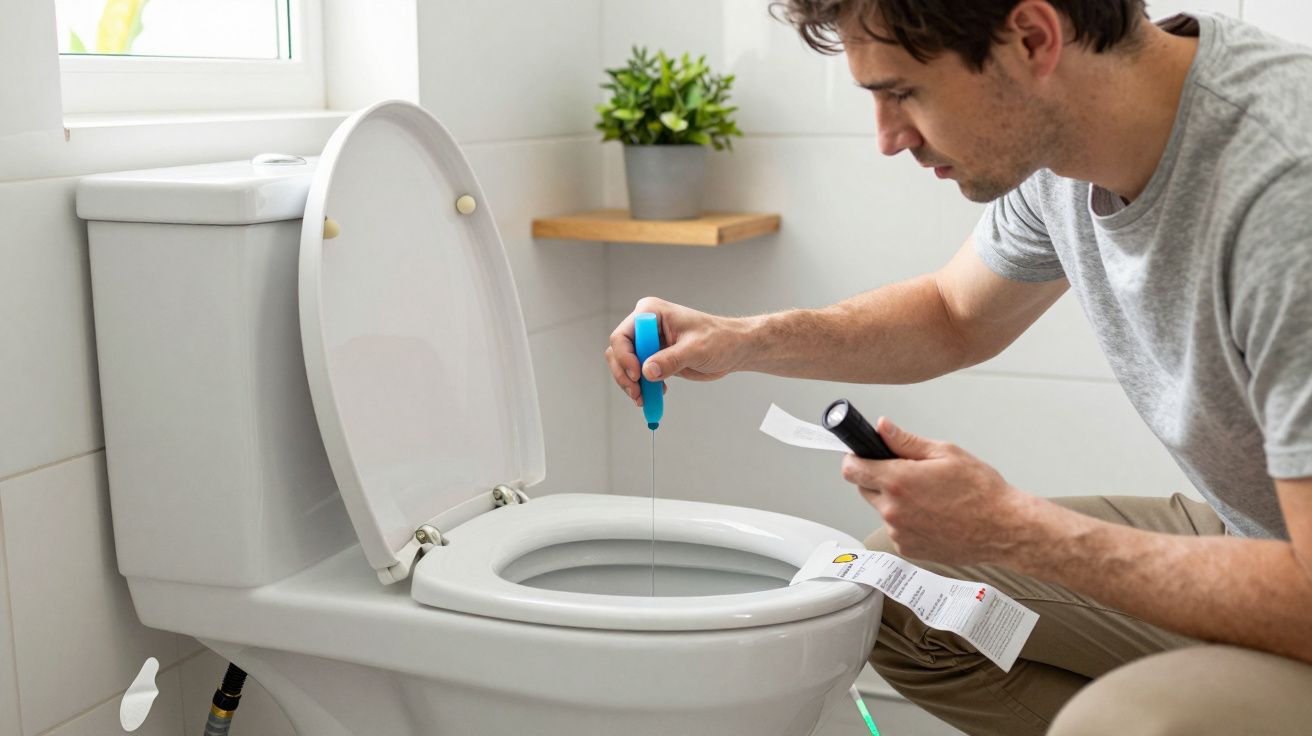
- Put a few drops of food colouring in the toilet cistern; don’t flush. If colour appears in the pan, you’ve got a silent leak.
- Check isolation valves and flexi tails with dry tissue after a day of normal use.
- Listen: hissing, intermittent filling, or a tap that “sings” can be pressure or valve issues.
- Look for limescale “tracks” on chrome or fittings-often the first visible sign of a slow weep.
None of these require you to become a plumber. They just bring leaks back into the visible world, where they’re cheaper to fix.
| Thing people assume | What it really indicates | What actually predicts leaks |
|---|---|---|
| High water efficiency rating | Low designed water use | Installation quality, pressure control, commissioning |
| Premium brand | Better materials (sometimes) | Parts availability, correct fitting, aftercare |
| “No drips today” | The seal holds at the moment | Ongoing stress, movement, water chemistry, time |
What changes when you treat leaks as part of efficiency
The strange twist is that the most water-efficient home isn’t just the one with low-flow fittings. It’s the one where water only goes where it’s meant to go.
When you start thinking this way, the priorities shift. You still choose efficient products, but you also pay for careful installation, you ask for tests, you keep records, you fix small faults before they become damp archaeology.
Water saved at the tap is good. Water not lost behind the wall is better-because you never had it, never heated it, never paid to make it clean, and never paid again to repair what it quietly ruined.
FAQ:
- Are water efficiency ratings useless, then? No. They’re useful for comparing intended consumption, but they don’t measure leak likelihood or workmanship.
- Do efficient fixtures leak more often? Not inherently, but some designs are less forgiving of debris, high pressure, and installation errors, so the context matters.
- What’s the single biggest cause of household leaks after upgrades? Poor joints and commissioning-small connection issues that weren’t pressure-tested or re-checked.
- How can I tell if I have a “silent” leak? Use the overnight meter check, and do the food-colouring test in toilet cisterns.
- What should I ask an installer before choosing a product? Whether your water pressure needs regulation, what flushing/testing they’ll do, and how quickly spares can be sourced for that model.





Comments (0)
No comments yet. Be the first to comment!
Leave a Comment